Pages

Showing posts with label Buffalo. Show all posts

Tuesday, 15 September 2020

Getting twitchie over a sharpie


The former mining pools of Malim Nawar is probably the location for most, if not all of my pure twitching trips. And this time, it is for a Sharp-tailed Sandpiper – a rare migrant to our shores. It was a cold and gloomy morning. To make matters worse, it started to drizzle just as Hor Kee, Michael and I were about to complete our two hour drive from Penang. When we finally reached the spot, we found ourselves staring at a huge semi-dry fish pond. Our target is a relatively small peeps. This is certainly a muddied version of the needle in a haystack saying. And no matter how stunning the view may be, I do feel my spirit lifted. Only a particular little wader that breeds in the northern tundra will be able to do that.


There were other waders present like Wood Sandpipers and Long-toed Stints. As most waders in winter plumage look quite similar especially in a distance, their presence were distracting. A huge number of Black-winged Stilts were out foraging throughout the pond and the possibility of a Pied Stilt (a recent addition to the Malaysian checklist) did cross my mind but a quick scan at the stilts revealed nothing out of the ordinary.


Anxiety soared as our target remained elusive. Sharp-tailed Sandpipers usually do not linger long at a stopover during passage. This twitch was beginning to put our skills (and patience) to the test. Ever since a camera joined my birding arsenal, I do not carry a scope anymore. Luckily, Michael still does and it took some good old fashion birding to save the day. As soon as he had his scope up, he found the ‘Sharpie’ foraging leisurely at the edge of the exposed mud. And Malim Nawar once again provided a successful twitch for me.


Here is the Sharp-tailed Sandpiper in comparison to the smaller Long-toed Stint. When seen together, the differences are obvious. However when seen alone and taking into consideration the possibility of hallucinating some some non-existing field marks, it is a different story altogether.


The lighting was less than desirable and the privileged guest was quite a distance from the access road. There was undoubtedly room for improvement with the images that I obtained. But I was elated. In light of all the hindrance caused by the Coronavirus pandemic, I was not even sure there could be any lifers for me any time soon. The Sharp-tailed Sandpiper was confiding enough I suppose and the prolonged observation made the experience a memorable one nevertheless.


With the lifer safely in the bag, I started to focus on the other waders present. One other certainly had my attention because it is usually shy by nature. The Greater Painted-Snipe is somewhat crepuscular and it is one of the few bird species in the world where the gender roles and even appearance is reversed. Anyway, this male was foraging quite comfortably right out in the open and that is something I do not see very often. I guess it would be pushing it to hope for the more striking female to make an appearance.


The Asian Openbills which have settled in well in the north are also finding this locality ideal. I managed to photograph one that was doing what it does best and that is to extract a meal out of a snail using its highly-specialized bill.


Another recent colonizer to Malaysia that is thriving here is the Little Cormorant. Although we did not get many photographic opportunities, this flying bird provided a sufficient souvenir for our trip.


One would think that after my trip to Cambodia I would not be so easily excited by the presence of an Oriental Darter. However, this sleek waterbird is rare here in Malaysia and one perched at a far distance still had my undivided attention.


No visit to this area would be complete without coming across the Grey Herons. Although, these majestic waterbirds are also found in my home state, I still find them intriguing. Birding, after all, is not always about rarities.


Grey-headed Swamphens (yes, another split) were given their due attention because we recorded the first Black-backed Swamphen in Malaysia quite recently. As with the stilt, there was no cause for celebrations. Only wishful thinking.


A feral Water Buffalo looking undeniably intimidating and it is not all bark and no bite for this occasionally ill-tempered animal. Thus, it has my respect which is rarely given to any semi-domestic animal.


It is alarming to find Javan Mynas outnumbering every other myna species here in Malim Nawar because the same thing could well take place back home in Penang. Not only are they displacing the locals but they are also attempting to ‘breed’ them out as several hybrids were seen. If this is not considered an invasion, I do not know what is.


As for the Zebra Doves, they went about their daily routine peacefully oblivious to the threat that the Javan Mynas now pose to a few of their fellow residents here.


I do not think I will ever get bored of the Stork-billed Kingfisher especially one as confiding as this individual. Just look at that bill...


Unbelievable as it may seem, the kingfisher was outdone by an unlikely species – a Crested Goshawk. In northern Peninsular Malaysia, this stunning raptor does not come by often enough for me and even when it does, it is exceedingly shy. This is the closest I have ever approached a Crested Goshawk and it was a moment worth savouring.


The only drawback was the awful lighting condition and there was not another single angle from which I could truly capture the beauty of the goshawk.


As our group was feeling luckier than usual, we decided to test our fortune at a slightly similar habitat closer to home for an equally rare peeps. The Pulau Burung landfill has been visited by the Pectoral Sandpiper before but luck can only take you so far. It would take nothing short of a miracle to bag these two rarities on the same day. A confiding Little Cormorant was the only consolation from our efforts of scanning the shallow ponds surrounding the landfill.
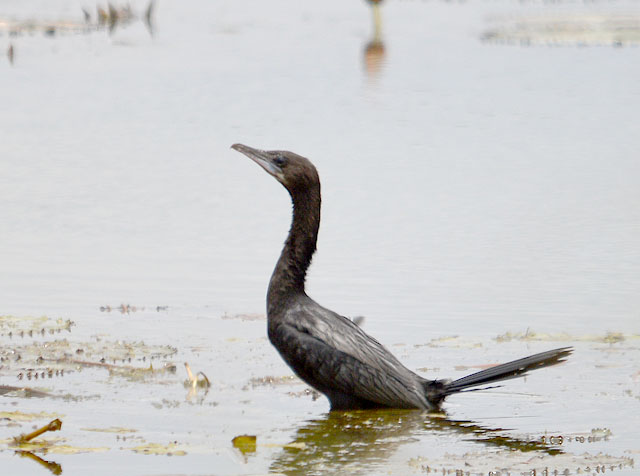


A tree full of Little Cormorants in the state of Penang is a sight that will still take some getting used to for me. The population has certainly flourished here and gone are the days when any cormorant is a rare occurrence.


Just like the Grey Heron, the Purple Heron still had what it takes to tickle my fancy. I guess being a big and beautiful water bird will make it easier to garner my affections.


It was a picture of serenity with this flock of Lesser Whistling-Ducks resting at the marshlands of this landfill. Their numbers are climbing again at this major stronghold and that is a good sign. The Lesser Whistling-Duck may be dull when compared to other ducks but it is still the only duck that can be regularly encountered in my neck of the woods.


Birds are not the only wildlife thriving in this environment. Reptiles like the Water Monitor Lizard has found sanctuary here as well. Some have grown to impressive lengths like this individual slithering about the river bank. This giant of a lizard wrapped things up for a great day out in the field as a successful twitch is one of the most exhilarating aspects of birding.


Friday, 16 December 2016

Man, not another dip out...

This year, the Wild Bird Club Malaysia held their AGM at Changlun in Perlis making it feasible for me to attend as it was not too far from home. The meeting will commenced in the evening and together with a few other birders, we decided to visit the neighbouring grasslands of Chuping for some birding in the morning first.


This was my first excursion to the site this season and raptors still rule the skies – much to my delight. This Oriental Honey Buzzard lazily flapping across our field of view made me realize how much I miss this birding hot spot.


It was a good day for raptors. Eurasian Kestrel, Pied Harrier, Eastern Marsh Harrier, Black-shouldered Kite, Brahminy Kite, Changeable Hawk-eagle, Osprey, Short-toed Eagle and Common Buzzard – that is a pretty impressive list from a single site. However, good photographic opportunities were certainly lacking. A recently fed Greater Spotted Eagle provided the best raptor image for the day as it rode the thermals above us.


The grasslands of Chuping is one of the best places in Malaysia to observe the Red-throated Pipit. It is a scarce migrant throughout the country except for this site. Today, there were easily a hundred birds present. Despite the big number, this pipit is usually wary of human presence and I have tried countless times to try and capture good images through the years but without success. It has an uncanny ability to disappear into its surroundings and you will only realize its presence as it makes its getaway. However, on this fateful day, a male decided not to behave like a Red-throated Pipit and remained stationery long enough in the open for us to capture his image.


The Manchurian Reed Warbler also winters here in Chuping. This species is one of the latest additions to the Malaysian checklist and still rightfully holds a celebrity status. The call is usually the only indication of its presence and decent views are hard to come by. It is not called a Reed Warbler for nothing and it has perfected the art of hiding among this vegetation. A 2-second windows was all it was willing to offer to have its image taken but I finally have a shot of this little brown job that actually resembled a bird.


Birding is not only about rarities. Not all the time anyway. The Barn Swallow occurs here in the hundreds and their graceful sallies are a common sight indeed. But a confiding individual in good lighting and against a smooth background deserves some love and affection.


The AGM later that evening went smoothly but my thoughts were distracted. Days before the AGM, news broke out of a Short-eared in Langkawi. From Changlun, Langkawi was not all that far. This owl is a vagrant to our shores and a lifer to most. Dave made his intentions clear about having a go at this beautiful bird. And I, give in to temptations too easily – especially when it comes to rare lifers. Dave, Wilbur and yours truly found ourselves on the first ferry to Langkawi the next day. The only other way to get there is by air. That made logistics an issue. It was a long weekend and this island being a popular holiday destination is bound to be crowded. Luck was on our side as we managed to rent what appeared to be the last car at the jetty. Anticipation was high as we geared up for the hunt. I was anxious as well. This migratory season has not being exactly kind to me - having to dip out on two consecutive twitches. What hand will dear Mother Nature deal me this time?


The very first bird that grabbed our attention in this sweeping landscape was a subadult Rosy Starling foraging among Common Mynas. This is only my third ever sighting and I guess our target of the day will just have to wait. It is not much of a looker when compared to the stunning adults but its scarcity made it irresistible nevertheless.


It was a tedious 5-hour search. We tried everything that we could think of. No bush was left unexplored and no stone unturned but the owl was no where to be seen. Even when Sofian (the man who discovered the owl) came and helped us search, it was to no avail. Having to be cautious of the herds of Water Buffalos that were present and the blistering heat did not improve the situation either. The Short-eared Owl is now my third successive dip out for a mega rarity. Quoting the famous words of Col. George A. Custer it’s not how many times you get knocked down; it’s how many times you get back up, I will live to bird another day.


On a brighter note, my last birding trip to Langkawi was many years back and one of my targets back then was the Red-wattled Lapwing. Unbelievable as it may seem, there was a time when this tropical island paradise was the only place where you are most likely to see one. So, seeing them here again brought back sweet memories of my first ever Red-wattled Lapwing. In a small way it did help ease the disappointment.


Among the Red-wattled Lapwings was a lone Grey-headed Lapwing – another species that used to be rare in my home state of Penang.


With the obsession for the owl starting to lose its grip on us, we were then able to appreciate the other bird species found at the locality. The bird life here is quite diverse and this site would be the type of location I will frequently explore during the migratory season if it was located in Penang. The majestic White-bellied Sea-eagle is common here which comes as no surprise. This striking adult bird flew literally overhead and turned out to be the only predatory bird to make its way into my memory card. The Short-eared Owl was another painful miss. The twitch for the owl, however, was an experience. The packed ferry shuttle service to the island, the frantic acquisition for a rented car, a mega rarity at stake and a whirlwind of emotional conditions made it a memorable one in the end as it reminisces those hardcore twitching endeavours of British birders. On this rare occasion, it was the experience and not the bird that made a lasting impression.

Wednesday, 29 January 2014

A jolly good tick (18/01/2014)


When news broke out of a Northern Shoveler wintering at the one of the former mining ponds of Malim Nawar in Perak, it was just a matter of when I had the time to make the 4-hour round trip to the locality. I had to endure 2 weeks of agony before I suddenly found myself with a free Saturday and together with Choo Eng and James, we arrive at the pond slightly after dawn. 


This is the second consecutive season that this locality has produced rare wintering ducks. Last year, it was the fourth confirmed record of a Tufted Duck in Peninsular Malaysia. However this year's Northern Shoveler, the third confirmed record in Peninsular Malaysia, makes it even rarer than the former. Like the Tufted Duck last year, it did not take us long to locate the celebrity duck.


The Northern Shoveler is considerably bigger than the other ducks that I have encountered before. But despite its size, it is quite shy and wary of human presence. Most shots were taken from a distance and I was lucky to manage a couple of closer ones after some stalking efforts. All in all, the Shoveler was an impressive species and a memorable mega tick that is up there among the best for me.


We had to keep our enthusiasm for better shots in check because of the presence of feral water buffalos. Although not as aggressive as the African Cape Buffalos, they can pose quite a threat to a wandering birder and even more so when there are young ones around.


The Northern Shoveler was in the company with a pair of Garganeys. The latter is a scarce migrant to our shores as well. The Garganeys were, surprising, even shyer than the Shoveler and good shots were certainly not possible. A couple of years back, a pair of Garganeys turned up at my local patch in Pulau Burung and they were certainly not as shy as this pair. But then, Pulau Burung always had a way of "taming" the birds that seek refuge there. 


Some of the other waterbirds that we managed to capture while waiting for the Shoveler to put on a better performance were this Yellow Bittern - looking for some breakfast.


And there were quite a number of Long-toed Stints present in the vicinity as well.


Snipes were also a common sight this trip and this is a Common Snipe resting at the water’s edge.


Purple Swamphens are one of the most distinct waterbirds that occur here in Malaysia with their enormous size and bright colouration. Unfortunately, none of them came close enough for any really good shots this time round. 


The majority of the terns here today were White-winged Terns and their number was in the hundreds.


With the breeding season in full swing, territorial calls are on overdrive and one of the most distinct ones today is the persistent and piercing notes of the Plaintive Cuckoo. Both the male and female put on quite a show for the visiting birders from Penang.


A handsome Common Iora striking a pose for some visiting birders…


The Greater Coucal was also more accommodating than usual and I took full advantage of its gracious mood today.


In fact, they seemed to be everywhere today. Here’s one enjoying a good tan…


The only way you can ever get close to Red Junglefowls on foot is to be able to make yourself invisible. And since I am no magician, I have to be content with shots like this.


The third notable sighting of the day was a flock of 6 Temminck's Stint foraging on some expose mud at the edge of one the ponds. In fact, this is the highest number I have ever recorded of this species. The Temminck’s Stint turned out to be a lifer for both of my companions and we took the time to appreciate this plain-looking but scarce wader.


To everyone celebrating the coming Chinese New Year, I wish you Gong Xi Fa Chai!