Pages

Showing posts with label Dollarbird. Show all posts

Tuesday, 19 April 2022

Better late than never


There was only one reason I found myself at the swamp forest of Air Hitam Dalam in mainland Penang for the second consecutive time and it was to attempt for the rare migratory Slaty-legged Crake again. In fact, it could well be my final try as spring migration will draw to a close soon. This species would be a significant addition to my life list and naturally, anxiety was high despite my calm appearance. After all birding is about luck and lady luck has been unkind to me so far.


As I patiently waited for the distinguished visitor to reveal itself, I tried my best not to be distracted by other species present in the vicinity. But a little brown job flitting about the foliage of the forest could not be taken lightly especially at this time of the year. During passage, one has no idea what might decide to make a stopover at one of the few remaining forests in mainland Penang. Upon further scrutiny, it turned out to be an Asian Brown Flycatcher. It may be a common migrant to this part of the world but a confiding individual like this deserves some attention.


The resident pair of Mangrove Blue Flycatchers serenaded the locality with their pleasant territorial calls. The striking colouration possessed by these birds also helped to pass the time during my tedious wait for the Slaty-legged Crake.


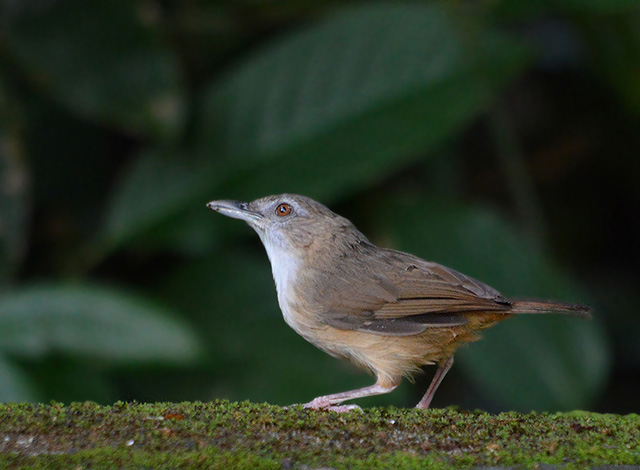
There is not much aesthetic appeal to be found on the Abbott’s Babbler but an adult bird with a recently fledged juvenile in tow indicated yet another successful breeding season for this robust undergrowth dweller.


A Blue-winged Pitta in full view would have normally made my day because pittas are such amazing creatures. However, I was a man on a mission today and the stunning beauty of the Blue-winged Pitta did not have the usual influence over my emotions.


I sighed in relief when the Slaty-legged Crake finally strolled into view. It was a young bird as it lacks the colour intensity of the adult birds. Not that it mattered. I was transfixed on the rhythmic gait of the crake. The exhilaration was intense and I struggled to keep my hands steady as I accumulated digital memories of the encounter.


Almost as soon as it appeared, the rare migrant disappeared back into the swampy undergrowth and the performance was over. I managed to obtain the images I wanted but most importantly, acquired a lifer which is a rare thing for me nowadays.


My companion and I decided the explore the surrounding areas but by then, the temperature had started to soar. A lone Dollarbird seemed unperturbed by the scorching heat and took no effort to seek some shade. Inevitably, the harsh lighting made photography of this attractive bird difficult.


April is the best time to catch the Pond-Herons in their breeding plumages before they undergo the journey back north to breed. We recorded all three species on this trip but unfortunately, none were confiding enough for any memorable photographs. This mediocre image of an Indian Pond-Heron foraging in a sea of paddy stalks still managed to wriggle its way into this blog post. Being the rarest of them all has got absolutely nothing whatsoever to do with it.


The scrubland habitat was ideal for Red-wattled Lapwings and we found several individuals in the vicinity. The absence of any other notable species cut short our exploration here and we turned our attention to the coast.


The timing of our arrival at Kota Kuala Muda was ideal with the rising tide pushing the waders and other water fowl to the high tide roost. However, it was a case of so close and yet so far. There was no safe walking access to the roost and inevitably, we made our way as far as the sandy beach was willing to take us.


We had some consolation in the form of Common Terns. A few of these graceful coastal terns decided to roost on the beach and they provided the best photographic opportunities here.


One of them has a deformed lower mandible but judging from its overall appearance, life goes on as normal for this determined individual.


Some waders were also found roosting close to shore but the heat wave was too overwhelming for any decent photographs. Nevertheless, the sight and sounds of thousands of roosting water birds is always a breath-taking affair. As Hor Kee did a final sweep of the roosting flocks for any surprises with his scope, I took the time to enjoy the spectacle before we wrapped things up for the day.


Monday, 1 June 2020

Enjoy the little things


I awoke to a Saturday morning that was simply too beautiful not to be out in the field. It has been a while since my last visit to Sungai Burung – a local patch located at the south-western corner of Penang Island. The scenic drive that cuts through the central hilly region to get to the site is now marred with the massive construction of an elevated highway. Luckily, the site itself remained pretty much the same as I last left it. In fact, I found the rural landscape to be more captivating than usual today. Or perhaps it is because I have been away for far too long.


The Black-naped Oriole is one of the most attractive birds that occurs within human settlements. I came across one resting on an electrical cable and it appeared to be in no particular hurry to start off the day and neither was I. Besides, I could use some colours in my life right now and the radiant plumage of the Black-naped Oriole will certainly do.


Feral species usually do not do it for me but Barbary Doves are still relatively uncommon here in Penang. Two pairs were seen perched suspiciously just outside a village house. The doves could well be free flying pets as they exhibited very little fear of my approach.


One pair had no intentions to conceal their feelings for each other. And I guess in no time, Barbary Doves will be a regular sight here but hopefully, not the entire island. We have more than enough Feral Pigeons flying about everywhere as it is.


An immature Blue-tailed Bee-eater was also making full use of the electrical cables. Unlike the doves, the youngster was using this man made structure to hunt for breakfast rather than procreation.


Along the access road next to the mangroves, the resident Collared Kingfishers were certainly out and about. Most have paired up for the breeding season and their raucous calls constantly broke the serenity of the surroundings.


There were fewer White-throated Kingfishers present which is expected of this location. In birding, it is sometimes about quality rather than quantity and this one White-throated Kingfisher provided the best photo out of all the kingfishers I came across today.


There was a big downpour the night before but it still does not explain why this Dollarbird is looking so miserable and wet. Not when other birds are looking prime and proper.


Despite having to endure human trappers, both the Zebra Dove and its bigger cousin the Spotted Dove are doing surprisingly well. While birding along the edge of the mangroves, I came across numerous individuals of both species. And one exceptionally tame Zebra Dove managed to convince me to stop for a photoshoot. While enjoying some sunshine on the rocky divider between the access trail and the mangroves, the little guy literally ignored my approaching vehicle. With the lighting condition ideal and the subject at eye level, it was almost too good (and easy) to be true.


The doves might be enjoying the good life here but they better not let down their guard too often. In this healthy ecosystem, predators lurk. The Crested Serpent-Eagle generally prefer a reptilian diet but who is to say if it suddenly acquires a taste for avian meat.


Brahminy Kites are aplenty today and the majority of them were juveniles. It is a scavenger by nature but will take life prey when the opportunity presents itself and small birds are certainly part of its diet.


The Purple Heron has little to fear from these raptors as it is simply too big for them to overpower. It enjoys its time in the sun with very little worries. At this location, the only species that poses any real threat to it would be humans. But not this human for he has nothing but admiration the heron’s stately presence.


At the nearby estuary, Striated Herons are abundant and it has been that way for as long as I could remember. Immature birds lack the lovely plumage colouration of the matured birds.


An adult Striated Heron is an attractive water bird that most birders and bird photographers often take for granted. But today, I was not on tour nor was I on any twitching mission. Today’s excursion was a relaxed outing to a local patch just to catch up with all the birding I was deprived of by the government’s partial lockdown order. And I intend to enjoy the little things like giving the Striated Heron the attention it truly deserves.


Even the Pacific Swallow managed to grab hold of my attention today and that does not happen often.


This is one of the few locations on the island where the Large-billed Crow can still be seen regularly. There is no doubt they are losing out to the marauding House Crows and that is a shame. I like the Large-billed Crow more or maybe I am just biased towards the House Crows for all the misdeeds they are capable of doing.


I kept a look out for Javan Mynas as they have been recorded from the island as well. However, there were not many mynas around today and those few Jungle Mynas that came my way did not produce any surprises.


As I was driving next to the river, I was surprise to see five Grey Herons at a single spot each perched on a different but adjacent tree. It appeared to be like a small heronry and in all of years of birding here in the Pearl of the Orient, this is my biggest count to date.


Another notable personal count for the island was a group of six Red-wattled Lapwings. Long before I could see them, I could hear their loud call as I approached the paddy fields. I have seen Red-wattled Lapwings at this site irregularly through the years but always lone birds. This species is doing so well throughout the peninsular nowadays and there is really no reason for them not to thrive here as well.


A few all too familiar silhouettes glided across the sky before alighted on a flooded patch of the paddy fields. It was not unexpected but to finally know I share my island home with Asian Openbills was definitely the highlight of the trip. I do not think this is the first confirmed sighting from Penang Island but it does not really matter. These unique storks have settled in well just across the narrow straits that separate the island from the mainland. It was just a matter of time before a few decide to opt for an island life. Unlike the invasive Javan Mynas, these storks certainly have my welcome.


Saturday, 30 May 2020

Conditional freedom


When the Movement Control Order was finally lifted (conditionally that is) about three weeks ago, birders were able to go into the field again but forest reserves and parks remain close and that is most unfortunate. With the migratory season all but over now, forest sites are usually the preferred choice. The deadly COVID-19 pandemic affected the livelihood of countless humans around the world. I did not rush out to bird immediately after this conditional freedom was acquire. There were more dire matters to attend to and one of them is to make sure I do all I can to help the company that I work for fight through this difficult time. With eco-tourism in fact any kind of tourism in a complete standstill, there will certainly be no guided birding tours for me anytime in the near future. Birding is the love of my life but it would be not much of a life if I cannot provide for my loved ones.

It has been more than 70 days since my last birding excursion. With interstate travel still prohibited and the unavailability of forest sites, I found myself at my last birding locality before Malaysia came under partial lockdown. I arrived at the marshland of Batu Kawan just after dawn and sight of a few Asian Openbills preparing for the day ahead made me realize just how much I miss birding.


I could not help but to notice that the water level within the marsh has risen higher. I do not think it is tidal and that could be spell bad news. The smaller water birds, as expected, did not reveal themselves like my previous visits because of the lack of foraging patches. I have been kept away from birding long enough to appreciate whatever that has been given to me. It will be a long time before I will consider any birding excursion to be poor – a long time indeed. This juvenile Purple Heron is one of the tallest birds here and the water level could not prevent it from performing well for my first birding excursion in months.


Just like the Purple Heron, the Grey Heron is another towering presence at this location. This individual was taking a breather next to a stream and proved to be most confiding – much to my delight.


A cumbersome landing by a Watercock among the reeds caught my immediate attention. Apart from males in breeding plumage, it is hard to tell them apart. This individual, judged by its indistinct barring on its underside, should be a juvenile. Anyway, I could managed only a few record shots before it barged its way through the reeds and out of sight.


Even from a distance, I could make out a pair of Lesser Whistling Ducks flying above the vast marshland. Like their namesake, these duck emit a unique whistling call that cannot be mistaken for anything else here in Peninsular Malaysia. I half heartedly attempted to capture their images as the lighting condition was not exactly favourable at the time. In the end, my lack of self confidence was uncalled for as the image turned out quite decent.


For the remaining half of my trip to Batu Kawan, I decided to focus on land birds. There was a number of birds present but nothing out of the ordinary. During my ‘stay home’ period, I had ample opportunities to observe House Crows and Common Mynas going about their daily routines. I surprise even myself that I actually took the effort to capture this House Crow resting on a plastic pipe.


And a Common Myna doing exactly the thing a pipes down the access road...


You can always count on the Paddyfield Pipit to be obliging and today was no different. Perched so elegantly on its very own pedestal, there are no surprises as to why a photo of this common species is included in my post this time.


The Chestnut Munia remains to be the only munia species present in the vicinity and a flock was busy foraging among the long grass. However, they appear restless and easily agitated this morning and I rarely had any opportunities for a decent photograph.


Unlike my previous trip here, warblers did not contribute much this time. The male Common Tailorbird was the only one that greeted me on this beautiful day. Well, one warbler is better than none at all.


As I was leaving the location, the highlight of the day called out to from the scrublands. Long-tailed Shrikes used to occur and breed in Penang state. When I started birding, it was locally extinct from my home state. In recent years, it has been recorded again but only in mainland Penang. And today, a skittish individual became my first record of a Long-tailed Shrike in Penang.


My next location is another open country habitat. The conditional freedom left me with very little choice of birding locations. The migratory season would be the best time to visit the marshlands of the Pulau Burung landfill and with June just a few days to go, only resident species were present. A few White-breasted Waterhen were caught out in the open. Perhaps with the absence of anglers and other humans in the past months, the birds have grown bolder than usual.


It was nice to pick out a lone Intermediate Egret among the usual flocks of Cattle Egrets. Of all the resident egrets here at the landfill, I guess it is probably the rarest of them all.


A number of Lesser Whistling Ducks were present but not in their usual big numbers. The day has grown hot and perhaps they have taken refuge at another spot of the marshlands. The perimeter fence often hinders photographic efforts. The enthusiasm of the local authorities are usually short-lived and in this case, it is a good thing. Hardly any maintenance is done since the day they erected this horrid structure. Certain spots have collapsed or damaged and these gaps in the fencing provide a window of opportunity for some decent photography.


I can remember a time when I could easily obtain intimate encounters with Little Grebes (and several other species as well) here. I thought those days are long gone after the destruction of this birding paradise that took place a few years ago. But the Little Grebes today took me for a stroll down memory lane and performed exceptionally well. And for a while there it felt like I was back in the good old days. Back to the days when this place was in its prime.


A couple of Horsfield’s Bronze-Cuckoo was recorded a few weeks earlier near the mangrove area. Hopeful and successful are two very different things.  For today, it is only the former for me as there were no signs of the Austral migrants. During my search, I found a Dollarbird hawking in the vicinity. The buoyant flight always appeals to me and with the good lighting bringing out the true colours of this roller, it was an enjoyable encounter. It would have been better if the perch the Dollarbird chose as a vantage point had better angles for a photograph.


I had another personal first record for Penang state today. It is safe to assume that it was a fruitful day out in the field after all. However, I have mixed feelings for this second species. All of us in the north knew that it was only a matter of time before the Javan Mynas made their way here from the south. For months, it has been regularly recorded in this region and I knew then there was no stopping the inevitable.


On one hand, I admire the bird for its ability to adapt and spread. On the other, I find the Javan Myna to be invasive and a threat to the existing populations of mynas especially the Jungle Myna. It had to cope with the likes of the Common and Crested Myna and now, it has the Javan Myna to deal with as well. Anyway, a small flock of Jungle Mynas happily allowed this lone Javan Myna to tag along and this comparison shot, though not a good one, shows the differences between the two species.


The final bird of the day was the majestic Crested Serpent-Eagle. Electrical poles are one of their favourite perches and coming across one on such an exposed perch is not unexpected. By that time the lighting was harsh but the eagle was just one pole away from my stationary vehicle and at this distance, the encounter took my breath away. Birds have always been my source of inspiration and solace. Right now, I could well be facing one of the biggest challenges in my life and this birding excursion certainly did wonders for my wearied soul.