Pages

Showing posts with label Hawk-eagle. Show all posts

Wednesday, 5 February 2020

Rising to the occasion


I have been kept busy during the Chinese New Year period with several excursions with visiting birders. The warm but ideal weather was a welcomed advantage. The only drawback was the usual traffic congestion during the festive season in Penang Island. Like Mother Nature, nothing can be done about that except to factor in additional time for the driving in the Pearl of the Orient. The Bukit DO recreational park is the only site that I prefer it to be crowded during my visits. I have been there often enough with my foreign guests for the regular patrons of the park to recognize me (I guess having a bald head and birding gear makes you stand out) and know my intentions. The resident pair of Barred Eagle-Owls here is an integral part of my birding circuit but despite their size, can hide well if they wanted do. That is when the regular patrons come in useful. Some of them readily point out the roosting owls to me and that saves a lot of time and effort. With my Canadian guests this time, they got to admire the pair side by side courtesy of a couple of ladies on their morning walk. Despite some blockage by the vegetation, the encounter was as exciting as always with any roosting owls.


I have been guiding around northern Peninsular Malaysia close to a decade now and one of my first guests when I first started was Benjamin from Singapore. Through the years, I have showed him particularly everything that needs be seen in this region and beyond. But some uncommon migrants that are showing well now in the forest of Bukit Wang had his attention and I naturally obliged. We timed our arrival when the lighting condition was bright enough for photography and it did not take long to find the first target flickering about the understorey of the forest. I know that this particular male Chinese Blue Flycatcher in my most of postings of late. However, the species is uncommon enough to still have my undivided attention. His vivid colouration set against the gloomy condition of the undergrowth is not something one can easily forget. And due to the fact that he is just a winter visitor, I might as well enjoy it while it lasts.


We spend some time at a few fruiting trees along the access road as there was a high level of bird activity but most of the patrons were flowerpeckers. Unfortunately, the foliage was dense and these tiny forest gems were in a feeding frenzy. My modest photographic equipment could not cope and out of the four species present, I could only obtain a record shot of the Yellow-vented Flowerpecker.


Surprisingly, very few bulbuls were present. In fact, I only recorded one species and it was the Cream-vented Bulbul.


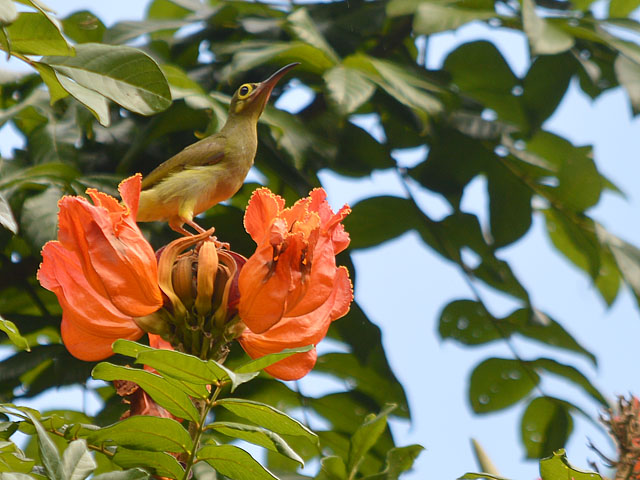
A few flowering trees were in bloom and they were quite a sight. However, my main interest with flowering trees is not due to the beauty of the coloured petals. It is the nectar-feeding birds attracted to the bloom. And today, a Spectacled Spiderhunter was the result of my search among the flowers. I cannot really consider it a search. The spiderhunter was loud and conspicuous as it fed on the sweet offerings. Unfortunately the flowers were at the top most part of the tree and typical of birding in the rainforest, our neck muscles were put to the test. Despite the distance, I am quite happy with how the images turned out and the bright red petals were certainly a contributing factor.


The second target of the trip required some effort and perseverance. The male Green-backed Flycatcher may be confiding but can be restless at times. The dimly lighted understorey of the forest where he frequents is no help at all. Just like the male Chinese Blue Flycatcher, he is also an uncommon migrant and may not return here the next season. And I know better than to take things for granted especially in birding.


Undoubtedly, the Short-tailed Babblers are now a regular feature for any visit to Bukit Wang. Adorable and inquisitive, I have grown fond of these terrestrial birds.


To them, there is no such thing as personal space and they will wander exceptionally close. And I certainly have no issues with that.


For my most recent excursion, I started off with a visit to the mangroves of Sungai Batu with a guest from Belize. Expectations were high. Belize, after all, is a birding paradise and my guest is no stranger to feathered denizens of the tropics. The resident pair of Abbott’s Babbler was the first to appear at the stakeout and they played their role well as appetizers to the main course.


The Yellow-vented Bulbul may not evoke much emotions among local birders due to its common status but to a visiting birder on his maiden trip to Malaysia, it did not go unappreciated.


When the male Mangrove Blue Flycatcher came into the scene, he provided much-needed colours and appeal to our visit here. He has been showing off well of late and today was no exception – much to the delight of both guest and guide.


I have had not much luck recently with the celebrity bird of the locality but when I heard the diagnostic territorial call of the Mangrove Pitta from the depths of the mangroves, I readied my guest for what would be the highlight of the day. When we finally saw the pitta hopping on the muddy terrain towards our direction, it was just mesmerizing. My guest naturally was swept away by the beauty and charisma of the pitta. As for me, I am most grateful to be still able to provide and share moments like this with visiting birders from around the globe.


Swaying their way into the day were the migratory Forest Wagtails of Sungai Batu. Stunning and adorable, they constantly thrill and tease birders with their antics. Judging from the reaction of my guest so far, I think the birding here was up to expectations.


A drive around the surrounding vicinity produced a male Common Kingfisher hunting for breakfast along a canal. Although my guest was originally from England where this is the only species of kingfisher to occur, he never had the chance to photograph the bird. That certainly changed when this particular individual proved to be reasonably confiding.


My guest just so happened to bring up the subject on raptors and the lack of them so far today. Like an answered prayer, I picked out a looming silhouette partly hidden by the foliage. From the shape, I could tell it was a raptor. Upon further scrutiny, it turned out to be a dark morphed Changeable Hawk-Eagle. And our first raptor of the day was this beautiful and impressive eagle. I love it when things work themselves out…


Greater Coucals are impressive birds but despite their common status, they are naturally shy. There are times when this large cuckoo will reveal its true form for all to admire and I have been birding long enough to know that these times are meant to be treasured. The concrete pole may be a manmade perch but to me, it makes no difference. If it is good enough for the coucal, it is sure the hell good enough for me.


Something from behind caught the attention of the Greater Coucal and made it turned around. It must have been something significant because it even tolerated us shifting position as well. When seen in good light, the Greater Coucal is not completely black and the sunlight will bring out hues of blue that is often hidden from view. A relatively common bird in a garden environment but yet able to provide just as exciting an encounter. That is the wonder of birding…


From the mangroves of Kedah, we adjourned to the swamp forest of mainland Penang. Although the Air Hitam Dalam Educational Forest has not been providing as well as it did in the past, in birding one cannot truly know what to expect. The Asian Openbills continue to rest and feed within the borders of this park and these unique birds are always a welcome sight to me.


A pair of Black-thighed Falconets was executing short burst of flight from a tall dead tree as they hunted for flying insects. Being small is always a disadvantage when it comes to photography but like I said in the beginning of this post, it was a sunny day and it was bright enough for me to capture these tiny terror on wings reasonably well.


My guest was not only interested in birds but other wildlife and nature as well. I am naturally tuned to pick out birds and this setback is my own doing. It came as no surprise when he spotted this Green Crested Lizard sunbathing near a spot where an Olive-winged Bulbul just alighted on. Thankfully, this little hiccup was soon to be forgotten.


The final bird of the day certainly left us breathless. It was not an exceptionally spectacular or rare species. But the confiding nature of this particular Square-tailed Drongo-Cuckoo was unbelievable. This species is known to bold at times and I have experienced that trait before. But I find this to be a privilege and one that will still make me as giddy as a schoolboy. Perched on an exposed branch at the edge of the forest, the Square-tailed Drongo-Cuckoo was undoubtedly on the hunt. It was stationary most of the time except for the occasional turn of the head. We could have easily walked past the cuckoo as it was unobtrusive. But like I said, I am naturally tuned for birds.


And if we were any closer, I would not be able to fill it into frame without reducing the magnification of my lens. It was just an incredible moment. In fact, it has been a terrific day of birding. Malaysia is certainly no Belize but I think the birds have done about enough to rise to the occasion. Ending the day with stunning views of the Square-tailed Drongo-Cuckoo was most memorable and almost overshadowed the Mangrove Pitta - almost. Maybe, just maybe, things might be turning around for this local patch of mine. That will certainly be good news because here in northern Peninsular Malaysia, we need all the rewarding birding sites we can get.


Tuesday, 15 January 2019

Big is beautiful


I yearned again to visit the nightbirds residing in the forest surrounding Pedu Lake in Kedah. Together with James, we departed from Penang in the middle of the night in order to reach our destination in time to catch these nocturnal hunters before they retire for the day. We stopped at a 24-hour fast food outlet for some breakfast to go and was surprised to see the number of patrons present at this hour. For them, their Friday night out was drawing to an end. But for us, it was just beginning. Upon arrival at this birding haven, we found it was a clear night and the view of the Milky Way from was mesmerizing as always.

Soon after, the diagnostic call of the Large Frogmouth echoed through the vicinity. My stargazing interest came to an abrupt halt because no astronomical spectacle can ever overshadow the presence of a Large Frogmouth. It did not take much effort to locate this amazing bird - again. Like my previous encounter, it was on an open perch at the edge of the forest. Only this time, it was a natural perch. For me, owling is one of the most difficult aspects of birding as we humans are certainly out of our element when darkness falls. However on those rare occasions when the subjects that we seek reveal themselves so obligingly, I cannot help but to believe in the existence of a Greater power.


The Large Frogmouth finally made it into my life list only a few years back (heard only records do not count in my book). Since then, I have been seeing it in the field quite regularly. Sometimes when you finally unblock a species, it shows up everywhere and makes you wonder why it took so long for you to see one. Anyway, the Large Frogmouth is a beautiful and remarkable species and I feel blessed that it is found in one of my regular haunts.


It was unfortunate that the Buffy Fish-Owl, Sunda Scops-Owl and Blyth’s Frogmouth only provided audio records this time. But the Large Frogmouth did enough to compensate for the rest. The breaking of dawn awakened the diurnal birds from slumber and the first one to break the silence was a Greater Racket-tailed Drongo. But the one vocal that had my undivided attention was not unlike the braying of donkeys and it is one of the largest (maybe even the largest) woodpeckers in the world. Great Slaty Woodpeckers are very vocal by nature and they seldom occur alone. That makes it almost impossible not to take notice of them whenever they are present.


A pair of this magnificent species kept us entertained for a prolonged period of time. They were not only foraging. Love was in the air as frequent courtship displays were observed. The male sports the red moustache but both birds are just as vigorous with their show of public affection.


The tallest canopies are their stage of choice. The distance and the speed of the birds’ movements made it difficult for my modest photography setup. But the encounter was a treat for the soul nevertheless.


In flight, the Great Slaty Woodpecker was just as difficult to capture. The flight is often direct and rapid and the only reasonable image I managed was strongly backlighted. The joys of forest bird photography...


A male Oriental Honey-Buzzard cast an eerie shadow as it glided very low overhead. Its presence panicked some of the smaller passerines as it is after all a predatory bird. The whole episode went by so quickly that I only managed a single shot before the buzzard disappeared beyond the gap in the canopy.


Pedu Lake is home to three species of Fish-Eagles and the biggest of them all is the White-bellied Sea-Eagle. The name may be misleading as this species is equally at home inland especially in the vicinity of a large body of water. There is no denying it is a common species even in Penang but the sheer size and beauty of this eagle will not stop me to be still in awe of its presence.


The Changeable Hawk-Eagle is smaller in size but it is much more tenacious as a hunter. An immature bird with a newly caught lizard delayed our departure from this birding haven. The lizard was nothing but a snack as this eagle is known to take much bigger prey. Today’s excursion may not have the quantity to match a typical good day of birding here but it did have its significant moments. The Large Frogmouth and the Great Slaty Woodpeckers alone was worth the trip here. Two iconic forest dwellers whose sizes are truly exceptional and presence, electrifying. We also recorded some birds that have gone missing for months and that is always a good thing.


Thursday, 13 December 2018

Smitten by bitterns


Brothers Nigel and Jimmy are regular guests of mine whom through the years, have become friends. We certainly have our share of birding excursions in far off lands. In fact plans are being made for another birding adventure next year and if it materializes, it would be my biggest birding trip ever. Anyway, closer to home the brothers were back in Penang for a family holiday and they managed to allocate a day for birding. One of their targets this time was the Scaly-breasted Bulbul and I knew exactly where to take them for this striking forest gem. Upon arrival at the forest surrounding Pedu Lake in Kedah state, we were greeted by sunny blue skies and that is a somewhat rare commodity these days. Then and there I had a very good feeling about today’s trip and my gut instinct was right on the money as I was about to find out.


The fruiting tree was still in full swing and birds were diving in from every corner. It did not take long to locate the first Scaly-breasted Bulbul. Everything about the bird’s appearance shouts attention and it certainly had ours. A little patience yielded better photographic opportunities as the bulbuls started to wander lower down to forage. The lighting condition today was such a stark difference from my last visit here a few days back. Naturally, the images revealed more of the bulbul’s true splendour. I was feeling elated although the Scaly-breasted Bulbul is not new to me. My guests, were overwhelmed.


When we could finally break ourselves free from the hold these bulbuls had on us, we took a slow walk along the access road seeking more denizens of this lush landscape. The grassy patches along the edge of the forest are frequented by the rarest munia species in Peninsular Malaysia. Pedu is the only one of my regular birding sites where the White-bellied Munia is recorded. I could hardly contained my excitement when we came across a small flock right next to the road. The dense vegetation made it frustratingly difficult to obtain unobstructed views. After many attempts and streams of profanity later, one member of the flock alighted on an exposed perch to soak in the warm rays of the morning sun. There was a small gap in the vegetation to allow me my moment of glory and that was more than I could ever wish for.


Nowadays, every Ashy Minivet that I encounter will be given its due attention to ensure that I do not overlook similar but much rarer species. There was nothing unusual about this female Ashy Minivet but she did provide a stellar performance for this group of visiting birders.


A trogon perched at eye level got my imagination running wild and almost had me believing I was staring at the highly sought after Cinnamon-rumped Trogon. But when reality took back the reins, there was no denying the presence of red on the rump. The Scarlet-rumped Trogon may be the most frequently encountered species but it has enough finesse to brighten up any birding excursion. Not that today’s excursion needed any brightening.


Not quite as appealing as the trogon, the Streaked Bulbul still deserves some recognition as it not a common species. It does not usually patronize fruiting trees and prolonged encounters like this one will not go unappreciated.


During my last visit here, our group had an exhilarating encounter with a Giant Forest Scorpion. Today, it was a Spider Wasp living up its namesake. This skilful hunter has just caught a spider of similar size and was dragging its prey off into the forest. Pedu never ceases to amaze.


Raptors were certainly up and about today and I bet it had a lot to do the sunny weather we were enjoying. The first of these predatory birds to cross our path was a Crested Goshawk. It is a beautiful raptor and here in the north, we are not blessed with many encounters. What did I tell you about my gut feeling in the beginning of this post?


The far carrying territorial calls of the Crested Serpent-Eagle echoed through the vicinity on more than one occasion. However, this common but still impressive raptor did not get down low enough for any memorable shots.


Today, the Oriental Honey-Buzzards were everywhere. It is a little late in the season but they still appeared to be on migration. A flock of 5 buzzards taking full advantage of the rising thermals gained our undivided attention.


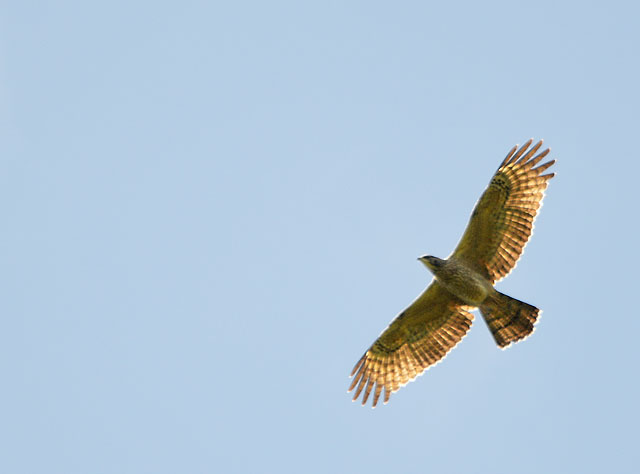
As we were enjoying the small spectacle, I swore I heard the cries of a Blyth’s Hawk-Eagle. Upon further observation, one of the ‘buzzards’ looked a bit odd and when it took a swoop at a nearby comrade only did I realized it was the Blyth’s Hawk-Eagle that I heard. The concentration of Oriental Honey-Buzzards must have hit a nerve and the eagle took matters into its own wings. The Blyth’s Hawk-Eagle was the fourth and final species of raptor to make an appearance during our visit here.


However, the bird of the day at this site do not rule the skies. It is a docile dweller of the canopy levels with a combination of vibrant colours that makes it one of the most alluring species in the tropical rain forest. The Red-billed Malkoha is not a rare species here and when one is privileged enough to encounter it foraging along the lower levels, it will be a memorable experience. It is not a particularly shy bird but has a knack to stay partly hidden by the vegetation.


Today was indeed our lucky day because it alighted on an exposed perch during its foray out of its comfort zone and for that brief moment, time came to a complete standstill. We found ourselves lost in this Red-billed Malkoha’s mesmerizing beauty. Life can be beautiful at times.


The next location we visited was the mangroves of Sungai Batu and the resident White-breasted Waterhen was the first to greet our arrival.


Inquisitive as ever, the resident pair of Abbott’s Babbler provided some good photographic opportunities as they moved about the vicinity.


Only the female Mangrove Blue Flycatcher presented herself well enough for me to photograph this time.


I have brought the brothers to this spot before but that does not stop them from getting all excited when the Mangrove Pitta hopped into the view. As a matter of fact, it did not stop me either...


The main reason for our visit to this site was for the Forest Wagtail. This adorable migrant did not show itself during the brothers’ last visit here. Thankfully, history did not repeat itself today and ample views were obtained.


From the mangroves, we then tried our luck at the paddy fields of mainland Penang. We were greeted by a splendid view of a flock of Grey-headed Lapwings resting in a sea of green. The distance could not produce any reasonably good images but the encounter certainly provided a moment to be cherished.


On the next patch of paddy field, we were delighted to find a young bird resting much closer to the access road. The afternoon light today certainly complimented the image of this unusually confiding Grey-headed Lapwing well.


A number of Whiskered Terns were present in the vicinity as well today. Graceful and beautiful, it is always a joy to see them float about in search of food. However, it is not easy to capture them in flight. A flock at rest is the best alternative.


The isolated trees within the paddy fields were again alive with starlings. Since it is that time of the year again, we scrutinized the flocks hoping for some Christmas magic. But it was not to be and only the usual Daurian Starlings were recorded. And their memorable performance helped to ease my disappointment of failing to reconnect with the much rarer White-shouldered Starling that I recently photographed here.


The Jungle Myna is relatively common here but the same cannot be said for built-up areas on the island. Stiff competition from the other myna species are reducing the population of Jungle Mynas as a whole in this state. There could be more bad news as the Javan Mynas are inevitably colonizing their way up north.


The Common Kingfisher is a regular winter visitor to the vicinity but can be easily overlooked due to its small size. Do not be misled by the name. Although it is not rare, it does take some luck and effort to see one in the wild. This female bird was hunting from a clean perch at eye level and together with her lovely plumage, made her rather conspicuous and a good subject for photography.


On the other hand, the White-throated Kingfisher can be seen on every visit here. It is not only due to its stunning appearance and larger size. It is by far the commonest inland kingfisher in Malaysia. Usually ignored due to its abundance but today I felt like paying homage to every confiding bird we encounter as a sign of gratitude for the good fortune we have been given today – weather and bird wise.


A small patch of reeds next to the access road provided one of the highlights of the trip. There was a Yellow Bittern was on the hunt and it was not the least perturbed by our presence.


We had to shift our vehicle midway during our observation because of an approaching vehicle. I usually curse under my breath in times like these (although it is no fault of the other vehicle) but this time, it turned out to be a blessing. The slight shift produced a second bittern that was there all this while undetected. I have seen this ‘Kungfu’ pose in the works of others and today, I finally got my own. Bitterns can be confiding at times but today, these individuals were amazing.


Unbelievable as it may seem, there was a third bittern in this very spot and for the second time today (the Oriental Honey Buzzards at Pedu and now this), we found ourselves surrounded by the subject we so passionately seek. There was some Christmas magic in the air after all.


The dreadful weather that has been plaguing our lands of late finally crept up later in the evening. For once, it was of no worry as I was about to conclude the tour. It has been an incredible day despite the lack of any true rarities. A refreshing difference after several trips of difficult and wet birding. The tropics no doubt houses some of the most fascinating and enchanting bird species in the world but the challenges will always be there and you will have to rely on your passion to get you through.