Pages

Showing posts with label Kubang Semang. Show all posts

Monday, 6 April 2026

A tale of two twitches


Before my birding tour in central Thailand ended, it came to my attention that Yellow-breasted Buntings were also seen and photographed at the Bluethroat site back in Penang. To have two mega rarities literally together of which one is critically endangered and a global lifer for me was too good to be true surely. But the images surfacing in social media say otherwise. Well, my pending visit to the locality escalated from gradually to urgently. I had ample time at the airport when I waited for my flight back to Penang. Normal folks would be homesick and all that but I am a birder and we are a breed apart. As I sipped my over-priced coffee at one the cafes, there was only one mind on my mind – Yellow-breasted Buntings. A plan was formed before I boarded the plane. By the time I climbed onto bed, it was midnight. At the break of dawn, I found myself at the grasslands of Kubang Semang in mainland Penang for my first twitch in years. I have not had so much excitement in my birding life for a long time and it was invigorating to say the least.

It was a Monday and the chosen day was also part of the plan. A mega like the Bluethroat will have any place in Peninsular Malaysia crowded especially when the bird is stable and regular. Add another mega into the mix and you do the math. It was empty when James and I arrived at the site. Just as I was about to pat myself on the back, other like-minded ‘bird’ people started pouring in. And I guess a working Monday is not much of a hindrance after all. The male Bluethroat, as expected, did not take long to reveal his stunning presence. Having just experienced a similar encounter less than twenty-four hours ago, the usual thrill of a successful twitch was a little lacking.


All my years of birding has taught me quite a number of things and taking birds for granted is not one of them. I continued to shower the Bluethroat with attention while James and a few others who have spent enough time with the Bluethroat last week, were on the lookout for the Yellow-breasted Buntings.


An Oriental Reed-Warbler wandered into view and this common but at times elusive migrant, warranted some attention as well.


When anxiety set in, I set everything aside and focused all my attention in finding the main reason behind this rare weekday excursion. It was a hive of bird activities at this patch of grasslands. As fate would have it, I have the Baya Weavers to thank for this bustling atmosphere. And I do not mean it in a good way. The similarities between a female Baya Weaver and the buntings were undeniable. Inevitably, every movement by the former will have my bins locked onto them and there were about a dozen of them around.


The Munias can never to be mistaken for the buntings but their movement will occasionally distract me from my quest. The majority of these adorable birds were White-headed Munias. On any other day I would have invested some time and effort to document them but today is not the day.


The same can be said about the Black-headed Munias.


As the day grew hotter, fatigue and frustration heightened. I was distracted by the Baya Weavers so often that I can now recognise their jizz in an instance. And a lone bird foraging at a short distance do not strike me as one of them. Before I could switch to my camera, my lifer took off but I alerted the rest of its presence nevertheless. Soon after, a Yellow-breasted Bunting popped into view and there was no denying its identity now. However, there was no icing to the cake. I can blame it on my gear or even old age but it will not change the fact that this horrible image was all I have to show at the end of the encounter.


The outcome of the twitch was a bitter pill to swallow. I am well aware I could have just as easily missed the Yellow-breasted Bunting altogether. I refuse to believe that my experience with this species will be nothing more than a case of so close and yet so far. No, there has got to be more and I have to make sure of that. Four gruelling work days had to pass before a re-visit was possible. The resident Bronze-winged Jacana which used to be a rarity, was the first to greet me during my second attempt at the critically endangered Yellow-breasted Buntings.


The present status of this vagrant is a sad tale indeed. It used to be common where it naturally occurs but common does not mean invincible if share your home with humans. Rampant trapping and hunting have driven the Yellow-breasted Bunting to the brink of extinction. The world does not need another example like the Passenger Pigeon to show just how fragile the wellbeing of wildlife can be. And now, there are at least three individuals wintering in my neck of woods. It will be a shame if I do not give it my all to connect with this species before it is too late. Minutes turned to hours and still no signs of the celebrity birds despite the number of eyes looking for them. Naturally, I was not alone as it was the weekend after all.


Nothing is ever a sure thing when it comes to birding. It does not matter how skilled you are or how meticulous is your planning and strategies. If the bird does not want to be seen or photographed, there is nothing you can do about it. Fortunately, luck was on my side and a Yellow-breasted Bunting suddenly decided to alight in front of me. There is a God after all.


From the images posted on social media, one of the birds was an adult male and the other two were either first winter or female birds in different stages of moult. The individual that I was staring was not the adult male and that was the only thing I can be sure of at that time. Opinions from knowledgeable friends and resources online indicated that it was a female. Although not as striking as a male bird, she has more than enough captivation to leave a lasting impressive.


Best of all, she was obliging enough to allow all those present to obtain photographic memories of the encounter. And all the earlier ill feelings she and her kin caused, was forgiven.


Almost immediately after she retreated, a second bird was spotted. However, it could not live up to the first encounter due to the distance. The second bird also turned out to be a female but her underparts are more heavily streaked and lacking the colour intensity.


When she took flight, another individual followed and I can only assume was the first female. And that concluded my observation of the Yellow-breasted Buntings. I found my closure in the end and the world is a beautiful place once again.


Just in case you are wondering, the handsome male Bluethroat was still around and performing for a number of admirers since morning. However, it was the female Bluethroat that caught my eye today. It is common knowledge that the duller female was the shyer of the two at this location. Anyway, it was a record shot more than anything else but completed my observation of the rare Bluethroats as well.


A surprisingly confiding Yellow-bellied Prinia held me back from my making my journey home. Like what I mentioned earlier, nothing in birding should ever be taken for granted and even the commonest species deserve some attention especially if they are performing well like this.


Friday, 4 January 2019

Year end delights - Part 2


The Muda Resort situated just outside the forest of Pedu Lake in Kedah state was our accommodation of choice for the night. I woke to my alarm an hour before dawn and I was about to conclude my simple breakfast when an all-too-familiar call filled the predawn sky. The call belonged to the Great Eared-Nightjar and it sounded really close. After rounding up my Singaporean guests, we watched in awe as a pair of these impressive night birds floated around just above our chalet. It was too dark for photography but for Seng Beng, his passion for sound recording kept him busy. For the two us, we soaked in the sight and it was surreal. I cannot find the words to describe the experience but these Great Eared-Nightjars provided one of the best moments in birding for me this year. The day was certainly off to a good start.


As soon as it got bright enough, we were back at the access road of Pedu Lake where we had an eventful outing just last night. The weather was again favourable but the true blessing was the level of bird activity and it was exceptionally high. A Black-bellied Malkoha glided into view and got the ball rolling. Despite their large size, malkohas can be difficult to photograph as they tend to scurry about hidden among the vegetation.


With a little patience and luck, eventually we were presented with a handful of opportunities to capture this lovely cuckoo in full view.


The Raffles’s Malkoha should be the commonest malkoha in the country but that does not make it any less appealing. Sexes are dimorphic and today, the female was much more obliging than the male. And lucky for us, she is just as striking as the male.


She came surprisingly close to our position on one occasion. Unfortunately, the dense foliage obscured parts of her beautiful plumage. It was frustrating but to be in such close proximity with an attractive female certainly set our hearts aflutter.


The male, told by his almost completely rufous plumage, revealed himself briefly before disappearing into the lush landscape where he remained for the rest of our visit here.


The Red-crowned Barbet may not be all that common throughout the country but here, it is one of the most conspicuous barbets. Good views are hard to come by and although this individual was resting and preening slightly lower than usual, it made sure that the chosen perch will not give too much of itself away to the eager birders present. I guess it was Mother Nature’s way of keeping us birders in check with reality.


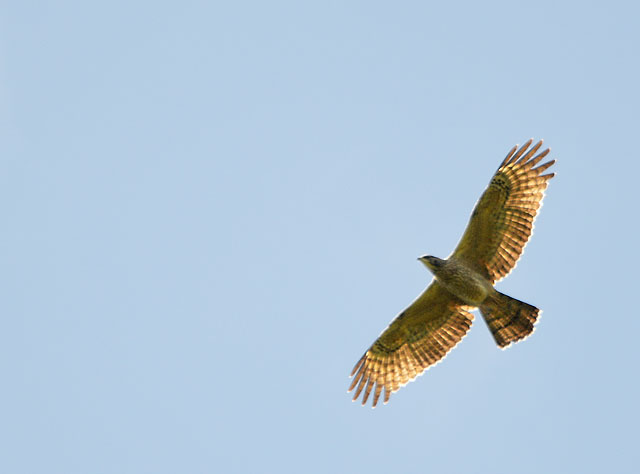
A Crested Goshawk flew past overhead with such velocity neither birds (that form its prey) nor birders (that form its fan base) could react accordingly fast enough. I managed to press the shutter a few times before the raptor vanished and luckily, one shot came out relatively well given the circumstances.


The long grass area failed to deliver any White-bellied Munias as I had hoped for but a pair of vocal Rufescent Prinias provided some compensation.


A flutter of wings flying across the road turned out to be a male Scarlet-rumped Trogon and it would be a sin not to acknowledge his splendid colouration just because he can be more easily encountered than the others of his kind.


We had a surprisingly sumptuous lunch at a local eatery before proceeding to the next destination. I could not help but to be drawn to one of the pet cats found there. Birding trips naturally is all about the birds but sometimes, little things here and there do help to make it complete.


The sun was scorching down from the heavens above today and mid afternoon was probably the best time to wander around the paddy fields from the comforts of our vehicle. Initially, only the usual congregations of egrets were present today. However towards the end of the fields, we came across flocks of Grey-headed Lapwings. It has been about 10 years since this species was last recorded in Singapore and a few confiding individuals certainly had the attention of my guests. This locality is one of the main wintering grounds for this lapwing in Malaysia and despite my numerous encounters with it, this locally common migrant still has my attention especially well-behaved ones like these.


Our final destination for the tour was my local patch of Air Hitam Dalam. The birding scene here has trickled back to normal now that all the exciting passage migrants have continued their journey down south. Some of the migrants will stay for the entire winter and this Square-tailed Drongo-Cuckoo looked quite at home here in this freshwater swamp forest. Resting unobtrusively along the forest edge, it could have been overlooked if not for my vigilance at this particular area of the reserve.  


The Asian Koels are starting to make their presence felt with their characteristic territorial calls as the breeding season drawing near.  More often heard than seen, we were lucky today to have a female in full view as she gorged on a low fruiting tree.


The skies above this little piece of birding haven is usually not void of bird life. As evening approaches, the migratory Black Kites will start to return to their roosting site across the river. Often enough, they will provide an aerial display of elegance and agility before retiring for the day. With the light hitting the raptors from a favourable direction and my subjects in a showboating mood, my photographic attempts were well rewarded.


It has been a rewarding two days of birding here in northern Peninsular Malaysia. The weather was ideal, the birds were up and about and the companionship thoroughly enjoyable – all the right ingredients for a memorable birding adventure. As the three of us gazed at the Black Kites twist and twirl in the brilliant blue sky overlooking the Perai River, the feeling of contentment was undeniable. I could not have asked for a better way to conclude this trip.


Thursday, 13 December 2018

Smitten by bitterns


Brothers Nigel and Jimmy are regular guests of mine whom through the years, have become friends. We certainly have our share of birding excursions in far off lands. In fact plans are being made for another birding adventure next year and if it materializes, it would be my biggest birding trip ever. Anyway, closer to home the brothers were back in Penang for a family holiday and they managed to allocate a day for birding. One of their targets this time was the Scaly-breasted Bulbul and I knew exactly where to take them for this striking forest gem. Upon arrival at the forest surrounding Pedu Lake in Kedah state, we were greeted by sunny blue skies and that is a somewhat rare commodity these days. Then and there I had a very good feeling about today’s trip and my gut instinct was right on the money as I was about to find out.


The fruiting tree was still in full swing and birds were diving in from every corner. It did not take long to locate the first Scaly-breasted Bulbul. Everything about the bird’s appearance shouts attention and it certainly had ours. A little patience yielded better photographic opportunities as the bulbuls started to wander lower down to forage. The lighting condition today was such a stark difference from my last visit here a few days back. Naturally, the images revealed more of the bulbul’s true splendour. I was feeling elated although the Scaly-breasted Bulbul is not new to me. My guests, were overwhelmed.


When we could finally break ourselves free from the hold these bulbuls had on us, we took a slow walk along the access road seeking more denizens of this lush landscape. The grassy patches along the edge of the forest are frequented by the rarest munia species in Peninsular Malaysia. Pedu is the only one of my regular birding sites where the White-bellied Munia is recorded. I could hardly contained my excitement when we came across a small flock right next to the road. The dense vegetation made it frustratingly difficult to obtain unobstructed views. After many attempts and streams of profanity later, one member of the flock alighted on an exposed perch to soak in the warm rays of the morning sun. There was a small gap in the vegetation to allow me my moment of glory and that was more than I could ever wish for.


Nowadays, every Ashy Minivet that I encounter will be given its due attention to ensure that I do not overlook similar but much rarer species. There was nothing unusual about this female Ashy Minivet but she did provide a stellar performance for this group of visiting birders.


A trogon perched at eye level got my imagination running wild and almost had me believing I was staring at the highly sought after Cinnamon-rumped Trogon. But when reality took back the reins, there was no denying the presence of red on the rump. The Scarlet-rumped Trogon may be the most frequently encountered species but it has enough finesse to brighten up any birding excursion. Not that today’s excursion needed any brightening.


Not quite as appealing as the trogon, the Streaked Bulbul still deserves some recognition as it not a common species. It does not usually patronize fruiting trees and prolonged encounters like this one will not go unappreciated.


During my last visit here, our group had an exhilarating encounter with a Giant Forest Scorpion. Today, it was a Spider Wasp living up its namesake. This skilful hunter has just caught a spider of similar size and was dragging its prey off into the forest. Pedu never ceases to amaze.


Raptors were certainly up and about today and I bet it had a lot to do the sunny weather we were enjoying. The first of these predatory birds to cross our path was a Crested Goshawk. It is a beautiful raptor and here in the north, we are not blessed with many encounters. What did I tell you about my gut feeling in the beginning of this post?


The far carrying territorial calls of the Crested Serpent-Eagle echoed through the vicinity on more than one occasion. However, this common but still impressive raptor did not get down low enough for any memorable shots.


Today, the Oriental Honey-Buzzards were everywhere. It is a little late in the season but they still appeared to be on migration. A flock of 5 buzzards taking full advantage of the rising thermals gained our undivided attention.


As we were enjoying the small spectacle, I swore I heard the cries of a Blyth’s Hawk-Eagle. Upon further observation, one of the ‘buzzards’ looked a bit odd and when it took a swoop at a nearby comrade only did I realized it was the Blyth’s Hawk-Eagle that I heard. The concentration of Oriental Honey-Buzzards must have hit a nerve and the eagle took matters into its own wings. The Blyth’s Hawk-Eagle was the fourth and final species of raptor to make an appearance during our visit here.


However, the bird of the day at this site do not rule the skies. It is a docile dweller of the canopy levels with a combination of vibrant colours that makes it one of the most alluring species in the tropical rain forest. The Red-billed Malkoha is not a rare species here and when one is privileged enough to encounter it foraging along the lower levels, it will be a memorable experience. It is not a particularly shy bird but has a knack to stay partly hidden by the vegetation.


Today was indeed our lucky day because it alighted on an exposed perch during its foray out of its comfort zone and for that brief moment, time came to a complete standstill. We found ourselves lost in this Red-billed Malkoha’s mesmerizing beauty. Life can be beautiful at times.


The next location we visited was the mangroves of Sungai Batu and the resident White-breasted Waterhen was the first to greet our arrival.


Inquisitive as ever, the resident pair of Abbott’s Babbler provided some good photographic opportunities as they moved about the vicinity.


Only the female Mangrove Blue Flycatcher presented herself well enough for me to photograph this time.


I have brought the brothers to this spot before but that does not stop them from getting all excited when the Mangrove Pitta hopped into the view. As a matter of fact, it did not stop me either...


The main reason for our visit to this site was for the Forest Wagtail. This adorable migrant did not show itself during the brothers’ last visit here. Thankfully, history did not repeat itself today and ample views were obtained.


From the mangroves, we then tried our luck at the paddy fields of mainland Penang. We were greeted by a splendid view of a flock of Grey-headed Lapwings resting in a sea of green. The distance could not produce any reasonably good images but the encounter certainly provided a moment to be cherished.


On the next patch of paddy field, we were delighted to find a young bird resting much closer to the access road. The afternoon light today certainly complimented the image of this unusually confiding Grey-headed Lapwing well.


A number of Whiskered Terns were present in the vicinity as well today. Graceful and beautiful, it is always a joy to see them float about in search of food. However, it is not easy to capture them in flight. A flock at rest is the best alternative.


The isolated trees within the paddy fields were again alive with starlings. Since it is that time of the year again, we scrutinized the flocks hoping for some Christmas magic. But it was not to be and only the usual Daurian Starlings were recorded. And their memorable performance helped to ease my disappointment of failing to reconnect with the much rarer White-shouldered Starling that I recently photographed here.


The Jungle Myna is relatively common here but the same cannot be said for built-up areas on the island. Stiff competition from the other myna species are reducing the population of Jungle Mynas as a whole in this state. There could be more bad news as the Javan Mynas are inevitably colonizing their way up north.


The Common Kingfisher is a regular winter visitor to the vicinity but can be easily overlooked due to its small size. Do not be misled by the name. Although it is not rare, it does take some luck and effort to see one in the wild. This female bird was hunting from a clean perch at eye level and together with her lovely plumage, made her rather conspicuous and a good subject for photography.


On the other hand, the White-throated Kingfisher can be seen on every visit here. It is not only due to its stunning appearance and larger size. It is by far the commonest inland kingfisher in Malaysia. Usually ignored due to its abundance but today I felt like paying homage to every confiding bird we encounter as a sign of gratitude for the good fortune we have been given today – weather and bird wise.


A small patch of reeds next to the access road provided one of the highlights of the trip. There was a Yellow Bittern was on the hunt and it was not the least perturbed by our presence.


We had to shift our vehicle midway during our observation because of an approaching vehicle. I usually curse under my breath in times like these (although it is no fault of the other vehicle) but this time, it turned out to be a blessing. The slight shift produced a second bittern that was there all this while undetected. I have seen this ‘Kungfu’ pose in the works of others and today, I finally got my own. Bitterns can be confiding at times but today, these individuals were amazing.


Unbelievable as it may seem, there was a third bittern in this very spot and for the second time today (the Oriental Honey Buzzards at Pedu and now this), we found ourselves surrounded by the subject we so passionately seek. There was some Christmas magic in the air after all.


The dreadful weather that has been plaguing our lands of late finally crept up later in the evening. For once, it was of no worry as I was about to conclude the tour. It has been an incredible day despite the lack of any true rarities. A refreshing difference after several trips of difficult and wet birding. The tropics no doubt houses some of the most fascinating and enchanting bird species in the world but the challenges will always be there and you will have to rely on your passion to get you through.