Pages

Showing posts with label Penang Botanic Gardens. Show all posts

Monday, 10 August 2026

Binoculars Review: Svbony SA207Pro 8X42


Binoculars are treasured and rather personal items for old school birders like yours truly. Although I now spend just as much time photographing birds as I do birding, the latter remains top priority to this very day. And yes, these are two very different passions even if nowadays most consider them to be one. You can find me out birding with just my binoculars but it is very unlikely you can find a bird photographer doing the same. And my faithful Leica Trinovid 10X42 BN has been by my side in every birding adventure for more than three decades.

Recently, I was approached to do a review for a pair of binoculars that was just launched. Svbony is a Chinese company that specializes in optical equipment and their SA207Pro 8X42 binoculars is the latest addition to their range of optics available for the birding community. How will it fare in the hands of a birder who has sworn by Leica for most of his birding life? Read on to find out.

Unboxing the SA207Pro, you will find it comes complete with everything you need for a pair of binoculars – soft pouch, strap, harness, lens caps and a chamois cloth.


My first impression of the binoculars, it is well-built and not lacking of the premium feel and appearance. Weight-wise, it is about the same as my current one and should not pose any issue out in the field.


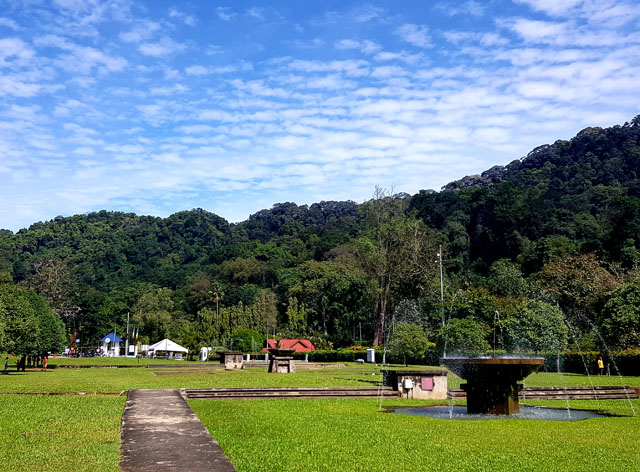
A trip to the forest surrounding the Penang Botanic Gardens was to be the first opportunity to test this mid-range binoculars. I decided to venture into one of the forested trails because every birder knows that it possesses one of the most challenging conditions you will face when birding.


As expected of any forest trail in Penang Island, birding depends a lot on luck and it took a while before the silence was shattered. The Greater Racket-tailed Drongo is still relatively common here but there is nothing common about the bird’s appearance which makes it hard to be overlooked. Its vocal nature makes sure of that too.


The SA207Pro certainly rose to the occasion during the excursion. In the gloomy undergrowth of the forest, the 8x42 magnification performed well by allowing enough light for good imagery and the wide field of view eases tracking of denizens like the Indochinese Blue Flycatcher. However, concluding an observation without a single photo of the bird to show is certainly not unheard of when it comes to forest birding.


It took very little getting used to and I quickly accustomed myself to the works of the SA207Pro. Soon, I was enjoying the birding excursion without much thought of the new optical device in my hands.


From the forest, I gradually moved to more open areas and the landscaped gardens of the locality. Naturally, the new binoculars continued to excel. And the beauty of a Stork-billed Kingfisher was truly reflected by the Apochromatic (APO) system with Single ED and Lanthanum lens elements.


Mid-morning temperatures brought out a majestic White-bellied Sea-Eagle. As the raptor soared effortless overhead, the Flat-field technology and the smooth focusing ring allowed me to follow its movements with breath-taking views.


No visit to the Penang Botanic Gardens is complete unless this state speciality is recorded – the Crested Myna. Penang Island remains to be the major stronghold for this introduced species that has long been accepted into the official country checklist.


The Little Egret is another common sight and usually frequents the river just outside the gardens. The presence of this water bird provided a flair of elegance to the excursion.


Overall, the Svbony SA207Pro 8X42 is a delight to use. It is a balanced and precise optical aid that almost rivals the high-end range of binoculars available in the market today. If you are on the look out for a good pair of binoculars without a premium price tag, this one is worth considering.


For a limited time, you can enjoy an exclusive discount with the coupon code RETECHOY if you purchase the Svbony SA207Pro 8x42 here:

https://shopee.com.my/product/122371056/45861364815

Friday, 31 December 2021

Ending the year with some Christmas cheer


Christmas - that special time of the year when anything is possible or so they say. And what better time to set out for not one but two lifers than on Christmas Day itself. It has been nearly 15 months since I last increase my life list. Undoubtedly, this is the longest I have ever gone without a lifer and it is courtesy of the ongoing pandemic and all the travel restrictions. I had a little appetizer before the main course which was slated for the afternoon. Unfortunately, the Black Bittern that was showing well for others at the Penang Botanic Gardens was no where to be seen. It was not a good sign especially before a major twitching trip and a striking Blue-tailed Bee-eater did not possess enough finesse to lift my spirits. So much for the magic of Christmas so far.


The Pied Stilt looks very much like some variances of the Black-winged Stilt and this graceful wader was my first twitch of the trip. It is a recent colonizer from the south to Peninsular Malaysia and a few finally made their way up to Penang state as predicted. The paddy planting district of mainland Penang houses hundreds of wintering Black-winged Stilts. Relying on the information others have provided and faith, I scanned through the flocks looking for the odd ones out. Luckily, I had James’s help for this tedious task as he accompanied me on this excursion. It was a hot and sunny day and the heatwave was almost unbearable. And then among a flock of 50 or so, I noticed one sporting a distinctive black mane. It was far and the paddy stalks, tall. Upon further strenuous scrutiny, it was beyond doubt I was squinting at my first Pied Stilt.


I carefully trod onto the muddy bund with the hope of obtaining better images. The paddy field is not a place where one can easily sneak up to a bird and the magic of Christmas, like everything else in life, has its limits.


Time was of the essence on this occasion and as I was about to leave for my next destination, the Pied Stilt strolled into full view. It was still a dreadful effort but then again, I could have just as easily missed the bird among the sea of stilts and stalks. Thus, always be grateful of what you have being given.


We arrived at the jetty along the Penaga River just in time to join the rest to search for Malaysia’s second Black-faced Spoonbill by boat. There is not much I can add that Google cannot provide about this unique and globally endangered species except that it presses all the right buttons for me – a water bird that is big, beautiful and rare.


We found the Black-faced Spoonbill at the river mouth where it frequents. However, all the excitement and anticipation built up to this moment drowned away because the distinguished visitor was foraging at a spot where the possibility of reducing the distance was non-existence.


The only thing left to do was to wait and hope for the Black-faced Spoonbill to wander closer and it was a long and taxing wait. A juvenile White-bellied Sea-Eagle gilded in and momentarily distracted us from the depressing situation we were in. It may sound like I am contradicting myself. I got my double lifers, didn’t I? It really should not matter that I only managed record shots for this lifer as well. But I was really looking forward to a memorable experience with the spoonbill and a distant observation is not exactly what I had in mind.


Anyway, back to the eagle. A sudden change of pace caught everyone by surprise and I almost missed the opportunity of capturing this majestic raptor dive successfully for what appeared to be a snake. On any other given day, this would have left me on cloud nine. But the disappointment with the spoonbill could not be that easily forgotten.


Even the appearance of a juvenile Brahminy Kite soaring effortlessly in the clear blue sky did very little to brightened up the trip. Not when now that the Black-faced Spoonbill had gone hidden from sight as it rested behind a line of mangrove trees.


At that point in time, we decided to venture elsewhere and to return here again before the day is over. A Collared Kingfisher was also taking shelter from the scorching heat and perched among the foliage of the mangroves.


The Black-capped Kingfisher is one difficult bird to photograph because of its shy nature. I found out today that it is more tolerant to approach by boat than car and this individual continued to rest in the shade despite our intrusion. This common but striking migrant did reposition itself during our observation and the encounter gave us to courage to hope for better things to come before the end of the day.


It was the moment of truth and the boat circled back for one more attempt with the Black-faced Spoonbill. On a wing and a prayer, we are hoping that the receding tide will draw it out from hiding and forage along the water’s edge. Just like this Great Egret.


Even from a distance, there is no mistaking the foraging technique of the spoonbill as it sweeps for aquatic invertebrates. We cautiously approach and now at least, we can truly admire the unique and enigmatic Black-faced Spoonbill.


Before the trip, I gawked at some of the images that were posted on social media. Although my own efforts do not even come close but I am happy. Two lifers in one day is a rare feat for me and given the unprecedented period I had to endure without lifers, this is one of my best Christmas Days in a long time. I suppose every birder wishes for easily attained lifers. However, sometimes the drawbacks and drama in a way add value to the experience. There was certainly no shortage of that today.


Little did I know the Black-faced Spoonbill saved the best for last. As the last light of day gradually slid back into the horizon, we found our main target of this boat trip basking in the golden light of the setting sun. And I, just took a deep breath and soak in the view. From utter disappointment to total bliss. The magic of Christmas? You bet it is. At the time of writing, this vagrant has not been seen in two days. All the more reason to be grateful.


When we returned to the jetty, a few Black-crowned Night-Herons have emerged from their roost. As our day comes to a close, theirs have just only begun. These common nocturnal water birds wrapped things up for the day and what a day it has been. The Pied Stilt will most probably get commoner here in Malaysia but for now, it is certainly a significant record. The Black-faced Spoonbill was just amazing and I may not have another chance to see this rarity again in my homeland. 2021 may not have been an eventful year but the appearance of these two species in the final weeks of the year has now made it otherwise.


Wednesday, 1 December 2021

A tree full of flycatchers


The male Mugimaki Flycatcher is an exquisite creature. Though not especially rare, I could certainly do with some decent images of this stunning migrant. The Penang Botanic Gardens is a known wintering site and when news reached my ears of several individuals showing well at this popular recreational locality, there was only one course of action to be taken. I had no trouble finding the exact spot as there was a small crowd present upon my arrival. Penang Island is undeniably small and the occurrence of not only Mugimaki Flycatchers but the rarer Zappey’s Flycatcher as well will naturally draw in local birders and photographers like bees to honey.


It did not take long for the first Mugimaki Flycatcher to fly in from the adjacent forest. Soon there were at least five individuals but unfortunately, all females. Do forgive my lack of enthusiasm because the aesthetic appeal of the females is a far cry from the males. And that is the brutal truth. The reason for the congregation of these flycatchers is an active fruiting tree in the landscaped garden. Some flycatchers, despite their name, are omnivorous. And a fruiting tree can be as appealing as a swarm of insects.


As I patiently waited for the arrival of the male Mugimaki Flycatcher, a noticeably bigger flycatcher swooped in and it was the other current star bird of this location. The Zappey’s Flycatcher is rarer than the Mugimaki Flycatcher and this individual is an immature male. At the time of writing, the first record (pending confirmation from the Records Committee) of a Blue-and-white Flycatcher in Peninsular Malaysia was discovered in the state of Perlis. As only the adult male is distinguishable from the commoner Zappey’s Flycatcher, it is only right to leave the identification of this youngster that was also gorging on the fruits of this faithful tree as a Zappey’s/Blue-and-white Flycatcher.


An immature “Blue-and-white Zappey” is uncommon enough to raise the level of excitement for most who were present today. I thought to myself if only he was a mature bird and out of nowhere, an adult male Zappey’s Flycatcher appeared to the astonishment of everyone including yours truly.


I usually keep myself calm and composed when in the presence of other birders. I do have a reputation to maintain after all. But all that went out the window. The rich blue plumage of this stunning bird took my breath away. This may not be my first adult male Zappey’s Flycatcher but I do not think it is possible for one to ever get enough of this bird. I enjoyed gripping views as he foraged among the foliage. However, photography was challenging because he kept to the top most parts of the tree.


Just when I thought it could not get any better, he flitted down to the lower branches and momentarily rested on an exposed perch. Call it luck, fate or even divine intervention but it was just an incredible moment.


Soon after, only the Mugimaki Flycatchers remained and as well as this confiding Asian Brown Flycatcher. In the presence of more notable species, this common migrant could not garner much attention despite being the most obliging flycatcher in the vicinity.


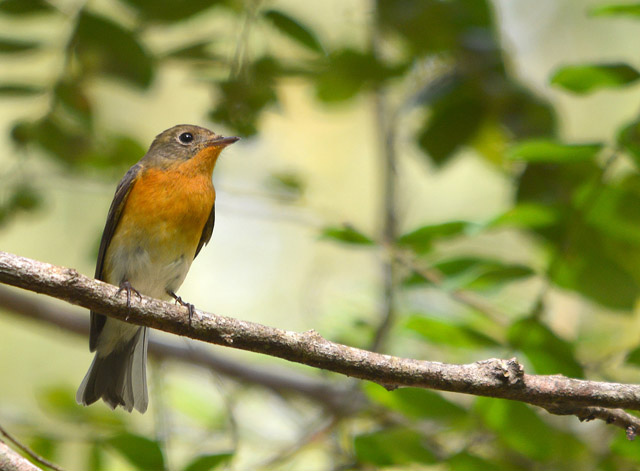
It is often difficult to age birds accurately. Even sexing can be complicated at times. I consider it to be an art form and special set of skills are definitely required. I, however, do not possess such skills and I like to keep my birding simple. But it is not often one is surrounded by Mugimaki Flycatchers and I took the opportunity to attempt this tedious task. These individuals with brownish face and upperparts and lack any indications of a supercilium should be females.


One sported a deeper orange throat, more greyish face and upperparts and a faint supercilium should be a first winter male.


I may be going out on a limb here but I think this is also a young male...


Other than the flycatchers, a number of other bird species were also attracted to the fruits. Most did not provide good photographic opportunities. Either that or I was too preoccupied with the flycatchers. The Yellow-vented Bulbuls were present more or less throughout the duration of my visit.


Red-eyed Bulbuls were given exceptional attention not because of their status or anything like that. They forage rather cumbersomely much to the dislike of the delicate flycatchers. This will often put the latter to flight and hinder our photographic efforts.


Flocks of Crested Mynas patrol the garden grounds as they have been doing for the past decade or so. This species is the dominant myna here and from the look of things, will continue to reign for years to come.


Along the river bank, another regular species was going about its daily routine. In coastal habitats, the Striated Heron is prevalent and can occur in huge numbers. It also thrives in freshwater habitats but usually in smaller numbers.


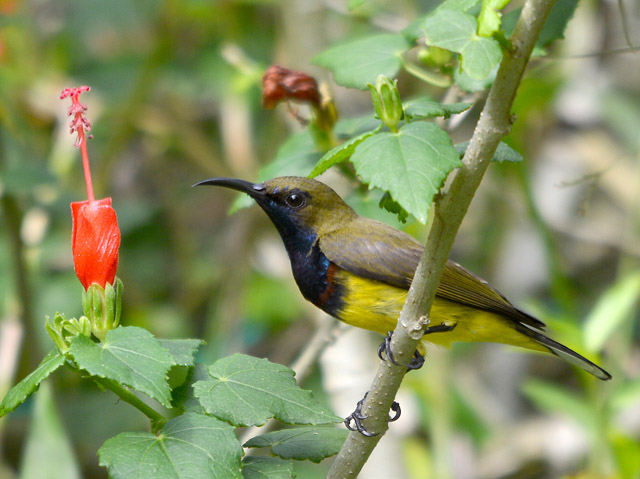
As I made my way back to my parked car, I stopped by a flowering bush that is usually patronized by sunbirds. True enough, there was a pair of Olive-backed Sunbird. I was utterly surprised not having to blame Murphy’s Law on this occasion because the drabber female appeared to be more wary of my presence.


Her handsome mate, on the other hand, fed without the slightest hesitance. The subspecies that occurs here in the north sports an orangey collar which can be indistinct at times. And the iridescent blue throat, despite being in good light, will only reveal its true splendour in certain viewing angles.  


The Penang Botanic Gardens is one of the best sites to marvel at the radiance of the male Crimson Sunbird. One was lingering about a bamboo clump but the lighting condition was less than desirable. The vivid plumage colouration could not be captured completely by a manmade device. Through my eyes though, he was remarkable and certainly a worthy species to close chapter of my birding journal.


ps. In case you wondering, the male Mugimaki Flycatcher managed to give me the slip again – exactly like my last season’s attempt at the very same spot.