Pages

Showing posts with label Wren-babbler. Show all posts

Wednesday, 13 July 2022

Well, what do you know...


There was a time when Cameron Highlands was a haven for both birds and birders. Fast forward to the present day and you will usually have traffic congestion greeting you upon your arrival, development everywhere and an unbelievable number of people present. In short, they brought city living up to this hill station. This trip was a family vacation more than anything else. For my better half, it was her first outstation trip since the lockdowns. The colours and fragrances of the floral gardens and the rolling hillslopes of the tea estates certainly had her attention. I naturally agreed to everything that was in her itinerary. Getting in her good graces in exchange for some birding time never once crossed my mind.


I managed (or should I say allowed) to sneak out twice during our stay here. The first was an afternoon affair and it was along an isolated road close to our accommodations. Hopping about the undergrowth was a small ball of feathers and I knew exactly it was. The ever-adorable Pygmy Cupwing was the first true montane species I encountered on this trip and I could not have asked for a better start. As usual, the skulking nature of the bird and the cover provided by the dense vegetation tested both my patience and photographic gear.


My lucky break came when the Pygmy Cupwing was done tormenting me and alighted on an exposed perch. In full view, it is undoubtedly a cracking bird. And I thought to myself perhaps there is still some magic left here after all.


The Lesser Shortwing is another skulker of the mountainous regions and its distinctive and melodious call is a common sound in this habitat. To enjoy good views, one usually has to work (or pray) really hard. And for my efforts this time, a view that I really should not complain about but the obstructing vegetation hampered what could have been a decent image of a handsome male bird.


Away from the hustle and bustle of Brinchang town and potentially a good birding area, I was grateful to have found this “local patch” to satisfy my birding addiction. Here the natural habitat remains relatively untouched and the sounds of Mother Nature filled the vicinity instead of human activities. It reminded me of the Cameron Highlands of old and the nostalgia brought back unforgettable memories of a teenage birder experiencing the avian wonders this place had to offer.


I froze when I came across an open space among the forest. There was a slender and black mammal lying on the ground in a distance and it appeared to be feeding. As I lifted my binoculars, I could hardly contain my excitement. However instead of a fearsome Black Panther as I so wishfully hoped for, it was just a domestic dog. Luckily I was alone and my pride, intact.


The Mountain Tailorbird, apparently, is no longer a Tailorbird but it is still a warbler. Whatever it is, this bird is difficult to photograph because it is restless and small. The individual I came across today was rather inquisitive and a little more confiding than usual. And I pulled every trick in the book to try to finally obtain some images of this montane denizen. The images obtained were not exactly award-winning material but it did not matter. This Mountain Tailorbird was the bird of the day for me.


Not only did I managed to photograph the Mountain Tailorbird but the little guy lingered around for quite some time before disappearing back into the forest. Initially, I did not expect much from this short excursion but it turned out to be quite the opposite. Like I always say, expect the unexpected when it comes to birding.


Flowering bushes will often yield the Black-throated Sunbird which is the only sunbird here in Peninsular Malaysia that has adapted to life in the mountains. And the iridescent throat, in certain angles, had yours truly gawking at one of the most easily encountered birds in Cameron Highlands.


A quick glance at my watch and it was time to head back. An early dinner with the family awaits at the famed night market of Cameron Highlands. And keeping your end of the bargain especially after a birding excursion, is one of the keys to a happy marriage. Despite that, a soaring raptor is almost impossible to ignore and this one turned out to be a resident Oriental Honey-Buzzard. To the unwary, it can be dismissed as the commoner Crested Serpent-Eagle because of the similarities in plumage.


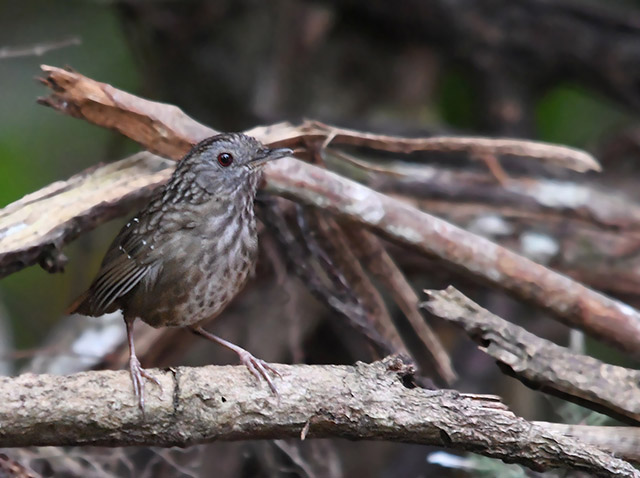
The next morning, I was blessed with another hour of birding and I arrived at my local patch at first light. The dawn chorus was absolute music to my ears and one particular call had my immediate attention. It belonged to yet another skulker of the undergrowth and effort was certainly required before I had visual of the Streaked Wren-Babbler. It was still dim and my photographic gear struggled to obtain some digital memories of this encounter.


Determination and luck eventually produced some decent images. It has been ages since I last enjoyed such views of a Streaked Wren-Babbler. Despite the urge to carry on with the excursion I could not bring myself to do it and continued to enjoy the performance.


The tail markings of the White-tailed Robin are prominent even when seen in a gloomy environment. However to appreciate the true splendour of a male bird, he has to be in enough light for his colours to shine. Which he was but only for the briefest moment.


I caught sight of some movement along the edge of the access road and proceed to investigate as discreetly as possible. When I was greeted by a clear white throat, it was none other than a Rufous-browed Flycatcher in search of breakfast. Then it dawned on me. Almost all the photographic opportunities here so far involved species that frequent the lower storey of the forest. And that is often not the case because these birds tend to be more elusive than their arboreal counterparts.


The Silver-eared Mesia to me is the perfect epitome for montane birding. Beautiful and charming, no visit to the mountains is complete without this common but stunning species stimulating your senses with its presence. And the Silver-eared Mesia was a fitting end to my birding quickies at Cameron Highlands. Although birding was not a priority this time, I enjoyed some fascinating moments with the birds that still called this diminishing paradise home.


Sunday, 15 April 2018

Good day, mate - Part 3


One of the reasons that Fraser’s Hill is such a haven for birding is the confiding nature of some of the resident birds. A few of the bungalows are known for the birds’ morning visits and several species can come together to forage on leftovers, handouts and insects attracted by lights during the night.


The Fire-tufted Barbet is huge by barbet standards. Combined with its striking appearance and signatory call, this barbet is certainly one of the star birds of this locality. The fiery lashes are usually hidden from view except when in close proximity. I try not to stare too long as they have a somewhat hypnotic effect – on me anyways.


Moving about in noisy flocks, the Long-tailed Sibia is one of the more conspicuous birds of hill stations like this. What it lacks in colour is made up with character. And a flock in search of breakfast is a delightful encounter.


I have yet to obtain any close shots of the male Black-and-crimson Oriole although I see it during most of my visits to the mountains of Peninsular Malaysia. Having no yellow at all in its plumage already makes this oriole unique and its skittish nature makes it a bird that I always keep a lookout for when I am in its neck of the woods.


There are little brown jobs that call this hill resort home but because of their less radiating appearance, they are usually ignored. The Buff-breasted Babbler is no ordinary brown job to me as it is uncommon where I come from. Even here, it takes some effort to obtain decent shots.


The evening sky brought the rains in and my Australian guests decided to have a little siesta before dinner. Despite the obvious setback, I wandered out on my own and tried my luck at the Malaysian Partridges’ tuft. When the rain trickled to a stop, my quarries strolled into view from the ravine below. I, just sat back and enjoyed the show.


However, there were no signs of the little bundles of joy like yesterday. It is possible that these birds are from a different flock as there is a healthy population of these endemic gamebirds here in Fraser’s Hill.


An explosive series of double note whistle echoed through vicinity from a nearby ravine followed by the calls of a second bird. A heightened sense of exhilaration overtook me. I now have two Rusty-naped Pittas calling persistently in front of me. Experience has taught me this is one of the most difficult and shyest birds to see. But I yearn for my first ever photograph of this terrestrial creature. I crawled my way into the ravine an inch at a time and waited patiently crouched like a rock. Leeches and God knows what else were no longer relevant. One of the pittas was just beyond a line of understorey vegetation. I lost track of time as the pitta proved to be as elusive as ever. Sweat began to trickle down my temple and my legs cramped up from this uncomfortable position. Then a rustling of leaf litter beyond my shoulder propelled the moment to the point of climax but when whatever it was making the noise finally came into view, it turned to be only an inquisitive Malaysian Partridge and not the Rusty-naped Pitta which I had hoped for. I looked down the ravine only to see the Rusty-naped Pitta hopping across and disappeared into the vegetation. Reluctantly, I hauled myself up the ravine a broken man.


The next morning, I was still reeling from the disappointment with the Rusty-naped Pittas. Failing to capture the Mountain Scops-owl and Grey Nightjar before dawn offered no relief at all. But this is Fraser’s Hill. A premier birding site in Malaysia. And you do not stay disappointed for long. The Sultan Tit is a living work of art and a pair was foraging confidingly in our presence. We, the humans were certainly humbled by its divine beauty. Insects attracted by the lights of the bungalow the night before often linger around well into the morning. That in turn attracts insectivores like the Sultan Tit.


It would have been the perfect start to the day if we were better positioned to capture the courtship feeding of this pair of Sultan Tits. But I guess there is a limit to the magic of this birding paradise.


A pair of Mountain Imperial Pigeons resting on a lofty perch slightly shrouded by mist was a picture of blissful serenity...


Swooping in from the adjacent forest, a pair of Common Green Magpies shattered that peace and quiet with their resonant calls. This is another resident that is a true gem of the montane forest. The sheer size of the magpie only amplifies its striking appearance. The availability of food enticed this usually shy bird right out into the open. At such close quarters, the Common Green Magpie is an impressive bird indeed.


With poise and grace, a few Lesser Racket-tailed Drongos hawked for insects in the vicinity. Unfortunately, only one had the long tail streamers. Sod’s Law then came into play and that particular individual somehow managed to evade all my attempts to photograph it.


Fraser’s Hill is not only about birds. It has so much more to offer as well. This trip, I managed to obtain some images of squirrels that roam the forest here. The Pallas's Squirrel is a commonly encountered species. A confiding individual had my attention momentarily and I managed to capture some of the best images to date.


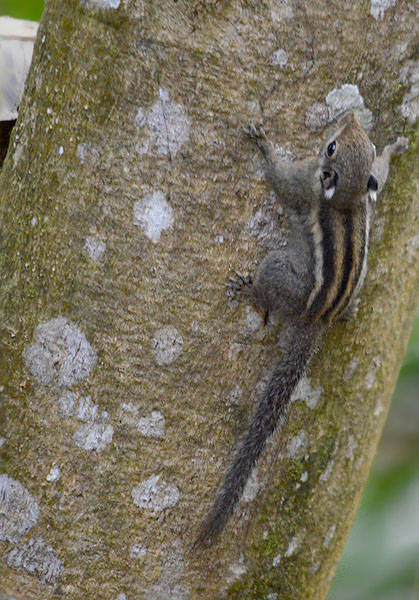
The Himalayan Striped Squirrel moves at hyper speed most of the time. Its diminutive size makes it adorable but it also makes it difficult to photograph. A pair were having a territorial dispute and in between the high speed pursuits around one particular tree trunk, the squirrels will pause for a breather. I took advantage of this repetitive behaviour to finally add this species to my digital collection.


My best moment in Fraser’s Hill this time took place on our last day. I decided to take my guests birding along the road that goes down to the Gap. There is one resident bird of Fraser’s Hill that has eluded me all these years and I have made it a point to mesmerize its call. As we made past a deep ravine, there was no mistake of what was calling down below – the elusive Marbled Wren-Babbler. Excitement soon turned to frustration as the calling bird remained hidden from view. Out of desperation, I descended the ravine and a brief view of my lifer moving deeper into the forest was all that I got in return.  A distant shot of a young Slaty-backed Forktail shortly after was very little compensation for my failure to photograph the Wren-Babbler.


We made one last visit to the stakeout where the White-tailed Robin frequents and were not disappointed. The male bird showed off his subtle yet enchanting colouration for our group to admire and appreciate.


The final bird for the Fraser’s Hill chapter is the Rufous-browed Flycatcher. A small bird that spends a lot time in dimly lighted undergrowth and with its soft high pitched song as the only indication of its presence. The puffy white throat does give the flycatcher some contrast to its plumage. However when seen in good light, it does boost enough appeal to earn some space in my memory card. From here, we headed down to the lowlands of Selangor where a whole different set of birds await. That will be covered in my next post.


Tuesday, 30 January 2018

It's raining rarities

I travelled all the way to the limestone hills of Gunung Keriang once again hoping for a more intimate encounter with the recently discovered Brown Fish-owls. I reached the locality way before day break and together with Hor Kee and Dr. Neoh, waited patiently for the celebrity birds to make an appearance while listening to the calls of other nocturnal birds of this recreational forest – the Barn Owl and Sunda Scops-Owl. Unfortunately, the Brown Fish-Owls reminded me how elusive they can be and offered only fleeting views as they made their way back to roost.

A pair of Streaked Wren-Babblers foraging confidingly at the foot of the limestone hill provided some birding excitement but it was little compensation for the disappointment with owls. This babbler is a resident of the montane forest throughout most of the country. However, a number of montane species are known to occur at sea level here in the north and this babbler is one of them. Dim lighting and the active nature of the babblers was a major hindrance for obtaining better images. But to observe these Streaked Wren-Babblers foraging among the undergrowth at such close proximity was good enough for this time.


As we were about to head to our next location, the tinkling notes of a Leaf-Warbler from the nearby bush was just to tempting to be ignored. While we were trying to ascertain the identity of the Sakhalin/Pale-legged Leaf-Warbler, an all-too-familiar call whispered through the undergrowth. I have had enough field experience with the Taiga Flycatcher of late that I would be able to recognise its rattling call anywhere. And there is one calling right in front of us. A stroke of good luck and a small gap in the vegetation enabled me to capture a record shot of this supposedly rare migrant but this is the second individual recorded this season.


It has been months since my last visit to the vast, sweeping landscape of Chuping. It is a unique habitat and the sceneries are often mesmerising like this image of a flock of Cattle Egret gliding low over a patch of aquatic mimosa plants before alighting to forage.


This birding hotspot is renowned for wintering raptors and it did not take us long to come across our first raptor. It was a beautiful female Pied Harrier and she has finishing up a meal next to the access road that cuts through this agricultural land. We observed her from a reasonable distance using our vehicle as a hide but we could not be sure what the prey was.


Whatever the unfortunately victim was, it was a hearty meal for the Pied Harrier. Her obvious extended crop was proof of that as she flew away.


A few other raptors were also recorded but most did not provide good photographic opportunities. This Osprey was seen hunting at a commercial fish pond and it may not be wise to risk incurring the wrath of the fish farmers. However this is not the first time I have seen the fish hawk here and I can only conclude the greater the risks, the greater the rewards.


A Common Buzzard was photographed here recently and although this scarce migrant is not new to me, it has been years since I last saw one. Unfortunately, all the buzzards recorded (there was a number of them I might add) were Oriental Honey-Buzzards and here is the image of the one that came the closest.


Birding along the vast grasslands could have been better and the one of the few birds that managed to find its way into my memory card was this tiny Zitting Cisticola proclaiming its territory from the top of a wooden stake.


We also came across a Brown Shrike making short work of a tiny frog it has just caught. An accomplished hunter with a feisty character, this predatory bird must be terrifying to all small vertebrates that share its wintering ground.


Posing for my camera when it was done feeding. That’s my boy...


However, the magic of Chuping should never be underestimated. A detour to one of the lakes provided the main highlight for this locality.


I twitched for Peninsular Malaysia’s fourth Tufted Duck back in 2013. Since then, there have been no other sightings. And now, we found ourselves ogling over a female paddling leisurely in the company of Little Grebes. That certainly injected excitement into the excursion.


It was a big lake and the lighting was harsh. There was almost no way to reduce the distance. A desperate and muddy attempt did get us slightly closer and we had to be grateful with what that was given and cherish the moment. After all, this girl is a rare record for Peninsular Malaysia and that is a whole lot to cherish.