Pages

Showing posts with label Sibia. Show all posts

Wednesday, 24 October 2018

Living colours (Part 1)


It is always nice to hear back from a guest again and a couple of years have passed since Paul’s first birding excursion with me in Malaysia. He hails from Costa Rica – a place where one regularly encounters such divine species like the Resplendent Quetzal. What could possibly trigger his return visit to this part of the world? Well during his maiden trip here, the Mangrove Pitta was sorely missed. And he still needs a Red-headed Trogon to stride closer to achieving his lifetime goal of photographing all the Trogon species in the world. It was doable assignment and confidence was high. All that was needed was another trip to the mangroves of Sungai Batu for the former and a road trip up to the montane forest of Fraser’s Hill for the latter. But after all these years, I still do forget that nothing is a sure thing when it comes to birding. Something that I will be reminded of harshly later in the trip.

Our 3-day birding adventure certainly did not start off well. While waiting to pick up Paul at the hotel lobby, overcast skies loomed with showers agonisingly poured from the heavens. Rain is and always will be one of the most dreaded elements in birding. Anyway, we travelled north to the mangroves as planned and hoped for the best. The Mangrove Pitta may not be looking its best now but it was still an exhilarating lifer for my guest. Compared to the last time Paul was here, getting the Pitta was like a walk in the park. A muddied park but the pitta was certainly worth getting a bit dirty for. It just goes to show again that not everything can go according to plan. But I am glad it did for the Mangrove Pitta this time.


With the first main target of the trip safely in the bag, the weather also improved slightly. Or it seemed that way. Paul has a penchant for brilliantly coloured birds and naturally, he could not resist the alluring beauty of the Mangrove Blue-Flycatcher despite having encountered this species before in his previous visit. Besides, it would a sin to ignore such an obliging individual.


I do think wagtails occur in Central America judging from the reaction of my guest when we came face to face with a Forest Wagtail. Strikingly marked and adorable, this common winter visitor received its due admiration as it swaggered about the swampy grounds.


By the time, we reached the windy Gap Road that leads up to the birding paradise known as Fraser’s Hill, it was already dark. It was an early night for the both of us in anticipation of the all-out birding that is to follow tomorrow. It turned out to be a clear and beautiful morning the next day. Fraser’s Hill is one of my favourite birding sites and I am sure I am not the only birder that feels this way. The cool mountain air, the lush landscape, beautiful architectures and most importantly home to an array of living colours in the form of feathered denizens. All these make Fraser’s Hill what it is.


We set out for the second main target of the trip but much to my dismay, the Red-headed Trogon proved to be elusive even from its usual haunts. Despite numerous attempts throughout the day, the closest we got to it was a lone bird calling from deep inside its forest domain. My work suddenly became much harder than I had anticipated. A male White-tailed Robin did his best to lift our spirits by foraging outside his gloomy domain of the forest undergrowth.


Some of the commonest birds of this hill resort sport brilliant plumage colouration. The Spectacled Laughingthrush is often taken for granted due to its common nature but to my guest, it was a sight to behold as this is his first birding excursion to a montane forest here in Southeast Asia.


The Long-tailed Sibia, like the laughingthrush, is just as confiding. It may be lacking in colours but the long tail and inquisitive nature make it another attractive species as well.


We have only a few endemics here in Peninsular Malaysia. Naturally, I take pride in showing off the Malaysian Hill-Partridge to all my foreign guests. This endemic game bird has been showing well at one particular stake out for the past few years and it did not take long for three of them to scurry their way into today’s highlights.


I sometimes still find it hard to believe that this bird used to be one of the most difficult to find and observe at this site. But that is in the past. Now with a little patience and the right timing, you will get to admire flocks of these amazing birds in their full splendour.


Joining the partridges, was a pair of Malayan Laughingthrushes. Slightly more cryptic and unobtrusive than the Spectacled Laughingthrush, it is still made up of a combination of colours that will capture your attention.  


The dimly-lighted lower storey of the forest is where the Large Niltava can be found. Even in the shadows, the striking colouration of the male bird is undeniable.


On those occasions when he does wander into the sunlight, the true splendour of this sizeable flycatcher will be revealed and it is spectacular. Even with those hideous rings on his legs.


The female on the other hand is a pale comparison to the male’s beauty. Only traces of blue can be found on her but the confiding nature exhibited by this girl deserves a space in my blog post. And she concludes the first half of our birding excursion to one of the most rewarding birding sites in Malaysia. The second half of this birding adventure continues in the next post.


Sunday, 15 April 2018

Good day, mate - Part 3


One of the reasons that Fraser’s Hill is such a haven for birding is the confiding nature of some of the resident birds. A few of the bungalows are known for the birds’ morning visits and several species can come together to forage on leftovers, handouts and insects attracted by lights during the night.


The Fire-tufted Barbet is huge by barbet standards. Combined with its striking appearance and signatory call, this barbet is certainly one of the star birds of this locality. The fiery lashes are usually hidden from view except when in close proximity. I try not to stare too long as they have a somewhat hypnotic effect – on me anyways.


Moving about in noisy flocks, the Long-tailed Sibia is one of the more conspicuous birds of hill stations like this. What it lacks in colour is made up with character. And a flock in search of breakfast is a delightful encounter.


I have yet to obtain any close shots of the male Black-and-crimson Oriole although I see it during most of my visits to the mountains of Peninsular Malaysia. Having no yellow at all in its plumage already makes this oriole unique and its skittish nature makes it a bird that I always keep a lookout for when I am in its neck of the woods.


There are little brown jobs that call this hill resort home but because of their less radiating appearance, they are usually ignored. The Buff-breasted Babbler is no ordinary brown job to me as it is uncommon where I come from. Even here, it takes some effort to obtain decent shots.


The evening sky brought the rains in and my Australian guests decided to have a little siesta before dinner. Despite the obvious setback, I wandered out on my own and tried my luck at the Malaysian Partridges’ tuft. When the rain trickled to a stop, my quarries strolled into view from the ravine below. I, just sat back and enjoyed the show.


However, there were no signs of the little bundles of joy like yesterday. It is possible that these birds are from a different flock as there is a healthy population of these endemic gamebirds here in Fraser’s Hill.


An explosive series of double note whistle echoed through vicinity from a nearby ravine followed by the calls of a second bird. A heightened sense of exhilaration overtook me. I now have two Rusty-naped Pittas calling persistently in front of me. Experience has taught me this is one of the most difficult and shyest birds to see. But I yearn for my first ever photograph of this terrestrial creature. I crawled my way into the ravine an inch at a time and waited patiently crouched like a rock. Leeches and God knows what else were no longer relevant. One of the pittas was just beyond a line of understorey vegetation. I lost track of time as the pitta proved to be as elusive as ever. Sweat began to trickle down my temple and my legs cramped up from this uncomfortable position. Then a rustling of leaf litter beyond my shoulder propelled the moment to the point of climax but when whatever it was making the noise finally came into view, it turned to be only an inquisitive Malaysian Partridge and not the Rusty-naped Pitta which I had hoped for. I looked down the ravine only to see the Rusty-naped Pitta hopping across and disappeared into the vegetation. Reluctantly, I hauled myself up the ravine a broken man.


The next morning, I was still reeling from the disappointment with the Rusty-naped Pittas. Failing to capture the Mountain Scops-owl and Grey Nightjar before dawn offered no relief at all. But this is Fraser’s Hill. A premier birding site in Malaysia. And you do not stay disappointed for long. The Sultan Tit is a living work of art and a pair was foraging confidingly in our presence. We, the humans were certainly humbled by its divine beauty. Insects attracted by the lights of the bungalow the night before often linger around well into the morning. That in turn attracts insectivores like the Sultan Tit.


It would have been the perfect start to the day if we were better positioned to capture the courtship feeding of this pair of Sultan Tits. But I guess there is a limit to the magic of this birding paradise.


A pair of Mountain Imperial Pigeons resting on a lofty perch slightly shrouded by mist was a picture of blissful serenity...


Swooping in from the adjacent forest, a pair of Common Green Magpies shattered that peace and quiet with their resonant calls. This is another resident that is a true gem of the montane forest. The sheer size of the magpie only amplifies its striking appearance. The availability of food enticed this usually shy bird right out into the open. At such close quarters, the Common Green Magpie is an impressive bird indeed.


With poise and grace, a few Lesser Racket-tailed Drongos hawked for insects in the vicinity. Unfortunately, only one had the long tail streamers. Sod’s Law then came into play and that particular individual somehow managed to evade all my attempts to photograph it.


Fraser’s Hill is not only about birds. It has so much more to offer as well. This trip, I managed to obtain some images of squirrels that roam the forest here. The Pallas's Squirrel is a commonly encountered species. A confiding individual had my attention momentarily and I managed to capture some of the best images to date.


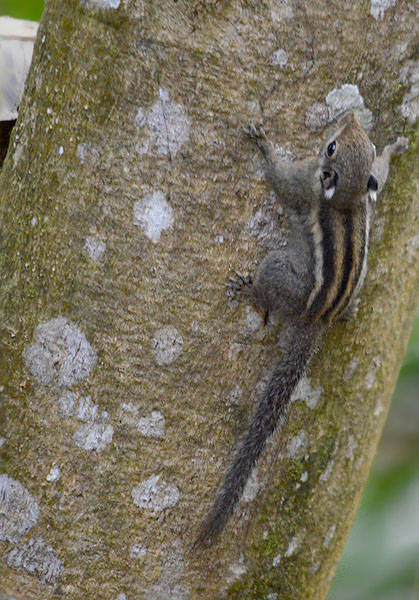
The Himalayan Striped Squirrel moves at hyper speed most of the time. Its diminutive size makes it adorable but it also makes it difficult to photograph. A pair were having a territorial dispute and in between the high speed pursuits around one particular tree trunk, the squirrels will pause for a breather. I took advantage of this repetitive behaviour to finally add this species to my digital collection.


My best moment in Fraser’s Hill this time took place on our last day. I decided to take my guests birding along the road that goes down to the Gap. There is one resident bird of Fraser’s Hill that has eluded me all these years and I have made it a point to mesmerize its call. As we made past a deep ravine, there was no mistake of what was calling down below – the elusive Marbled Wren-Babbler. Excitement soon turned to frustration as the calling bird remained hidden from view. Out of desperation, I descended the ravine and a brief view of my lifer moving deeper into the forest was all that I got in return.  A distant shot of a young Slaty-backed Forktail shortly after was very little compensation for my failure to photograph the Wren-Babbler.


We made one last visit to the stakeout where the White-tailed Robin frequents and were not disappointed. The male bird showed off his subtle yet enchanting colouration for our group to admire and appreciate.


The final bird for the Fraser’s Hill chapter is the Rufous-browed Flycatcher. A small bird that spends a lot time in dimly lighted undergrowth and with its soft high pitched song as the only indication of its presence. The puffy white throat does give the flycatcher some contrast to its plumage. However when seen in good light, it does boost enough appeal to earn some space in my memory card. From here, we headed down to the lowlands of Selangor where a whole different set of birds await. That will be covered in my next post.


Wednesday, 16 August 2017

Birding Marathon (Part III)

Since my main targets for the trip were securely in the bag, the final day of my birding marathon was conducted at a more leisurely pace. I even had time to soak in the breath-taking landscapes that surround Fraser’s Hill. I get carry away with my birding especially during long trips like this when I am far from my home state. Perhaps with age, I might be able to broaden my passion for other things as well. Perhaps there is more to life than just birds. Who am I kidding? It will always be the birds. Always have and always will be.


The Silver-eared Mesia is the rightful mascot for this hill resort. Colourful, charismatic and common throughout the locality; no visit to Fraser’s Hill is ever complete without encountering them. Our first locality this morning which was a bungalow compound, was literally overrun with flocks of Silver-eared Mesias. I think I can consider myself to be a seasoned birder but these cheerful birds still can get me all excited.


Birders often take them for granted. I am occasionally guilty of this too but not this morning. The Silver-eared Mesias were given their due admiration and affection. In return, the birds provided a display of colours and beauty that was simply spectacular and a bit nostalgic. As a kid, I often wandered when I will finally lay my eyes on the exquisite colours of this gorgeous bird. Since it only occurs in mountains along the Titiwangsa range, it took me a while. Anyway, it was nice to be momentarily transported back to those carefree days. Birding does not only excite but it rejuvenates as well.


The Long-tailed Sibia is a common sight here as well. What it lacks in colour is made up with grace and charm. The sight and sound of a flock in flight, that marks their arrival each time, can never be mistaken for anything else. At rest, it is an exquisite looking bird but it suffers the same fate as the Mesia because of its common status.


Chestnut-capped Laughingthrushes were everywhere as usual and yet I still cannot resist taking a shot or two. What can I say? I am easily smitten by anything with feathers especially those that look like this.


The shyer Malayan Laughingthrush usually requires a little more effort in order to capture its image. One was seen foraging in the open and it brought out the colours of this Malay Peninsular endemic. Due to its preference for the gloomy lower storeys and slightly wary nature, the subtle colouration of this bird is often concealed. A moment to admire its true beauty was the natural thing to do.


A lone White-thighed Langur casually moved alongside the bungalow and momentarily distracted me from the birds. Animals living in the mountains tend to be more confiding than their lowland counterparts and this docile mammal does not seem to mind the attention it was receiving.


A sizeable bird glided down from the canopy and no optical aid was required to identify it. The Fire-tufted Barbet is the biggest barbet in Malaysia with eyelashes that will put most ladies to shame. It certainly had my undivided attention. At such close proximity, the Fire-tufted Barbet is truly impressive. Rare birds are always exciting but for me, sometimes even the common birds are capable of escalating my senses to ecstatic levels as well – especially when they perform remarkably well like this barbet.


The Fire-tufted Barbet wanted to make sure it was the star of this little patch and provided views from the front as well. And I would be a fool not to oblige.


A stroll along the more isolated roads away from the weekend crowd produced a few small bird waves. However, the only species that found its way to my memory card was a pair of Blue-winged Minlas. Not all that uncommon, this plain but attractive tree babbler can be seen combing through the vegetation of montane forest in small flocks. This pair was at the canopy level when they were spotted and inevitably, photography was challenging. There was a particular shot I took with strong backlight that surprisingly, caught my fancy.


The Rufous-browed Flycatcher seemed to be everywhere today as well. If it I was up to me, I would have named the bird with something to do with the conspicuous white throat. Even from the depths of the understorey in which this flycatcher makes its home, the first thing you will notice is the white throat. Anyway, I find this species adorable and delighted that the population is thriving here.


It rarely visits the higher storeys of the forest and that makes it an ideal subject for photography. Lighting conditions can sometimes hinder your efforts but luckily, we had very little issue with this today. In fact, these may be my best images to date.


I wish I could say the same about another little brown job but the Buff-breasted Babbler was wary throughout our stay at Fraser’s Hill and seldom offered any photographic opportunities.


The Pygmy Cupwing got the better of two grown men last evening and we just had to give it another try. We positioned ourselves the best we could and waited. But the juvenile Lesser Shortwing was the first to arrive and this time the lighting was so much better. The more I look at it, the more this youngster gained my affection. Its confiding nature had a lot to do with that as well.


A second Lesser Shortwing made an appearance and this one was an adult female. The juvenile did not receive any motherly love from this new arrival. In fact, they got into a bit of a squabble at one time and I can only assume, there are no blood relations between the two.


As for the Pygmy Cupwing, it did show up eventually but like last evening, was in no mood to be photographed. The Lesser Shortwing and the Pygmy Cupwing may be somewhat similar in appearance and thrive in the same type of habitat but their personalities were as different as night and day. On one occasion, the Cupwing stood still slightly longer than usual. I managed to squeeze the shutter once and was surprised to see the image being reasonably good. Gotcha!


As my 3-day birding marathon came to a close, Victor suggested we be normal tourists for a moment and immortalized this incredible trip by taking a photo of ourselves at the iconic clock tower of Fraser’s Hill. It was certainly incredible and the 800-km round trip was worth the effort. The drive back from long trips always give me ample time to reflect. And I certainly had plenty of reflections of wings and inspiration to ponder upon courtesy of this time’s birding adventure.