Pages

Showing posts with label Goshawk. Show all posts

Saturday, 13 June 2026

Not so ordinary garden birds...


My birding endeavours take me to all kinds of locations ranging from spectacular mountain tops and lush tropical rainforests to bleak coastal mudflats. However, there is one type of habitat that I will try to avoid and that is habitats with humans. Wherever there are humans, there will usually be situations. Situations that I can do without when I am enjoying my birding. I guess there is some truth when some consider me to be somewhat anti-social but I will not be losing any sleep over that. Before I carried away with this, I better get back to the birds. That is what this blog is all about after all. A quiet neighbourhood in the outskirts of Taiping became the centre of attention when the presence of Common Hoopoes was discovered. This enigmatic species is still considered rare here in Peninsular Malaysia with irregular records throughout the years. I have personally recorded this species as far back as 2003 and it is not new to me. But at this particular location, it appears to be thriving and that is good enough a reason for a visit.


With my companions Hor Kee and Rodney, we arrived at our destination just after dawn. The first bird that caught my attention was a Crested Goshawk surveying its domain from a lofty perch. This stunning raptor was a great way to start off the day and I began to develop a good feeling about this modest location.


A pair of Oriental Pied Hornbills compounded the feeling as they wandered about the housing area. No matter how many times I have recorded this species living alongside humans, it still evokes the same amount of excitement.


I guess the same can be said about Lineated Barbets but on a lesser scale. Well, very few things in life can rival the awe of hornbills and that is the brutal truth. From the look of things, the barbets have also found sanctuary here and the population is set to increase.


A lone Asian Openbill casually foraging within a house compound certainly took me by surprise. There is no doubt this species has come a long way since when they first started to colonize Peninsular Malaysia back in 2010. But this cool fellow is taking it to a whole new level.


Pink-necked Pigeons occur even in my own home compound and I would find it odd if I do not come across them here. Here is a male feeling a little dismay that the lighting condition and my photographic effort did not do much justice to his true appeal.


Another common species of built-up areas is the Asian Glossy Starlings. Electrical cables are predominant in any housing area and birds have a tendency to use them as perches. For birders, this behaviour eases our main mission in life which is to find and observe.


For a bird photographer, these man-made perches hold little value for their photographic effort. This applies to even a striking species like the Blue-throated Bee-eater. In my eyes (and the bird’s), the cable is a strategic point for it to launch aerial assaults on flying insects. If it good enough for the bird, it is good enough for my camera.


The Red-whiskered Bulbul is a species you do not get to see in a lot of neighbourhoods. So, it was heartening to see one here. There is a possibility of escapees for the beautiful bird as it is a popular cage bird. Either way it will not cause any major scientific impact if I get the status wrong for this individual.


I stated earlier birds on cables are more conspicuous and to proof my point, that is how we got our first Common Hoopoe of the day. This may be normal sight in neighbouring countries like Thailand but in my own, it will take some getting used to.


Eventually, we managed to locate a flock of at least five birds consisting of adults and sub-adults as feeding still took place within the flock. During my documentation of the birds, I could not really tell any differences between the birds. All of them were striking and charismatic.


When I scrutinized my photographs back home, I noticed that all the birds I shot had slightly shorter bills. Only then did I realize that maybe both the adult birds managed to evade my photographic efforts.  


The discomfort of a “human-habitat” started to take its toll and we shifted to the second destination of the trip which is the foothills of Bukit Larut. Soon after our arrival, we were greeted by the diagnostic territorial call of the Banded Broadbill. It took a little effort but the result was rewarding. Often hidden by the cover of the forest canopy, a good view like this is a real godsend to me.


I could not believe it when another broadbill species decided to show well after the first encounter. The Black-and-yellow Broadbill can be confiding at times but the individual today has surpassed that point.


The full black collar indicated that it was a male bird and that feature is only the difference between the sexes. He is a truly exquisite creature of the forest.


A few fruiting trees in the vicinity were in season and they attracted the usual groups of bulbuls. Among them was a female Blue-winged Leafbird and she was the only that managed to find her way into my memory card.


The Verditer Flycatcher is a species that I have not seen for a long while now. When one decided to hawk for insects nearby, I was elated. It may be the duller female but the prolonged encounter was fair compensation.


I know I always lament how frustrating forest birding can be but apparently, not today. Another female bird provided a memorable encounter and she was a Raffles’s Malkoha. Initially she played hard to get, typical of most desirable ladies. On a more serious note, malkohas are usually difficult subject for photography and the Raffles’s Malkoha is no different. But the good girl performed unexpectedly well in the end and made every birder present fell head over heels for her.


Here is one final image of the alluring Raffles’s Malkoha to wrap things up this time. The foothills of a colonial hill station and a surprisingly birdy neighbourhood certainly rose up to the occasion and provided ample material for another entry to my birding blog.


Saturday, 15 May 2021

The urban hawk


A bird may be common to the entire country but if you do not come across it often enough it can be considered, in a sense, rare. There are hardly any records of the Crested Goshawk here in Penang Island. I cannot recall having seen one personally except for a fresh corpse in the outskirts of Georgetown City. Recently, a pair was reported to be nesting in a posh neighbourhood in the northern part of the island. I rarely question the ways of nature but the reason for the nest to be built on a lone tree growing from the divider of the main road instead of the safety of the adjacent forest, is beyond my comprehension.


I managed to make a single visit to pay homage to these beautiful birds of prey. This should be the first recorded nest for the island and hopefully, it will not be the last. Elsewhere in the country, the Crested Goshawk has adapted to living in urban areas and that trait alone can ensure the continuality of your existence in the world today. It was the dry season and the fallen leaves left the nest exposed to all the surrounding elements. But the two nestlings, days away from leaving the nest, appeared to be doing absolutely fine.


Another aspect about this nest that got me wondering was the tolerance of the local mob. Flocks of House Crows can be seen loitering about the vicinity but surprisingly, these marauders left the chicks in peace. Perhaps the parents manage to assert their dominance but it will take a whole lot to break the will of House Crows.


One thing that was not unexpected was the presence of birders and photographers at the nest site. Since it was smacked right in the middle of a residential area, we in turn drew the attention of curious onlookers. Although it is not really my cup of tea, I did my best to explain the significance of this raptor nesting here to all that approached me with the same query.


The parent birds did not make an appearance during my observation and I found out later that I arrived shortly after they have fed the chicks. In the absence of the adults, the youngsters make several short explorations of the surrounding areas in preparation of the big day when they will leave the nest for good. They have yet to develop the full aesthetic appeal and living skills of their parents but they certainly had my attention. After all, they are the true reason for my visit here.


Lately, there have been an uproar regarding unethical photography of nesting birds. It is nothing new and has been going since the first day people started nest photography. However the great lengths poachers and photographers used to obtain their goals this time, reignited the issue. My documentation of the Crested Goshawk took place almost 3 months ago and the chicks by now, are out there somewhere terrorizing small birds and mammals on their own in my beloved island home. I am no birding authority. Just a bloke who is passionate about birds and birding. So, here I am thinking out loud. If it has to take installing a barricade to keep your enthusiasm in check, then so be it. Perhaps in time, an imaginary barricade will do the job just as well. By the way, your fantastic images will still garner the same amount of likes even if you post them on Facebook or whatever online social media a few months later. And to conclude my post this time is this young Crested Goshawk that wandered reasonably close to my position.


Tuesday, 15 September 2020

Getting twitchie over a sharpie


The former mining pools of Malim Nawar is probably the location for most, if not all of my pure twitching trips. And this time, it is for a Sharp-tailed Sandpiper – a rare migrant to our shores. It was a cold and gloomy morning. To make matters worse, it started to drizzle just as Hor Kee, Michael and I were about to complete our two hour drive from Penang. When we finally reached the spot, we found ourselves staring at a huge semi-dry fish pond. Our target is a relatively small peeps. This is certainly a muddied version of the needle in a haystack saying. And no matter how stunning the view may be, I do feel my spirit lifted. Only a particular little wader that breeds in the northern tundra will be able to do that.


There were other waders present like Wood Sandpipers and Long-toed Stints. As most waders in winter plumage look quite similar especially in a distance, their presence were distracting. A huge number of Black-winged Stilts were out foraging throughout the pond and the possibility of a Pied Stilt (a recent addition to the Malaysian checklist) did cross my mind but a quick scan at the stilts revealed nothing out of the ordinary.


Anxiety soared as our target remained elusive. Sharp-tailed Sandpipers usually do not linger long at a stopover during passage. This twitch was beginning to put our skills (and patience) to the test. Ever since a camera joined my birding arsenal, I do not carry a scope anymore. Luckily, Michael still does and it took some good old fashion birding to save the day. As soon as he had his scope up, he found the ‘Sharpie’ foraging leisurely at the edge of the exposed mud. And Malim Nawar once again provided a successful twitch for me.


Here is the Sharp-tailed Sandpiper in comparison to the smaller Long-toed Stint. When seen together, the differences are obvious. However when seen alone and taking into consideration the possibility of hallucinating some some non-existing field marks, it is a different story altogether.


The lighting was less than desirable and the privileged guest was quite a distance from the access road. There was undoubtedly room for improvement with the images that I obtained. But I was elated. In light of all the hindrance caused by the Coronavirus pandemic, I was not even sure there could be any lifers for me any time soon. The Sharp-tailed Sandpiper was confiding enough I suppose and the prolonged observation made the experience a memorable one nevertheless.


With the lifer safely in the bag, I started to focus on the other waders present. One other certainly had my attention because it is usually shy by nature. The Greater Painted-Snipe is somewhat crepuscular and it is one of the few bird species in the world where the gender roles and even appearance is reversed. Anyway, this male was foraging quite comfortably right out in the open and that is something I do not see very often. I guess it would be pushing it to hope for the more striking female to make an appearance.


The Asian Openbills which have settled in well in the north are also finding this locality ideal. I managed to photograph one that was doing what it does best and that is to extract a meal out of a snail using its highly-specialized bill.


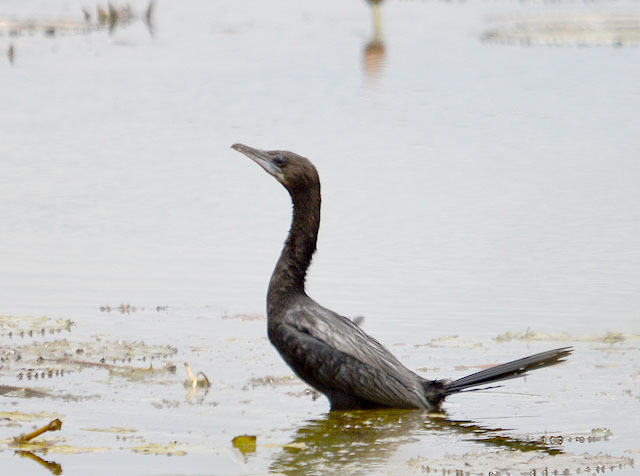
Another recent colonizer to Malaysia that is thriving here is the Little Cormorant. Although we did not get many photographic opportunities, this flying bird provided a sufficient souvenir for our trip.


One would think that after my trip to Cambodia I would not be so easily excited by the presence of an Oriental Darter. However, this sleek waterbird is rare here in Malaysia and one perched at a far distance still had my undivided attention.


No visit to this area would be complete without coming across the Grey Herons. Although, these majestic waterbirds are also found in my home state, I still find them intriguing. Birding, after all, is not always about rarities.


Grey-headed Swamphens (yes, another split) were given their due attention because we recorded the first Black-backed Swamphen in Malaysia quite recently. As with the stilt, there was no cause for celebrations. Only wishful thinking.


A feral Water Buffalo looking undeniably intimidating and it is not all bark and no bite for this occasionally ill-tempered animal. Thus, it has my respect which is rarely given to any semi-domestic animal.


It is alarming to find Javan Mynas outnumbering every other myna species here in Malim Nawar because the same thing could well take place back home in Penang. Not only are they displacing the locals but they are also attempting to ‘breed’ them out as several hybrids were seen. If this is not considered an invasion, I do not know what is.


As for the Zebra Doves, they went about their daily routine peacefully oblivious to the threat that the Javan Mynas now pose to a few of their fellow residents here.


I do not think I will ever get bored of the Stork-billed Kingfisher especially one as confiding as this individual. Just look at that bill...


Unbelievable as it may seem, the kingfisher was outdone by an unlikely species – a Crested Goshawk. In northern Peninsular Malaysia, this stunning raptor does not come by often enough for me and even when it does, it is exceedingly shy. This is the closest I have ever approached a Crested Goshawk and it was a moment worth savouring.


The only drawback was the awful lighting condition and there was not another single angle from which I could truly capture the beauty of the goshawk.


As our group was feeling luckier than usual, we decided to test our fortune at a slightly similar habitat closer to home for an equally rare peeps. The Pulau Burung landfill has been visited by the Pectoral Sandpiper before but luck can only take you so far. It would take nothing short of a miracle to bag these two rarities on the same day. A confiding Little Cormorant was the only consolation from our efforts of scanning the shallow ponds surrounding the landfill.


A tree full of Little Cormorants in the state of Penang is a sight that will still take some getting used to for me. The population has certainly flourished here and gone are the days when any cormorant is a rare occurrence.


Just like the Grey Heron, the Purple Heron still had what it takes to tickle my fancy. I guess being a big and beautiful water bird will make it easier to garner my affections.


It was a picture of serenity with this flock of Lesser Whistling-Ducks resting at the marshlands of this landfill. Their numbers are climbing again at this major stronghold and that is a good sign. The Lesser Whistling-Duck may be dull when compared to other ducks but it is still the only duck that can be regularly encountered in my neck of the woods.


Birds are not the only wildlife thriving in this environment. Reptiles like the Water Monitor Lizard has found sanctuary here as well. Some have grown to impressive lengths like this individual slithering about the river bank. This giant of a lizard wrapped things up for a great day out in the field as a successful twitch is one of the most exhilarating aspects of birding.