Pages

Wednesday, 18 August 2010

17/08/2010: Sungai Sedim (Kedah)

When news broke out of a fruiting fig tree at the car park of this locality was being patronized by hornbills for a couple of hours on a daily basis, I was both excited (because you don’t come across an occurrence like this every other day) and frustrated (because I was tied-up with work and other matters – even on the following weekend) at the same time. Anyway, this was way too big a thing to be missed especially when it is taking place in one of my usual birding areas. I took leave from work as soon as I could and made my way to the locality with Choo Eng who has had the opportunity to observe the hornbills on three separate visits since then. Upon our arrival, much to my dismay, we were greeted by an “empty” fruiting fig tree.


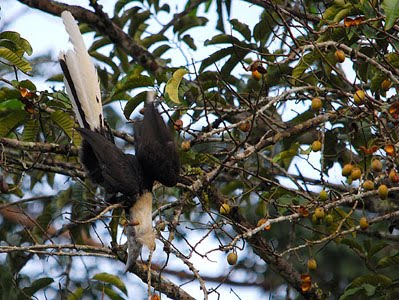
We then took our time to set up position and hoped for the best. All my disappointment and sorrow immediately vanished the instant Choo Eng alerted me of the presence of a family of 3 White-crowned Hornbills on the fig tree. I was somehow distracted by something else and the hornbills managed to slip past and landed on the fig tree. I did not even hear the diagnostic wing beats typical of this family of birds. After years of pain-staking effort to try and get close to these wonderful animals, I was finally the chance to photograph them up close and personal as they gorged themselves on the Myristicaceae Figs. And no, I did not suddenly become an expert on plants and I still know very little about identifying them. I got a little help from the Forestry Department as the tree was labeled with this name. Although this particular hornbill is not new to me, the encounter is certainly one that I cherish for life. This is the stunning adult male bird with the white underparts.
Despite of the fact that the Rhinoceros Hornbills (which are the more regular patrons to the fig tree so far) did not turn up at all, one word can sum up the whole experience – AWESOME.
This is an immature male that is gradually attaining his adult plumage. Young birds will usually perform better for the camera and this fellow was no different as it went about feeding without the slightest worry of our presence.
And this is the third member of the flock and it also looks like an immature male as well.
However, my moment in sun came to an abrupt halt when a worker wandered to close to the base of the tree while performing his maintenance duties and put the hornbills to flight. Well, in life not everything will go exactly as you have planned or hoped. You just have to roll with the punches.
After the hornbills disappeared into the forest, I hung around the area hoping for them or any other hornbill to come flying back in. During the wait, I had a flock of Red-eyed Bulbuls to keep me occupied…
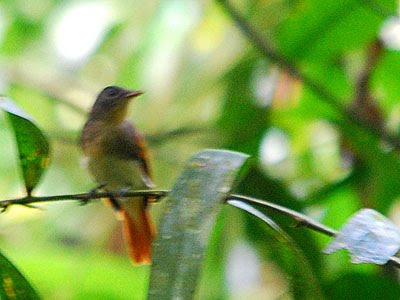
As well as a foraging Asian Brown Flycatcher that has probably just arrived from its breeding ground up north.
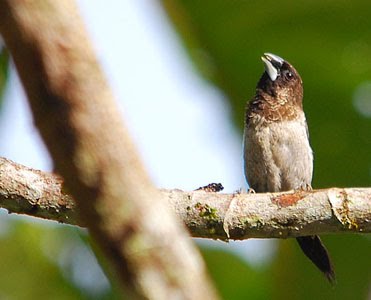
This White-rumped Munias were rather wary of my presence and kept its distance most of the time…

But ever-present Pacific Swallows played their roles to perfection.
I eventually gave up on the hornbills and joined Choo Eng for more birding along the access road next to the river trail. Sungai Sedim may be well-known among the local birding community for its birds but for the adventure seeking community, it is rafting down the ferocious white waters…
As usual, the forest residents were making me work really hard to obtain good images like this Chestnut-breasted Malkoha.
A Green Iora foraging just below the foliage of the canopy is no piece of cake either.
Neither was this foraging male Ruby-cheeked Sunbird.
Luckily, the Plain Sunbird that was feeding on the same tree cut me some slack…
But when it all do come together, you will get a overwhelming sense of satisfaction like what this confiding female Banded Kingfisher provided me - the success of capturing one of Mother Nature’s gems permanently in my memory and photography gallery.
Both the Black-winged and Bar-winged Flycatcher-shrikes were seen on this particular trip.

The Scarlet Minivet is by far one of the most striking birds of the forest. A male bird darting around reminisce a burning arrow cutting through the forest vegetation. Unfortunately, this species spends most of its time in the canopy levels and photographic opportunities are far and few. So when this male foraged lower than usual, I helped myself to a few reasonably good shots.
The female, however, was little more reluctant to follow her mate.
An adult Rufous-bellied Eagle is always a welcomed sight due to its attractive plumage.

We can only guess that this aerial maneuver was an unsuccessful attempt to capture swifts in mid flight. Either that or this fellow is simply a show-off and wanted to give 2 tired birders a good performance.
When an animal dropping suddenly seemed to have a life of its own and started to move by itself, a chilly feeling ran down my spine. After all, it is now that time of the year when the Chinese celebrated the month of the hungry ghost. It is like Halloween but the gates of underworld will remain open for the entire month and not just for a day. My mom used to discourage me from birding during this period of time because of all the wild and lonely places I to go in search of birds and nowadays, the responsibility seems to have been passed down to my wife. Anyway when I regained my composure, there can only be one logical reason for the phenomenon – the Dung Beetle. The dropping was so big that from certain you just can’t see the beetle at all. These little workers of the natural world are simply amazing in terms of strength, tolerance and determination. I guess to each its own when it comes to survival and that includes us humans too.
A flycatcher that was foraging among the dense mid level of the forest captured our undivided attention because we were having a tough time identifying the species. Its active nature and the dim lighting conditions only made matters worse. After much scrutiny, it turned out to be a male blue morph Rufous-winged Philentoma. This colour morph is considered rare when compared to the typical male and it is the first for the both of us. Here are a few shot taken by Choo Eng who always seems to be faster with the camera than yours truly.
The appearance of a female bird later on helped us to confirm his identity.
Monday, 26 July 2010

24/07/2010: Bukit Wang (Kedah)

I decided to bring my godfather along for a trip to this locality. I thought maybe this place can put an end to the "drought" (of bird photos) that I have been experiencing during my past few birding trips as this forest reserve always has something up its sleeve for every trip so far. Anyway, I thought my godfather would rather enjoy the birds and beauty of the locality.

Unfortunately, the trip produced very few birds when compared to previous trips. Even one of my favourite spots along the access trail failed to deliver because of the noise level produced by the on-going rebuilding works of a hut. It is times like this that I truly miss my beloved migratory water birds. It is a long 2 months before any of them will show up again. Anyway, back to the trip. A female Dark-throated Oriole foraging along the canopy is never an easy target.

The resident Bat Hawks provided some consolation although they were resting beyond the reach of my camera for any great shots...

This is not exactly my cup of tea but when things are slow, you tend shoot anything that vaguely resembles a bird...

This female Scarlet Minivet allowed me to take a few shots of her before she foraged higher up in the canopy.

Monday, 28 June 2010

26/06/2010: Sungai Sedim (Kedah) & Penanti (Penang)

I arrived at the car park of this recreational forest just after dawn and I found that I was not the only one that was up and about. This Crested Serpent-eagle was already contemplating what to have for breakfast from a vantage point at the edge of the car park.
And so was this Finsch’s Bulbul. Although the lighting was still quite dim, the yellow throat was clear enough for me to make a proper identification.
I decided to take the trail up Gunung Bintang and the weather condition was much better than I had expected considering the previous days of rain back in Penang. Although the trip was great in terms of birding, photography was another let down. The Maroon Woodpecker, Rufous-collared Kingfisher and Orange-breasted Trogon provided tantalizing glimpses but not photographic opportunities. And don’t even get me started on the 3 species of Hornbills (Wreathed, Rhinoceros and Helmeted) that I managed to record during this trip.
If your ear drums haven’t experience the far-carrying territorial call of the Siamang before, then I guess you haven’t been to a Malaysian forest because it is certainly one of the most diagnostic and loudest sounds produced by any animal found there.
Around midday, I decided to call it a day and made my way home. However, I made a quick visit to Penanti as it was along my way back. As usual, I was greeted by the loud and distinctive calls of the resident Red-wattled Lapwings.

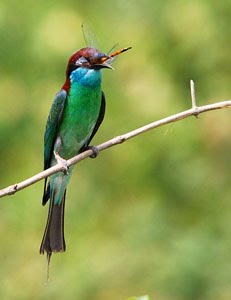
The Blue-throated Bee-eaters provided the photography highlights for the day.
I found a few sub-adults in the vicinity as there are still traces of its juvenile plumage and the elongated central tail feathers were not yet fully developed.
They may be called Bee-eaters but here in Penanti, I guess Dragonfly-eaters would be the more appropriate name…
And this is how you enjoy a Dragonfly for lunch….

Monday, 14 June 2010

12/06/2010: Kupang-Gerik (Perak)

The entrance to this locality has changed tremendously since my last visit. The Bat Hawks’ nesting tree now stands alone as most of the other big trees have been logged away. There is a new rest stop facility near the entrance as well. As this is an active logging area, the change in habitat is expected but not the rest stop - not to me anyway. As Choo Eng and I gradually move deeper into the logging trail, the piercing rays of the early morning sun started sending the mist back into the heavens.

The timing was just nice as a flock of 6 Blue-rumped Parrots filled the vicinity with the distinctive metallic calls as they flew about the vicinity. When the flock decided to alight on a nearby tree, I had a feeling that today is going to be a good one and it was because we managed to record over 70 species in the end. I have numerous encounters with this species in the past but this is my first good opportunity for photography.
As they bask in the sun and preen to their hearts content, we were delighted to find them rather confiding as well. We had ample time to go about the bottom of the tree to find the best angle for our photograph session. I don’t see myself as the kind of guy that will easily fall for cute little animals but for these adorable parrots, I’ll make an exception. The red bill and absence of blue on the head region suggest that this is fellow is an immature male.
Here an adult male sporting the diagnostic bluish head for comparison…
The Little Cuckoo-dove is not an uncommon species but it is very difficult to get close to them. I managed to capture this lone individual when it alighted on distant tree to rest. I reckon this is a male bird as females tend to have more barrings on the breast.

A male Whiskered Treeswift taking a break from its aerial sallies for insects.

This time, we recorded an unusually high number of Streaked Bulbuls around. In fact, I think this is the most I have seen from a single locality. We counted no less than 20 birds throughout the day.
The Scaly-breasted Bulbul is one of the most stunning representatives of this usually drab-looking family of birds. Unfortunately, this flock kept to the top most part of the forest canopy.
Photographing small active birds foraging among the forest vegetation is a challenge to any bird photographer. For instance, you are bound to come across the Dark-necked Tailorbird in any forest and yet, I still do not have an image I can truly be proud of.
This Large Woodshrike gave me no chance at all to obtain reasonable images…
This Crested Serpent-eagle, on the other hand, was not the least bothered by our intrusion.
All these years of birding has made all my senses especially heightened towards flying objects. However, birds are not the only things that fly about. There are also dragonflies. This individual had exceptional striking colours and was quite co-operative to my camera.
As we made our way back to civilization, a trio of crows caught my attention as the thought of Slender-billed Crows crossed my mind. In the end, they turned to be just the commoner Large-billed Crows. Overall, I am quite pleased with the outcome of the trip and some of the more notable species recorded include a Wallace Hawk-eagle and Rufous-tailed Shama.