
This
year, Malaysia played host
to the annual Asian Bird Fair and it was held at the alluring island of Langkawi
in Kedah. MNS was the organizer for this international event and the international
delegates of the fair were given an optional post-event birding tour of the
country. I assisted Andrew, MNS's Head of Communications, for this 5-day
birding excursion and the road trip kicked off at the open grasslands of
Chuping in Perlis. Although we only had an hour to spare at this locality,
quite a number of birds were recorded including a few northern specialties and
a lone dark-morphed Booted Eagle - the highlight for this short visit.

The
reason for the time constraint was a lunch date with the wildlife department at
the Bukit Merah Laketown Resort in Perak. After lunch, it was a 3-hour drive to
Sungai Tengi in northern Selangor for dinner and board at a home stay facility
of the same name. The next morning, we gathered at the town hall before
proceeding to our next destination. There, we were treated to a pair of
Oriental Pied Hornbills - right in the middle of this small town. This is the
only species of hornbill that occurs within built-up areas. Even then, it is
rare in some areas and completely absent from my home state of Penang. So, it was not only the foreign birders that got
all excited but a local birder from Penang as
well.


Next
in our itinerary was the Sungai Dusun Wildlife Reserve - also in the state of
Selangor. The main reason for our visit here was the Tapir Conservation
program. As this trip was organized by MNS, it was only fitting that we all got
to know the MNS mascot a little better. The Malayan Tapir is a fascinating and
unique animal. The contrasting black and white colours may make it a striking
animal in captivity but it the wild, it helps to break its huge form and blend
into its surroundings.


There
was a baby tapir in one of the paddocks and its colours are completely
different from the adults to help it hide better among the forest undergrowth.
It was certainly adorable but during our visit, it did not move about much and
this was the only angle I managed to take.

Birding
was also good within the reserve with sightings of hornbills, woodpeckers,
cuckoos and raptors. At the end of our 3-hour excursion here, we recorded about
40 different species and the highlight was a fruiting tree near the paddocks
which acted like a natural bird magnet.

A
lunch date in Kuala Kubu Baru at the foothill of Malaysia's premier birding site,
Fraser's Hill, was the next program for the day. After that, it was the scenic
drive up Fraser’s Hill for 3 days of pure birding in a montane wonderland -
something the group has been looking forward to since day one.


Fraser's
Hill has always lived up to its reputation as one the best birding sites in
Malaysia and for me, Christmas came early in the form of a Large Scimitar-babbler. This montane species is not particularly rare but somehow it
has eluded me all these years. I finally got it on the last day and my fourth
attempt at the renowned Telekom Loop. I have no photos to show for this lifer
and you know what? It does not really matter. I was elated I managed to tick
off one of my two target birds. The other ‘bogey’ bird was the Marbled Wren-babbler. However on both my attempts at its favourite ravine along the old
Gap Road,
it rained. I took as a sign from above that my time has yet to come. I was not
totally out of luck with all brownish babblers and this lucky shot of a
Grey-throated Babbler seconds before it disappeared back into the undergrowth
is certainly a keeper. The distribution
of this nondescript species in Peninsula Malaysia is rather peculiar because
it is strictly a montane bird in the central and southern regions but in the
north, it occurs in the lowlands as well.

Another
babbler that I managed to capture quite decently this trip is the ever-common
Mountain Fulvetta. Despite its abundance in montane forests, its active nature
is a big hindrance with it comes to photography.

The
Blue-winged Minla is not what one would consider to be a brownish babbler but
the local race has the plainest plumage variance of all the races. You can
hardly even notice the blue on the wings.

Did
I mention Christmas came early? Of all the Broadbills that occur here in Malaysia, the
Long-tailed Broadbill is the most striking and enigmatic. I have numerous
encounters with this species in the past but I do not have any good images of
it as it is shy and keeps to the canopy level most of the time. A foraging
party across the ravine provided eye-level views but the distance was a little
too far for any really good shots. And to be honest, I was content with the
images I obtained from this encounter


I
would never have guessed that the following day I will come across them again
in roughly the same area. This time one came relatively low and I was humbled
and totally in awe with this true spectacle of nature that was perched right in
front of me. It was a priceless moment that will remain with me for the rest of
my life.


The
Fire-tufted Barbet is another striking species that occurs here and unlike the
broadbill, it is more regularly encountered. This time, it seemed to be
everywhere - not that I am complaining. The bright colours, the red bristles
from which the name is derived and the unique cicada-like calls are just some
of the reasons why it is a much sought-after species.


The
call of the Black-browed Barbet is very much a part of the sounds of any
montane forest in Malaysia.
Unfortunately, I failed to obtain good images of this common species despite
many encounters throughout the trip.

There
are a number of birds found here that possess appearances so unique and
remarkable that they can never be confused with any other species. This
devilishly striking bird that goes by the name of Sultan Tit is certainly one
of them.


When
it comes to spectacular montane birds, the Green Magpie is another fine example
of this legacy. Despite its large size, vivid colours and vocal nature, it is
not an easy subject for photography. It tends to move about in the canopy level
and dense vegetation. Close and unobstructed images are rare privileges. As
fate would have it, this trip I managed to photograph it in the open but the
poor lighting condition at the dawn hour prevented me from fully capitalizing
on this rare opportunity.


This
Orange-bellied Leafbird must be feeling a little smug because had me fooled
when it called exactly like a Javan Cuckoo-shrike and I called out the wrong identification
to the rest of the group. Are you happy now?

Woodpeckers
are well represented in the montane forests of Malaysia. For this trip, the
Yellownapes provided memorable performances for the duration of our stay at
this hill resort. The Greater Yellownape is the larger of the two species -
naturally...

The
Lesser Yellownape is slightly smaller in size but possesses just as much
attitude and charm as its bigger relative.

Come
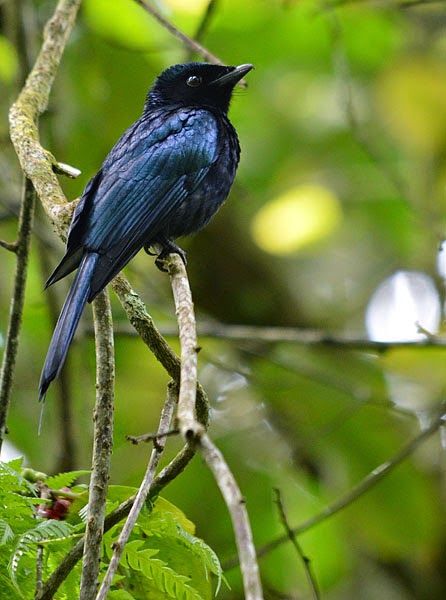
to think of it, dark blue seems to be the colour for montane birds here in Malaysia. The
most conspicuous of them is surely the Lesser Racket-tailed Drongo. Large,
noisy and hunts in mid-flight, it is very unlikely to miss it whenever it is up
and about. This one has lost one of its rackets...

This
one, on the other hand, has no rackets at all…
I
have noticed a drop in the sightings of the Large Niltava during this trip. In
fact, my only record came on the last day at this hill resort. This species
sports a brilliant blue plumage and you just have to take my word for it as
this back-lit image does no justice to its colours.

More
often heard than seen, the Lesser Shortwing is a minute thrush that never
leaves the cover of the undergrowth. A true skulker by nature, this was my best
effort despite a prolonged period of begging and persuasion to get it to come
out into the open.

The
Rufous-browed Flycatcher also finds refuge among the undergrowth but luckily,
it has more of a ‘showy’ personality and open perches are not much of an issue. Not all that uncommon in the hill stations but it is usually their soft whistling notes that give away their presence.


This
old landslide spot seemed to have something of interest to a flock of Everett's White-eyes.
These tiny, hyperactive balls of feathers are a real challenge to photograph
especially when they are in their elements along the canopy levels. This is the
first time I have seen them so low and staying put longer than usual. I took as
many shots as I could and hoped for the best. Here are some of the better
images obtained.


Jelai
Resort's compound used to a bird magnet as the lights from the resort at night
attracts insects which in turn attracts birds when morning comes. And the
resort employees also feed the birds. Now closed for almost two years, some of
the birds do occasionally pass through but not in such big numbers and
varieties as before. The Silver-eared Mesias still recall the good life they
used to enjoy here...

And
the Chestnut-capped Laughingthrush wonders when the good life will return to
Jelai Resort. So does most birders that had the good fortune of experiencing
the birding at this spot in the past.

As
the name suggests, the Mountain Bulbul is strictly a montane species and is
relatively common at all the hill stations. I always feel that images with
birds facing the camera somehow lose their appeal to me (with the exception of
owls). Anyway, this Mountain Bulbul was in a nice position but I only managed
one single shot before it flew away.

No
visit to Fraser's Hill is ever complete without encountering one of the
commonest birds of the locality which is none other than the Black-throated
Sunbird. Common it may be but the iridescent colours of the male bird never
ceases to dazzle and amaze.

There
is a slight possibility that one may miss the sunbird but there is no way one
can miss its close relative, the Streaked Spiderhunter. Abundant in all hill
stations, it is a slightly larger bird and extremely vocal. Birders tend to
take it for granted because you can see it everywhere. But in terms of beauty,
I think it holds up pretty well for itself.

Fraser’s
Hill does not only provide sanctuary to birds. There is a rich variety of other
wildlife that calls this little piece of heaven on Earth home. A group of wild
piglets foraging among the undergrowth next to an isolated access road got my
immediate attention. Initially, all I could only managed were glimpses of
something sizeable and brownish. Alarm bells went off in my head. I could
almost visualize the oscillation of the Mountain Peacock-pheasant through the
dense vegetation. Then, out came a snout and the rest as they say, is history.

We
were unsuccessful with owling for this trip but it was not a total loss. The
smaller residents of this montane forest provided some nocturnal entertainment.
Tarantulas are still common in Fraser’s Hill. Although they are not as huge as
some as their South American counterparts, they still look intimidating enough
to earn our respect.

The
Trapdoor Spider is not as fortunate because their population is on the decline.
That is a real shame because this spider is truly a wonder of nature. For the
benefit of those you are not familiar with the Trapdoor Spider, it builds a
lair (which is a burrow on the mossy hill slope) lined with web strain that will
help detect potential prey as them move over the strains. The lair comes with a
lid, hence the name trapdoor.

When
prey is detected, the Trapdoor Spider will spring out from its lair and usually
makes short work of the unfortunate victim. Here is an image, taken without any
“coaxing”, of the spider out of its lair.

This trip will go down as one of the best in my book. Not only were the birds performing well but to actually be a part of this group of fine birders from all over Asia and beyond. The experience, knowledge and friendship shared was very much the highlight of the trip as well.


