Pages

Sunday, 21 December 2014

Gulls galore...


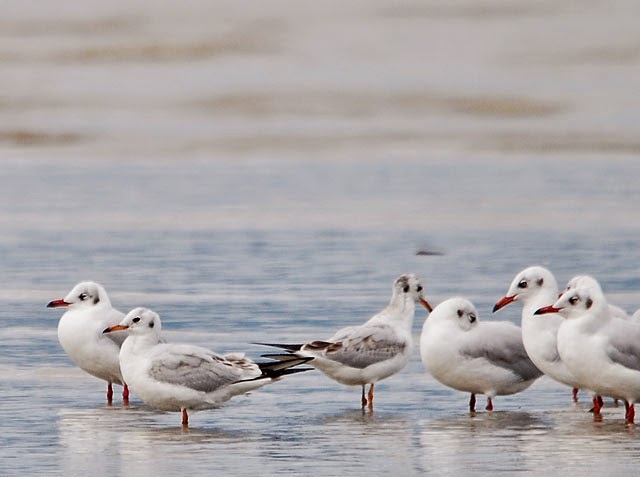
First of all, please do not let my title of this post give you a wrong impression. Gulls are uncommon here in Peninsula Malaysia. In fact, most of them are extremely rare. Of the handful of species that occur in our waters, only the Brown-headed Gull can be considered to be a regular winter visitor. It is locally common at only a few sites and the Bagan Belat coastline in mainland Penang is one of them. Numbering up to 40 strong at times, this species is no stranger to the birders here including yours truly. Now, the second commonest gull around is the Black-headed Gull. Both species are remarkably similar-looking especially in non-breeding plumage but there is one major difference - the latter is a rare migrant.


I was truly excited when Hor Kee found a juvenile Black-headed Gull among the flock of Brown-headed Gulls at the Bagan Belat coastline recently. I had no photographic evidence of my sighting of this species in the past at this locality as well and this individual, that seemed to have settled in quite comfortably here for the winter, presented me with an opportunity to make things right. It took a couple of trips before I finally managed to get close enough for a reasonably good photo session. Upon further scrutiny, I found not one but two juvenile Black-headed Gulls among the flock of Brown-headed Gulls. Christmas came early for me this year!   


The size is probably the most distinct difference for two species at rest but it is only helpful when both are present. When seeking confirmation of the identification of the celebrity gulls later back home, Dave pointed out that if the outermost primaries are completely white below, it is the Black-headed Gull. And that made life a whole lot easier…


Midway through my observation, one of the Black-headed Gulls drifted away from the flock and when for a swim…


In flight, the Black-headed Gull is distinguishable from the adult Brown-headed Gull (left) by the absence of the "mirrors" enclosed within the dark primaries. 


Another adult Brown-headed Gull in flight showing off its signature underwing pattern…


Juvenile Brown-headed Gulls are even more similar to the Black-headed Gulls and they even have the same dark-coloured irises as the latter instead of the pale irises of the adult birds – another characteristic that is used to tell adult gulls apart.


The "mirrors" are also absent from juvenile Brown-headed Gulls. So, it boils down to the outermost primaries again to differentiate young gulls. 


Here is a comparison shot of the juveniles of both species. Young Brown-headed Gull (left) can be lighter built at times and look so similar to the Black-headed Gull that they could have been passed off as siblings. Isn't gull identification such a joy...


This Black-headed Gull making sure I do not put it down as a juvenile Brown-headed Gull by flashing its completely white outermost primaries...


When the initial thrill started to wear off, I diverted my attention to the commoner Brown-headed Gulls. I must admit the adults are quite attractive even in non-breeding plumage. 


The Brown-headed Gulls sensing that the limelight is now on them started to put on a really good show for a very contented waterbird addict. I spend a whole lot of my time scanning the coastlines of Penang for birds and to me, this is about as good as it gets when it comes to gulls. 


Wednesday, 17 December 2014

Patience is a virtue (13/12/2014)


The recent sighting of a Zappey’s Flycatcher (a recent split from Blue-And-White Flycatcher) and a Black-headed Gull, both of which I have seen only once before in the past but without any successful photographic attempts, at the northern parts of mainland Penang helped me to decide for this week's birding excursion. My first destination was the swamp forest of Air Hitam Dalam for a scarce but stunning migratory flycatcher. 


After a thorough sweep of the area, I had to come to terms that the Zappey’s Flycatcher may not be around anymore. Another blue flycatcher that was certainly around was the resident Mangrove Blue Flycatcher. Along a more secluded part of the elevated boardwalk, I came across at least 3 individuals. This was the first male that crossed my path. 
 

This confiding fellow was the second male sporting a more typical extended range of orange underparts.


A lone female that has been following the males could be the mate of one of them…


A possible third male was seen among the undergrowth about a few feet away from where I observed the first batch of flycatchers earlier on. 


A small fruiting tree just outside the Management Office provided one of the highlights of the trip. Surprisingly, the fruits only attracted two species and apart from a few Olive-winged Bulbuls, there were Lineated Barbets. This barbet is more of a scrubland and mangrove species rather than a true forest dweller and this locality, is one of its strongholds. I have longed to photograph this barbet for quite some time now but without much success as it prefers the canopy levels. But today, the tempting fruits got the better of its security senses and I was presented with the opportunity for a most rewarding photo session. 


In the absence of other species at the fruiting tree, it became the star bird and that held my undivided attention for a good half an hour. And just like that, every bird suddenly took off and it was only me and the fruiting tree left. Thank goodness I have obtained more than enough photos of the barbet before its abrupt departure. 


The Green-billed Malkoha is the largest Malkoha in Malaysia and should be named the Long-tailed Malkoha instead. Like any other malkoha, it does not make an easy subject for photography. Despite its size, it is extremely agile and active. It scurries about the canopy levels like a giant squirrel. I almost lost it when all my efforts so far to capture a few shots were futile as it was always and somehow blocked by the vegetation. Even when it was stationery, it made sure I had something to curse about by resting in a partially hidden position. 

But like the words immortalized by Guns N' Roses in their song, Patience - "...take it slow. It’ll work itself out fine. All we need is just a little patience..." And finally, the Green-billed Malkoha decided to hop onto an open perch for more than 30 seconds with the lighting just about right. I can still recall the first time I saw this species. There was a pair of them and they flew right across the path of a teenage birder on one of his very first MNS organized field trips. Those gravity-defying tails certainly made an impact on his retinal receptors then. 

The swamp forest here is a haven for winter visitors and passage migrants alike. This season itself a few rarer migrants have found their way to this locality and today, I came across a confiding juvenile Crow-billed Drongo. Not really rare but I have yet to obtain any good images until today that is. 


It was following a pair of foraging Plaintain Squirrels - much like the Greater Racket-tailed Drongo's obsession with foraging Long-tailed Macaques. The principles are the same - the foraging mammals will unintentionally flush out prey for the Drongo. And supposedly, the Drongo will keep a lookout for harm in return. However, it seemed quite oblivious to my presence. Or perhaps it knew that this human with the telephoto lens pose no threat to either of them. 


At the mudflats of Bagan Belat, my next destination, a flock of Brown-headed Gulls resting reasonably close to shore was exactly what I was wishing for. Sure enough, I picked out a smaller individual from the lot through my bins. Hor Kee's Black-headed Gull was still around. Unfortunately, the gulls suddenly took flight and alighted on the far end of the mudflats. I am not sure if it was because of my over-zealousness to get closer for a shot or something else but the celebrity gull was now well beyond the reach of my gear. Worse of all, I could not picked it out from the crowd again.

While contemplating of a way to get to the gulls, a passing military helicopter spooked everything present into flight. Well, almost everything. The gulls remained where they were - as expected. 


A flock of Pacific Golden Plovers showing their displeasure towards the big iron bird's intruding and inconsiderate presence. Not that I blame them - the plovers, that is...


A reptile slithering along the exposed mud at a far distance got me all excited. Will this finally be my first wild crocodile? Nah, it was just a monitor lizard doing its best impersonation of a crocodile. I guess spending too much time under the hot sun will eventually get to you. I took this as my cue to leave - before I start seeing Pied Avocets (a dream Peninsula Malaysia's first record for yours truly) foraging at a distance. 


My final destination of the trip was the paddy fields at Kubang Semang. One of the best ways to go round the vast networks of gravel trails is by bike and I was on my faithful iron steed today. She does not only help me weave through the horrendous traffic of Penang Island with ease but takes me places where four wheels simply cannot. Well, you know it was a slow day at the paddy fields when I had the time to photograph my ride instead of birds. 

Friday, 12 December 2014

Trust your instincts (06/12/2014)


The long but awesome 5-day birding trip with the international delegates from the Asian Bird Fair is finally over. It was time for the long drive back alone to Penang from Fraser’s Hill and I thought it would be best to make a stop somewhere along the way. Somewhere I could spend a couple of hours birding just to rejuvenate my senses. Somehow, the Kek Loke Tong Temple at the outskirts of Ipoh in Perak kept popping up in my head. The compound of temple does provide sanctuary to a number of birds including the temple thrushes – the Blue Rock Thrush. It is also about the halfway point for the journey home anyway. After considering a few other possible localities, I decided to follow my instinct took the Ipoh exit from the highway.


It has been a few years since my last visit and to my dismay, the temple thrushes were no where to be seen. During my last visit, the Blue Rock Thrushes were found in good numbers and very confiding. Like I always tell myself – never take things for granted and enjoy it while it last. Just as I was about to curse myself for choosing this locality, I caught some movement at the edge of the secondary forest. Upon further scrutiny, it turned out to be a Drongo Cuckoo. I decided to spend a little more effort with it as there was nothing else about. Much to my delight, it was quite confiding and I managed to obtain some really good shots.


Halfway through my observation, it flew down to the ground and caught something. The action was a little too quick for me and I could not determine what it caught and ate. From the ground, it flew up and alighted on an even lower perch, just under the crown of a dense tree.


I did finally find a Blue Rock Thrush as I was about to exit the temple grounds. It was a stunning male resting on a rocky outcrop. The angle was a little steep and I had no choice but to make the best out of the situation.


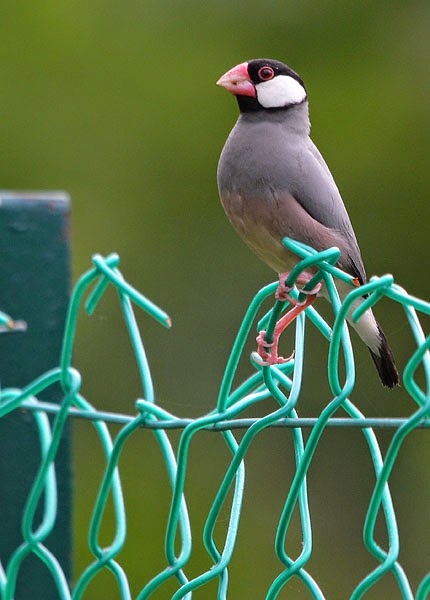
As I was driving along the outer perimeter fence of the temple, I thought to myself – well, at least I got a Drongo Cuckoo. Suddenly, a few small greyish birds flew across the path of my car and landed on the roadside grass straight ahead. I jammed on the brakes and had a quick look through my bins. My initial guess was right on the money – Java Sparrows! Locally common in only a few localities in the country, this area is one of its known strongholds. I have only one other encounter with this species and inevitably, I had a tough time trying to contain my excitement. Is it possible for sparrows to be sexy? If they look like this – absolutely!


Soon, I realized there was a small flock of them around and I slowly drifted my car towards them. The sparrows appeared quite comfortable with my stationery vehicle and I also made myself comfortable and proceeded with the photo session. I concentrated most of my efforts on two particular individuals that appeared to be more confiding than the rest. They seemed to have a thing for the perimeter fence and frequently alighted on it. No doubt that the fence is a man made object but if my subjects have no issues with it, why should I? 


It was only natural that I ignored the duller juvenile until I started to breathe normally again. Don’t worry, bud. It's your turn now...


At one point, they did alight on natural perch and I must say the image turned out better than expected. So, the detour to this temple cave was the right decision in the end. I should learn to trust my instincts more often in future.