Pages

Wednesday, 25 February 2015

A good start to the Year of the Goat (21/02/2015)

This year my Chinese New Year celebrations are a little more extensive than usual. Lucky for me I still had a free morning for birding but with the time constraint, I could not afford to travel far and it was down to my usual haunts again. Seeing that Dave had a very exciting excursion at Sungai Sedim in Kedah recently (check out his blog posting here), I decided to try my luck there as well. Who knows, maybe the Year of the Goat will bring some good fortune to this Penang birder. It seemed quite appropriate that the first bird to catch my attention during this Chinese New Year excursion was a male Chinese Blue Flycatcher. It is an uncommon migrant to forested areas in Peninsula Malaysia and a great way to get things rolling. However, his preference for the gloomy lower levels of the forest made photography difficult.


The Ang Pow (red packet) I received from Sungai Sedim this year was when I came across a fruiting tree teeming with birds. Bulbuls formed the majority of the patrons and curiously the usually common Black-headed Bulbuls were no where to be seen this time. The equally common Red-eyed Bulbuls, on the other hand, did not even bother to conceal themselves at all in my presence.


The Cream-vented Bulbul is another commonly recorded species here and its pale iris is what usually distinguishes it from the Red-eyed Bulbul.


Gradually, the rest of the birds accepted me being there and returned to take advantage of this heaven-sent food supply. Looks like I am not the only gaining a few extra pounds during this festive season. The usually elegant-looking Ashy Bulbul may not be anymore by the time they are done judging from the way they were gorging on the fruits.


Sungai Sedim is one of the few strongholds of the uncommon Finsch's Bulbul and being extremely vocal, their loud nasal calls announce their arrival each time they return to the feast like a welcoming band.


I recorded a total of 12 different species of bulbuls on this fruiting tree but not all were tolerant of my presence and some even avoided my photographic attempts. The Buff-vented Bulbuls were certainly not one of them and provided me with some of my best images of this common species to date.


It is undeniable that most bulbul species look quite similar to each other in the field and sometimes you have to pay a little more attention to the finer details to get the identities right. For the Grey-bellied Bulbul, I do not think it is necessary at all.


Being one of the most striking of all our bulbuls, it stood out from all the shades of brown and grey that were present. Naturally, I was smitten by its beauty and paid more attention to it. I am only human after all.


But there is another whose beauty equals or even surpasses that of the Grey-bellied Bulbul and it is the Scaly-breasted Bulbul. Usually found in the canopy level, good photographic opportunities are hard to come by. The feast was a little too much for it to resist and I finally managed to obtain really good shots of this forest denizen from almost eye level.


The intricate patterns of the underparts as well as the contrasting colours of the upperparts make this bulbul one of the most beautiful birds of the tropical rainforest.


The Streaked Bulbul dropped in for a short while only but luckily I managed to capture one shot before its abrupt departure. Perhaps the tree was a little too crowded for its liking.


Foraging among the shadows was a small flock of Hairy-backed Bulbuls. I was certainly spoilt for choice this time round and waiting for these skulking bulbuls to come to more open areas simply did not cross my mind. There were just too many distractions around.


The adorable flowerpeckers were also in good numbers at the fruiting tree and a total of 5 different species were present. The Yellow-breasted Flowerpecker is commonly found in the forest here and it comes as no surprise to find one gorging on the fruits.


The similar-looking Yellow-vented Flowerpecker is not often encountered and the presence of a single bird did not go unappreciated.


There is always a sense of anticipation whenever you come across a fruiting tree because you never know what might show up next. Deep inside, you always keep your fingers crossed for a rarity to come along and today, one did. It was a gorgeous male Scarlet-breasted Flowerpecker and I have only seen this species once before at Maxwell Hill in Perak. It has been so long that I almost forgot the whirlwind of emotions that swept through me when I saw this species for the very first time. But when I saw the piercing red breast again today, it all came back to me and what a rush it was! Unfortunately, he was very shy and took flight as soon as I pointed my camera at him. And that was the last I saw of him.

My failure to obtain even a single shot of the Scarlet-breasted Flowerpecker was a very bitter pill to swallow. Luckily, a rather confiding male Crimson-breasted Flowerpecker was there to help ease my disappointment.


Almost just as striking as his rarer cousin, he certainly did not mind my presence as he helped himself to the fruits. I guess some are more easily seduced by food than others.


A pair of Dark-throated Orioles was also wary of my presence despite my best attempt to keep myself inconspicuous throughout my observation at the fruiting tree. The pulling power of the tantalizing fruits got the better of the male bird and he did come for a quick bite before returning back to the cover of the canopy levels.


I have recorded the Plaintive Cuckoo from this location before but only from the adjacent fruit orchards. When a small cuckoo alighted nearby the fruiting tree, I was certainly not expecting a Plaintive Cuckoo. Did word got round of this Chinese New Year banquet and has it even reached beyond the borders of the forest?


The Plaintive Cuckoo may be a little out of place in the dense forest but the migratory Hodgson's Hawk-cuckoo is right at home here. I could have easily walked past it when I made my way out of the forest if not for a pair of Little Spiderhunters that mistook the cuckoo for a real raptor and were mobbing it. Their persistent calls made me stop to look and only then did I realize the presence of the cuckoo. I may not be aware of its presence initially but it was certainly aware of mine.


A little bit of stalking got me slightly closer and I managed to take a few more shots before the cuckoo glided out of sight. Although I did not get to meet up with some old friends like the Malaysian Honeyguide and the Wallace's Hawk-eagle, it was still a great way to spend a Chinese New Year morning - among other feathered friends that have always been an important part of my life. 

Monday, 16 February 2015

It's raining men! (14/02/2015)

An invitation from Dave to meet up for some birding at Chuping in Perlis was a little too good to pass despite the fact that I had to leave early for home in the afternoon. The trip certainly did not start off well for me as traffic came to a total standstill along the North-South Highway just after Sungai Petani. A lorry transporting concrete beams spilled its load all over the highway. It took more than an hour to clear up the mess and I was at my boiling point limit by then. I know that I am not very patient on the road and I guess that is something I need to work on. A new resolution, perhaps?

Anyway, I reached my destination later than planned and quickly made my way to the ponds where Dave was enjoying a Pheasant-tailed Jacana. Lucky for me, the jacana was still around at that time doing what it was born to do - foraging on floating vegetation. It was partly hidden but with a little patience (which is never an issue when birding), I managed to obtain a few reasonable shots.


There were a few Yellow Bitterns foraging in the same area as well. I had my sight set on one of them but it adopted its defensive posture when I got too close. It was quite confident with this strategy and I was allowed to practically walked till the water's edge. You can't see me...you can't see me...


A Little Cormorant unknowingly alighted near our stationery vehicles to take a breather from the morning hunt. Being the shy creature that it is, the sound of our camera shutter immediately sent it flying to the far side of the pond.


It was certainly a bright and beautiful day and the lighting condition was near perfect when we came across this small flock of Cotton Pygmy-geese foraging in one of the ponds.


Although the flock consisted of youngsters, it was still an exciting experience as this species is not that common. It is absent from my home state of Penang and I do not have many photographic opportunities like this.


The lone male of the flock was not in his prime yet but he was a handsome bird nevertheless. Inevitably, I paid more attention to him than his slightly drabber companions.


The lighting was even good enough for my modest setup to capture some swiftlets in flight. Well, maybe not some but one image was quite acceptable by my standards. It was a Germain’s Swiftlet, I think…


A Manchurian Reed-warbler had our undivided attention for quite a period of time. Unfortunately, it lived up to its reputation of being one of the most skulking Reed-warblers known to men and only gave the faintest of glimpses as it moved about the reeds. The Oriental Reed-warbler again proved that not all Reed-warblers are such a pain in the posterior and posed long enough for its image to be taken.


It was dry and dusty along the network of trails that cuts through the grasslands. And we have had better days in terms of birding. We did not really try to locate the Brahminy Starling but it was not at its usual haunt. This Asian Pied Starling, on the other hand, was being its usual conspicuous self.


We spent some time flogging the grasslands for rare passerines. The Oriental Skylark continues to elude my life list. Only the common Oriental Pipits were recorded today despite a few exciting moments for would-be Richard's and Blyth's Pipits. Richard, is that you? Dream on, human...


As for the raptors, only the usual suspects were present today. I only got round to shooting this female Common Kestrel which glided above us at the noon hour.


The army was conducting training at one end of the grassland and we made sure we avoided that section. A military plane flying low over the vicinity momentarily diverted our attention from the birds. And all of a sudden, the sky was filled with paratroopers. It was raining men at Chuping. This place is just full of surprises. Although it is non bird-related, it was still a first for me. Yes, this is the first time I have seen a parachute in real life. And judging from the crowd that started to form along the side of the main road, I am not the only one.


I still had a bit of time left after lunch and Dave managed to convince me to try for the Dusky Craig Martins at the limestone hills of nearby Bukit Jernih. This martin is the last swallow species missing from my Malaysian life list and after thorough search my life list remains as it is.


I would to take this opportunity to wish all those celebrating the Lunar New Year, GONG XI FA CHAI! 

Wednesday, 11 February 2015

Wherefore art thou now Rosy...(07/02/2015)

Dave and Hor Kee came back from a spontaneous weekday trip to the Kuala Gula Bird Sanctuary in Perak with an adult male Rosy Starling record. I have only seen this scarce migrant only once before and it was from this locality as well. But back then, it was just a dull-looking juvenile bird and incomparable to the beauty of the adult male that is worthy of a Shakespearean line. At the break of dawn the following Saturday I found myself scanning the very area the starling was last seen - naturally.


There were plenty of the usual starlings and mynas but no signs of my target bird. Despite a careful sweep, all I could find after an hour were more Jungle Mynas. Where is Rosy, bud?


A pair of Cinereous Tits foraged did come into view while I was waiting for the Rosy Starling but the strong morning sun at their backs and the distance did very little to cheer me up despite their adorable presence.


The Pied Triller is common even in built-up areas but I do not have many good photos of the striking male bird. So when a male happen to alight on the same tree as the Tits, I gave him his due attention.


The mangrove here is the stronghold of the Sunda Woodpecker. Like the Cinerous Tit, it is also a mangrove specialist and is an absolute delight to observe it going about its daily routine.


The majestic White-bellied Sea-eagle is always a sight to behold despite being one of the commonest eagles in Peninsula Malaysia. This individual seemed to favour a perch that was just next to the access trail. But the thing was it is quite skittish and every time a vehicle (or a birder) passes by, it will take off only to come back a few minutes later.


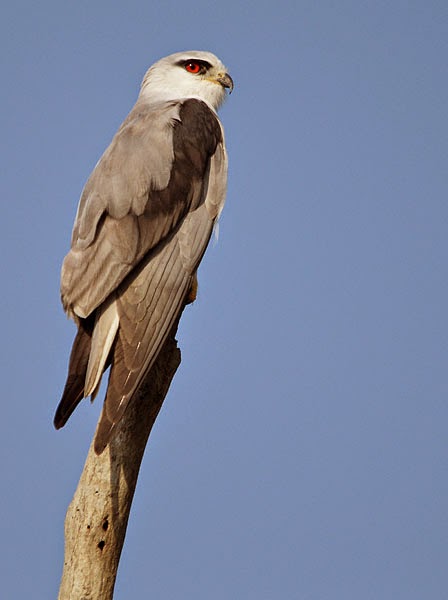
On the contrary, this smaller Black-shouldered Kite that was also perched on a dead tree next the access trail was not the least bothered by human presence. Its confiding nature provided me with some good images and this kite is one of the most elegant-looking raptors around.


During the migratory season, it is not hard to see five different species of kingfishers within the boundaries of this bird sanctuary. The Collared Kingfisher is the commonest one at this coastal hotspot and this pair looks set for the coming breeding season. Love is certainly in the air.


The Common Kingfisher is not as common as its name implies. It is a winter visitor to suitable watery habitats throughout Peninsula Malaysia but rarely found in big numbers.


The largest and loudest of them all is undoubtedly the Stork-billed Kingfisher. With a bill like that, it is almost impossible to miss this stunning species whenever it is around.


And talking about loud, the breeding season will signal the beginning of the persistent, almost to the point of being annoying, territorial calls of the Asian Koel. Anyone in Peninsula Malaysia, birder or non-birder alike, is familiar with the call of this parasitic cuckoo. I mean how can anyone not know the bird that calls loudly throughout the day and sometimes even through the night during the breeding season? However, hearing the bird is one thing. Locating it is another as it is quite efficient at staying out of view.


This exceptionally tame Striated Heron provided one of the highlights of the day. Undoubtedly the commonest heron in Peninsula Malaysia, it occurs in a wide range of habitats from the big monsoon drains of the city centers to the rivers of the lowland forests.


Because of their abundance, this species is usually ignored by birders and I am also guilty of this at times. But I find it hard to ignore any bird that is putting on a performance like this…


Large waterbirds are certainly one of my favourites and here, they are found in good numbers. On this particular trip, there were quite a number of Grey Herons in the vicinity.


The number of juveniles present is a good indication that this species doing well here indeed.


Kuala Gula is the one of the last few places left on Earth where the globally endangered Milky Storks still roam wild and free. The pure, wild birds are usually found deep in their coastal domain and the best way to see them is by boat. However, the Wildlife Department did some reintroduction programs years back and these semi-wild storks can be seen quite regularly near the park headquarters.


In fact, they are so accustomed to humans that they are actually like to be near human civilization.  At times, they can be as tame as domestic pigeons but they are still Milky Storks and some admiration is inevitable.


One last image to wrap up the trip and the honour goes to a confiding Garden Fence Lizard that posed so willingly for me. By the way, I found out at the time of writing that the Rosy Starling was seen again in the same area the day after my visit. Welcome to the wonderful world of birding...

Monday, 2 February 2015

Return of the openbills

A couple of weeks ago, I received an email from a British birder enquiring about birding around Penang. One thing led to another and soon, I found myself with a mother and son team of British birders at my local patch - the swamp forest of Air Hitam Dalam in mainland Penang on a beautiful Sunday morning.


This small area of birding delight has yet to disappoint any of my guests so far and it provided yet another memorable outing. The resident pair of Brown Hawk-owls had a lot do with the outcome. They were at their usual roosting tree and by now, are quite accustomed to human presence. Daytime observations of roosting owls are not a common thing but this locality is probably where you stand a better chance of experiencing them.


The Forest Wagtail is a common migrant to Peninsula Malaysia. However, I do not have much luck with obtaining their images but that was before this individual unexpectedly walked up to where we were standing and just stood there posing.  Well, are you going to photograph me or not?


Unfortunately, a lot of the images that I took had some blurred motion because the wagtail did not remain still for long. And I simply did not have the time to adjust my camera's settings. Either that or I was too excited. This was the best encounter I ever had with a Forest Wagtail and the bold markings that we normally take for granted, were simply mesmerizing at this close distance.


At noon, we were about to call it a day as this was only a half-day tour. However, Air Hitam Dalam had one last surprise for our group. From the car park, I could make out some all-too-familiar silhouettes circling in the sky above and it is a sight I have not come across for the past four months. The Asian Openbills have returned and all my worries about them moving on to another place for good can be put to rest. Although it is only a small flock of about 50-strong, it was still a breathtaking sight.


For the second day of their tour, the Vickers found themselves surrounded by the captivating sights and sounds of the tropical rain forest as we visited the Sungai Sedim Recreational Forest in Kedah. As it is their first time birding in such a habitat, it was a little overwhelming for them especially during the birdwaves. Thankfully for them, and me, some of the participants of the waves did remain still long enough for us to enjoy some good and prolonged views. This male Green Iora that was preoccupied with the meal at hand was certainly one of them. It is one of the many canopy-loving denizens of the rainforest here and close views are hard to come by. So, this encounter had both foreign and local birders quivering with excitement.


During a wave, you can easily overlook some of the birds. Several species frantically foraging for food can be very distracting and confuses their enemies and the birders alike. And if the bird is drably-coloured than the chances of it being overlooked is even higher. But there was no way in the world I could have overlooked this unfamiliar flycatcher that alighted momentarily on an exposed perch in front of us. It took a second for its identity to kick in but it was a female Green-backed Flycatcher - a scarce migrant that I have only seen once before. No wonder she looked unfamiliar!


On the way back from Sungai Sedim, I took my guests to a location that hardly seemed relevant for a birding tour - a motocross track. But to the local birders, this relatively unknown locality in Penanti in mainland Penang is one of the best places to observe bee-eaters. At this time of year, the Chestnut-headed Bee-eaters will be on hand to perform for any visiting birders.


It is a mystery why the birds choose this location to call home as they could have easily found similar habitats in adjacent areas. Whatever it is, they appeared to have found their little piece of heaven and so have the birders.


The Red-wattled Lapwing is not a bird you can easily miss. Being loud and colourful, it is one of the most conspicuous waders of the open country and a good bird to wrap things for this time.