Pages

Tuesday, 16 February 2016

No rarities, no problem (11/02/2016)

I have been quite consistent with my visits to the former mining pools of Malim Nawar in Perak during this time of the year. This locality does have a good record for producing mega lifers and I thought I will try my luck here on day 2 of my festive birding spree. The 200km drive was slightly taxing than usual due to my level of intoxication from last night’s festive drinking session. There have been records of the scarce White-shouldered Starling a few months back and I decided to start off today’s excursion from the spot where a pair of these migratory starlings were last seen. Luck was not on my side and despite a thorough sweep of the area; there were no signs of the starlings. So, I turned my attention to the next best thing – the uncommon Sand Martin. There is still some confusion about the true identity these martins and Malim Nawar is one of their regular wintering grounds. I am a simple man. Until, they find a way to differentiate the Sand Martin the Pale Martin (which is near impossible); they will all be Sand Martins to me.


At least 5 birds were present in the vicinity and they have a habit of resting along the wires, in the company of Barn Swallows, above the fish ponds. When compared to the latter, they are smaller and duller-looking but sometimes status supersedes everything else. With no way of getting any closer to the martins, I soon left them to their sunbathing and searched for other interesting species to document.


You are bound to see a few Cattle Egrets when birding in open country habitats like this. In winter, they are small and don their boring non-breeding plumage. Come spring and you will see an astonishing change for the Cattle Egret sports the most vibrant breeding plumage of all the egrets found here.


That remarkable breeding plumage is further enhanced when in full breeding plumage with the purplish hue to the lores and reddish glow to the legs. Exquisite is the word...


The Long-tailed Shrike is a beautiful bird and certainly beats the rest of the shrikes hands down. Unfortunately, it is also the shyest. I have come to a stage where I will not even attempt to try and reduce the distance for a better shot whenever I come across one in the field. Sometimes, God works in mysterious ways. I was not even trying today and the bird just happened to be along the route I was taking. To my astonishment, this Long-tailed Shrike did not budge. It still remained put when I raised my camera to focus on it. That’s more like it.


But the sound of the shutter must have struck a nerve because it flew across the trail after a few clicks. Luckily by then, I had already obtained my best images of this species to date. The lighting from this angle was better and the rays of the morning sun brought out the true splendour of the bird.


A colony of nesting Baya Weavers is not something you can easily miss. First of all, there is the presence of all those architectural work of art these birds call home. So amazing are these nests that are collected to be used as interior decorations. Unfortunately, these unscrupulous nest collectors lack conscience and humanity. Nests with fledglings still inside will not be spared and that just makes my blood boil. Secondly, the birds at a nesting colony tend to make a racket that can be heard from far away. There were at least 3 colonies within the area and I am glad this species is still doing well despite all the senseless prosecution.


As there was nothing much about, I took my time to observe a relatively new colony told by the big number of bachelor pads. Most of these pads are newly-constructed as they are still green. From these bachelor pads, all the hot-blooded males will sway, sing, shout and do whatever it takes to entice a female to join him. Not so much different from human beings, I guess.


This is the reason for all the activity at a colony – the dull female.


Once a male manages to find a mate, he will finish up the nest – turning his bachelor pad into a family suite. Again, this sounds very familiar. Anyway, this is what a completed nest looks like.


The Little Cormorants have settled in quite well to this locality. A handful were seen during this trip but they were extremely skittish and nearly impossible to approach even by car. These skilled fishers of birds were the only relatively uncommon waterbird that crossed my path today.


The commoner waterbirds, however, were very gracious and did a fine job hosting me during my visit. I absolutely adore Black-winged Stilts. There is always an aura of grace and poise about them. This male was so confiding that I could not help but to stop and photograph this common but striking wader.


It felt like there is a slight drop in the number of Grey Herons. In the past, I used to be overwhelmed by their sheer number. In fact, these large herons are one of the reasons I love this birding hotspot.


The same applies to the Purple Herons. It will be real shame if these two giants can no longer find sanctuary here in Malim Nawar. I could be a little paranoid but I have seen how these herons are losing grip of their home at the marshlands of Batu Kawan in my home state of Penang.


On the other hand, egrets like the Great and Little Egrets are finding life to be sunny and blissful here...


It is not that often a Greater Coucal allows itself to be photograph in the open. This cuckoo is shy despite its large size and common status. The deep booming call is frequently heard in a variety of habitats and is the best indication of its presence. Having said that, I guess having a few twigs in the way of my attempts to capture images of this skulker is not a big deal after all.


While taking a breather from intense searching for possible rarities under the blistering sun along the rows of former mining pools, a lone Eastern Yellow Wagtail wandered very close to my stationery vehicle. I certainly do not need any invites to start shooting this confiding individual. Now this is probably one of commonest passerines that spend their winter here in Malaysia. In suitable open country habitats, their numbers can be impressive. But a close encounter like this does help ease the disappointment of the lack of rarities for this trip.

Monday, 15 February 2016

Chinese New Year Feast (10/02/2016)

I have a few consecutive free days to kill for the rest of my Chinese New Year break. Thus began my festive birding spree. For my first day, I decided to go somewhere closer to home and it was none other than the forest at Sungai Sedim. The rationale behind this decision was to check on the status of the fruiting trees there. Victor, my old schoolmate, is back in Penang for the celebrations and joined me for this time’s excursion. It is good to know he is still very much into birding since the last time we met one year ago. While waiting him to arrive, I spent some time with the Whiskered and Grey-rumped Treeswifts at their usual morning hangout. The distance and lighting made it difficult for photography and the gathering of the treeswifts of Sungai Sedim will always be a spectacle best enjoyed through my binos.


Two of the locality’s regular fruiting trees have started to bear fruits but it will take a while for the fruits to ripe. My birding network has alerted me a few days back of an active fruiting tree along the Gunung Bintang trail and that was where were heading to. But mid way up the trail, we had to make a stop. A male Scarlet-rumped Trogon was calling from the forest edge and the bright red underparts stood out from the dimly lighted canopy level like a beacon in the night. It may be the commonest trogon but I do not think it is even legal to ignore such a stunning bird.


Red is an auspicious colour for the Chinese New Year and the presence of the trogon certainly brought good fortune to our excursion because we came across our second trogon species a short while later and it was a Diard’s Trogon. A pair was heard calling but despite a careful search, we only managed to locate the female. Although she was quite confiding, the dense vegetation prevented us from obtaining any better images. Don’t you just love shooting in the forest...


We almost had a third trogon species for the trip but the calling Red-naped Trogon just did not want to be seen today. Instead, we settled for a second male Scarlet-rumped Trogon. Not wanting to be outdone by its compatriot, it put on a good performance as well.


When we finally made it to the fruiting tree, Nelson was already busy shooting at the patrons of the tree. Three was not a crowd in this case and we made ourselves comfortable in our respective positions because from the look of things, we will be there for some time. The tree was aflutter with mostly bulbuls and flowerpeckers. The Red-eyed Bulbul is the commonest bulbul here and there will usually be a few at every suitable fruiting tree. Needless to say, they were gorging on the fruits here.


I am quite sure whoever named the Cream-vented Bulbul probably had his or her reason but the white iris is the distinguishing feature of the species and White-eyed Bulbul is an apt name in my humble opinion.


I have no qualms with the common name of the Spectacled Bulbul. It has a distinct yellow eye ring after all. However, it was exceptional shy today and kept to the furthest branches throughout our observation. It was a stark difference from their usual behaviour at fruiting trees. I guess birds, like people, have their mood swings too.


Ashy Bulbuls are generally shy and it came as no surprise when they kept their distance when feasting on the banquet.


The Buff-vented Bulbuls were one of the boldest today – coming right down to the lowest branches to gorge and completely disregarding the presence of the humans.


When it comes to bulbuls, the Scaly-breasted Bulbul is in a class of its own. The colour combination on the plumage of this bird can only be the work of divine powers and this beautiful representative of the bulbul family is worshipped by countless birders including yours truly.


But today, the divine Scaly-breasted Bulbuls were overshadowed by another colourful member of the bulbul family – the Grey-bellied Bulbul. It is a matter of personal preference but I feel the latter is just marginally behind the former in the looks department. It was their exceptionally confiding nature today that won me over. This time, they stole the limelight and even the Scaly-breasted Bulbuls had to concede defeat.


Quite a number of flowerpecker species were also gorging themselves on the fruits but the one that I was really hoping to see did not turn up – the gorgeous male Scarlet-breasted Flowerpecker. In its absence, the male Crimson-breasted Flowerpecker took center stage. Almost equally as attractive (personal preference at work here again), there were three males present today and at times, I could not decide which one to focus on.


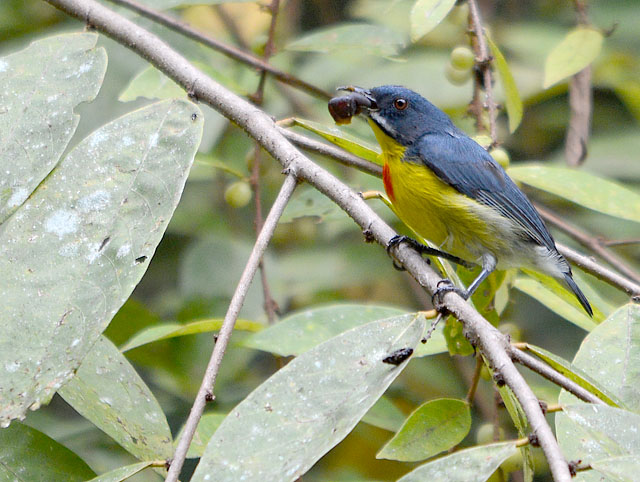
The male Orange-bellied Flowerpecker is another handsome devil and needless to say, had his fair share of attention today. Fruiting trees provide the best photographic opportunities to capture images of this little but striking bird. It applies to the rest of the flowerpeckers as well.


Not all flowerpeckers are brilliantly coloured but they still receive my undivided attention because some of the duller species are rare to say the least. Unfortunately, none of the rarer species made appearance but the common ones like the Yellow-breasted Flowerpecker certainly kept us busy.


The fourth species present at the tree today were the Yellow-vented Flowerpeckers. Although this species lacks the colours of some of the flowerpeckers, its strikingly marked underparts give it a certain appeal that is almost impossible to resist.


The distinct ringing call of the Everett’s White-eye filled the vicinity when a flock of these adorable birds descend upon the fruiting tree. The temptation of food can pull in all sorts of birds – even those that spend most of lives at the topmost canopy levels of the forest. That is one of the reasons I have so few images of this species. That, and the fact that it rarely stays still.


It is always exciting to find something other than the usual bulbuls and flowerpeckers at a fruiting tree here. Now, leafbirds do patronize fruiting trees but never with such consistency. The Lesser Green Leafbird is probably one of the rarer leafbirds here in Sungai Sedim but the excitement a pair brought to the tree was short lived as the male refuse to go anywhere near a slightly exposed branch. But his mate was a real sweetheart and provided plenty of good images.


I noticed last year of a male Green-backed Flycatcher that frequented fruiting trees here and since fruits are not part of his diet, it is the insects attracted to the fruits that he is after. When I saw male Green-backed Flycatcher flitting about the canopy level of the fruiting, it could very well be the same individual.


Not even an active fruiting tree can drown out what the locomotive wingbeats of hornbills does to me. Acting out on instinct more than anything else, my gaze and attention shifted to the sky above and just in time to capture a pair of Wreathed Hornbills passing through. A quick look at my camera’s playback was required to make sure it was not a pair of the rarer and similar-looking Plain-pouched Hornbills.  


On the way back home, I could not stop thinking about the Orange-headed Thrush at the Penang Botanic Gardens. Against my better judgement, I made a detour to the gardens and as expected found the tourist hotspot crowded. There was no sign of the thrush when I arrived at the spot I was it a few days back. I waited for about an hour but to no avail. A troop of Dusky Leaf Monkeys probably had a good laugh at my expense and seemed to be in no hurry to move on from the nearby trees. Well since it is the Year of the Monkey, I think they make a fitting end to another memorable birding excursion.

Sunday, 14 February 2016

A happy Chinese New Year indeed (06/02/2016)

The Penang Botanic Gardens is not exactly the kind of place that you will find me on a birding Saturday. No doubt it is a beautiful place with lush green landscapes and probably provides shelter to quite a number of birds. However, it is a popular tourist and recreational destination and it can get a little crowded at times. I do not consider myself to be antisocial. There is one thing though – I do prefer to do my birding in peace far away from all those stares and interruptions. It has been more than 25 years since I took up birding and yet, up to this very day there are still people who cannot grasp the thought of someone who loves and appreciates birdlife so much that he will travel far and wide just to observe and enjoy these wonderful and inspirational creations of Mother Nature.


I found myself walking alongside morning walkers at the break of dawn as I made my way to the Lily Pond section of the gardens. It must take a very good reason to risk exposing myself to the torments from my fellow human beings and it is an Orange-headed Thrush reported by a few birders that has been showing well at that vicinity. This migratory thrush may just be uncommon here in Malaysia but to me, it is rare as I have only seen it once before and with no photos to show. It was still dark when I reached the spot where the thrush was last seen and made myself comfortable on the narrow cemented forest trail and waited patiently for my quarry to show itself.


I did not have to wait long. The Orange-headed Thrush appeared out of nowhere and started foraging along the trail. There was enough light for me to enjoy the beautiful plumage of the thrush through my binoculars but my photography gear just could not cope under such conditions. Inevitably, I laid down my camera and just watched the thrush hopped along the trail (and into my heart) as it looked for breakfast while waiting for more light to pierce through the dense canopy. It was a stunning bird and its tolerance to my presence made the encounter priceless. The setting and close proximity brought back memories to a time when Penang Hill was still a birding haven. For a few seasons, a male Siberian Blue Robin would forage along a cemented trail next to the Southview Bungalow. Back then, I did not even own a camera. I just sat on the trail and cherish the encounters through my binoculars. Birding was definitely simpler then. I did not have to worry about lighting, composition, exposure, etc.


When the lighting condition finally improved, so did my images. The encounter was now complete as I was able to obtain reasonable images. Being under the cover of the forest, the lighting was far from ideal but you will not hear a peep from me. Giving and receiving Mandarin Oranges are very much a part of the Chinese New Year tradition. With the New Year just two days away, this ‘orange’ from Mother Nature is a gift that will be treasured for a long time to come.


All my years of birding has made my sense of hearing relatively sharp and there was no mistaking the calls I was hearing coming round the bend of the trail – human speech. I avoided eye contact hoping that the group will move past me as fast as possible without jeopardizing all the efforts I have put in to gain the trust of the thrush. But I guess sitting on a forest trail alone with birding equipment was too much for most humans to ignore and I tried to be as courteous as possible when thrown with the normal array of questions. This was the first of the three groups that walked past during my observation. With each passing group, it took the thrush longer to return to the trail again. After the last  group, I had to come to terms that there was no chance of the lighting condition improving and very likely, more recreational walkers will be marching down the trail. So, I decided to pack up and proceeded to the mudflats at Bagan Belat for some time at the beach.


One of my main reasons for this visit was to try and get some improvement shots of the Slender-billed Gulls. During my last visit, I was overwhelmed by the sheer number of gulls present and picking out the rare Slender-billed Gulls was tedious work. This time it was a whole lot easier as there were only seven gulls present. If only the Slender-billed Gulls were among these Brown-headed Gulls. This outcome devastated Andy (chairman of Wild Bird Club of Malaysia) who was back in Penang for the Chinese New Year more than me because the former would have been a Malaysian lifer for him.


The number of waders at the high time roost has decreased since the last visit. I never expected this phenomenon to last but I did not know it would be gone so soon. Utter disappointment...


The only wader that provided some good photographic opportunities was the Common Redshank. As usual, it will forage quite close to the shore line and will even disregard your presence if you do not pose to be of any threat to it.


Surprisingly, the highlight of this visit to the mudflats did not come from the mudflats but the sky above. When I first arrive at the river mouth, there was a pair of White-bellied Sea-eagles resting on some poles not too far from the coast and the waders. Since the waders are not perturbed by their presence, then neither should I. Midway through my visit, the eagles took to the air and were flying in unison. That can only mean one thing – we were in for a treat.


Most fish eagles throughout the world have spectacular aerial displays during the breeding season. The White-bellied Sea-eagle is certainly one of them. These large eagles lock talons in mid air while plummeting down to Earth spiralling. And just before they make contact with the ground, they release their love hold. Like the scene from The Big Year, one of my all-time favourite movies, where the three birders doing their big year actually took the time to enjoy a pair of common Bald Eagles performing a similar display. Usually they tend to exaggerate the truth in movies but there is no exaggeration about this scene. It is just as breath taking in real life. This is my crappy attempt to capture the moment and it does no justice to the courting pair.


I also bumped into Mr and Mrs Hum, some of the most senior birders in Penang, and their friend further down the coastline. Mr Hum has been shooting birds for as long as I could remember and his photographs are a true inspiration to me when I first took up bird photography to compliment my birding. However, the mudflats are unlikely to spring any more surprises and I decided to head to one last location before calling it a day. By the time I arrived at the Air Hitam Dalam Educational Forest, the sun was at its zenith and bird activities have dropped to a low point. But this is Air Hitam Dalam. You do not usually go home empty handed. This confiding Lineated Barbet certainly made sure of that.


The final bird of the day was a soaring Brahminy Kite. Red is an auspicious  colour for the Chinese New Year and an ideal way to wrap things up for this last trip before the New Year as the Brahminy Kite is a reddish bird after all. One last thing. Note to self – never pack up your camera until you are next to your vehicle because just do not know when a ever-wary Black-capped Kingfisher suddenly decides to alight on the rope of the boardwalk right in front of the gazebo you are resting in. Well, life goes on...