Pages

Thursday, 17 March 2016

Three is certainly not a crowd (12/03/2016)

When I first found out about the Hooded Pitta that was performing well at the Shah Alam Agricultural Park in Selangor a few years back, I had to give it a pass. Reasons being it was not a lifer to me, it would be a long drive and most of all, it would be crowded. I mean it is a pitta after all. One of the most sought after bird species in the world. The same applies to when they found the confiding Mountain Peacock-Pheasants at Bukit Tinggi in Pahang. I always stress on the fact that we should never take things for granted and now, after a few years, I finally decided to have a go at both these birds before it is too late. Immediately after work on Friday, I braved the horrendous rush hour traffic along the Penang Bridge to get to the mainland. Four hours later I left my fate at the hands of modern technology to help me maneuver through the residential areas of Petaling Jaya in Selangor to the house of my good friend and ardent reader of the Penang Birder’s blog, SL Foo. He and his wife certainly made me feel right at home and their gracious hospitality is one of the reasons that made this trip so memorable. It was an early night for me because it has been a long drive and at first light tomorrow we will be going after the famous Hooded Pitta of Shah Alam.

During my early birding years, I imagined that pittas are only found in remote natural habitats. That was until I had my very first pitta, a Blue-winged Pitta, at a modest rubber plantation in Perlis. It changed my perspective of these fascinating and spectacular terrestrial birds. We have migratory Blue-winged and Hooded Pittas to Peninsular Malaysia and they sometimes occur in unlikely places. I have had numerous memorable encounters with the Blue-winged Pitta since that eye-opening encounter in Perlis but the Hooded Pitta never quite provided any memorable ones. That explains why I drove 400 kilometres to visit a crowded tourist and recreational locality just beyond the borders of our capital city of Kuala Lumpur on a weekend. After all pittas are one of my favourite birds and for them, I am willing to travel to the ends of the world.


There is a particular spot next to a small stream with isolated clumps of bamboo where the Hooded Pitta has been wintering for the past few seasons. We did not have to wait long for the star bird to appear. Amidst morning walkers, cyclists and some Aerosmith-wannabes screaming their heads off at a nearby event; I finally connected well with this alluring species. The Hooded Pitta may not be a lifer but it certainly had me fooled with all the feelings it managed to conjure up inside of me.


The pitta came back to the spot throughout the morning and was as confiding as any wild bird could ever be. In fact, it was so well behaved, it made me feel overdressed for the occasion. I might as well don Bermuda shorts and shirt because I do not think it will affect the pitta whatsoever. Anyway, we made ourselves comfortable and enjoyed this memorable encounter.


To top it all up, there could be at least three birds present judging from the slight differences of their blue wing patches. All my life I have struggled to obtain good views of single birds. Now, here I am having a few Hooded Pittas take turns to entertain and thrill me. There are very few things in birding that can better that. Come to think of it, there are very few things in life too.


In between the pittas’ performances, two renowned songsters made brief appearances. The Oriental Magpie Robin is still doing well despite all the Illegal trapping and nest raiding.


The White-rumped Shama is not so fortunate. There is now a distinct reduction in its population throughout the country. The male bird was shy this time and I could only obtain images of the duller female.


As we were about to pack up and leave, the Hooded Pitta made a final appearance for us. Perhaps it was its farewell gift to us as it performed for the longest time today. Pittas are such amazing creatures. It does not matter if you encounter them deep in the forest or just next to an open-air concert. Every single encounter is magical.


Here is Foo trying to get me better acquainted with the other feathered residents of this agricultural park...


With my main target for the day in the bag, Foo took me to one of his usual birding haunts in the Klang Valley – the Forest Research Institute of Malaysia (FRIM) in Kepong. There is a fruiting tree here that is a centre of bird activity and one of the patrons is the adorable Blue-crowned Hanging-Parrot. Nothing beats having a local birder showing you around his local patches and I have Foo this time. You save time and effort trying to locate birdy spots within a locality and most of all, you are up to date with the latest happenings.


On the way to the fruiting tree, we made a short stop to look for a female Green-backed Flycatcher. Although not that rare, she is still uncommon enough to ignite some excitement. We found her foraging at the very spot Foo said we would. Now, that’s local knowledge for you.


The Stripe-throated Bulbul can be found in suitable habitats throughout the country. Unfortunately, I do not have many good encounters with it back in my home state of Penang. There is no denying the attractiveness of this species. The streaks engulfing the face region give you the impression that this bird is adorned with a golden mask. I was a little surprised when this individual alighted below eye level on a fallen tree in front of me and tolerated my efforts to slowly stalk closer for a better a shot. I started to see why this is one of Foo’s regular birding sites.


We settled down in front of the fruiting tree and the first thing that struck me was the size of the tree. It was a small tree as far as forest trees go and the birds will certainly be close when they feast on the fruits. The Lesser Green Leafbirds were the first birds to get my attention and they were certainly close. In fact, they did not show much fear of our presence. The male, as usual, is more colourful and charming.


The female Lesser Green Leafbird may lack of the colours of the male but her green plumage is just as vibrant as any male...


According to Foo, the fruits brought out the worse from the Greater Green Leafbirds. And couldn’t agree with him more. They were noisy, possessive and aggressive. All smaller birds including the Lesser Green Leafbirds were driven away by any means necessary. It is no wonder there were no signs of the parrots. I have never witness such tenacity from this leafbird at fruiting trees in my regular sites. I guess life near the capital city tend to change who you are and it is a true dog-eat-dog world. There were no female Greater Green Leafbird present and the males that were present were not too courteous to each other either.


You could basically walk below them and they will not even flinch. But shooting from directly below your subject will not get you anywhere. The foliage was quite dense and the leaves got in the way of most of my attempts. Luckily the bold nature of the birds provided ample opportunities and I did manage some unobstructed images in the end.


Sneaking in when the leafbirds are distracted was a family of Plain Sunbirds. This species spends most of its time along the canopy level and good views are not that easily obtained. Today, not only did I manage to obtain great views, the sunbirds were also very confiding as well. The male with his signature head patch came really close to my position but the foliage prevented me from obtaining better images than this.


The female, living up to her namesake, is certainly a plain looking bird. I caught her as she was devouring a fruit on an exposed perch. That certainly made my day.


There was some ground activity nearby the fruiting as well. You will not see any Selangor birders paying much attention to the Javan Myna. This myna is an adaptable and highly invasive species. It does not have a very big fan club but until it finally colonizes my home state of Penang, I will still be a fan.


We were about to get into the car and call it a day when the bleating call of the Black-and-red Broadbill seeped through the vegetation. With some effort and a little luck, we managed to locate the bird perched in the crown of a roadside tree. The lighting was terrible and a record shot can never do justice to the real beauty of this forest jewel.


Back at the Foo Residence, I was offered the perfect beverage to cool down and it was also my victory drink to celebrate one heck of a day. The Hooded Pittas certainly made the journey worth the while by performing so admirably for a visiting Penang Birder. And a supporting cast of colours and personalities completed this truly memorable excursion.


Socks, the cat of the house, probably could not comprehend why this day is any different from yesterday. To her, life is a bliss and every day is a great day. It was another early night for me as we prepare for an even earlier day tomorrow. The montane forest of Bukit Tinggi beckons and that birding adventure will be covered in my next post.

Thursday, 10 March 2016

Faith restored...(28/03/2016)

For the second day of his tour, I took Tony to the open grasslands of Chuping in the tiny state of Perlis. Upon arrival, Chuping appeared and felt like a whole different country to him and I could not agree more. The atmosphere at this locality does has its own distinct flavour and the birding, is usually exceptional.


Just as the first rays of the morning swept across the sea of grass, a handsome male Pied Harrier floated into view and caught us by surprise. When we recovered from the initial shock, I did my best to obtain better views and photographic opportunities. My gear struggled in the dim lighting and I felt a little short changed after the encounter. My guest, on the other day, got his shots and one of the best moments of his tour with me. A lone Paddyfield Pipit hopped up onto an exposed stake to bask in the morning sun now that the raptor has left the vicinity but it provided very little compensation for my earlier disappointment.


Blue-tailed Bee-eaters are not exactly what I would naturally look out for in Chuping but I will make an exception for a flock hunting in good light. This spot must be filled be bees as the bee-eaters seemed to be catching them effortlessly. Every sally was short and successful. And every shot I took had bee-eaters with food in the mouth.


On a recently ploughed patch, a pair of Siberian Stonechats was also having a field day. Judging from their constant movement, food was abundant. Although they were quite confiding, the lighting condition was difficult and the distant, less than desirable. The male was almost in breeding plumage and a record shot was the least I could do in appreciation for his performance and beauty.


Our main targets for this visit were the raptors - especially the harriers. Apart from the earlier encounter with the male Pied Harrier, we had very few photographic opportunities for the rest of the morning. A female Pied Harrier provided the only other reasonably good encounter. We followed her hunt momentarily and even managed to get her making short work of a large grasshopper.


The Eastern Marsh-Harriers were far and few. The striking male at this distance can hardly evoke any sense of excitement.


There is one more migratory raptor that is a regular here at Chuping and it provided one of the highlights of this visit. Resting all so elegantly on the barren earth, this female Eurasian Kestrel was more confiding than usual – much to our delight. I drove as close as possible and took a few shots as best as I could. She was not a big bird to begin with and the distance was just slightly beyond my gear’s comfort zone. But it was a good encounter. She allowed us to ogle at her beauty from the comforts of the car and that itself could almost make up for the long drive here.


There were plenty of Oriental Pratincoles around today and most were in breeding plumage. This unique wader is not an uncommon sight but it does make a good subject for photography. It usually has a high tolerance level towards human presence and we managed to obtain quite a number of good images.


By lunch time, the heat was getting a little unbearable and we decided to stop and have a meal before proceeding to the next locality. A striking male Red Collared-dove bade us farewell as we made our way out of the grasslands. The forest of Bukit Wang provided nothing of significance except for a pair of inquisitive but shy Black-and-Yellow Broadbill. Playing hard to get does enhance the encounter but only to a certain degree if you do not show yourself at the end of it all.


A repeat of yesterday’s fate was looming on the horizon. And against my better judgement, I decided to try Air Hitam Dalam again. When we arrive in the car park, it was relatively quiet. And my faith on the locality now hangs by a thread. Then I caught an all-too-familiar jizz of a bird with the corner of my eye. I could finally breathe again. A sigh of relief as a male Mangrove Blue Flycatcher proudly exhibits his splendid plumage to my guest. And my faith, totally restored. Throughout the visit, we managed to see three pairs throughout the vicinity including the complicated pair of Mangrove-Tickell’s Blue Flycatchers. The male was extremely confiding as usual and a wrong setting my in camera (accidentally turn the dial to shutter speed priority again) resulted in a slightly soft image. But I was not too worked out over it as I have plenty of good images from previous encounters. The important thing is the flycatchers are still here and for that, I am truly grateful. 

Thursday, 3 March 2016

No such thing as a sure thing in birding (27/02/2016)

Whenever I take guests out birding there will always be a sense of anxiety at the back of my mind. The birds that we so passionately seek are wild and free. How could anyone accurately predict the outcome of any birding trip? However if there is an active fruiting tree, you have got it made – most of the time anyway. My latest guest is from Australia and like me, is also an ad man by profession. After showing Tony the Treeswift Tree of Sungai Sedim, I took him straight to the fruiting tree that was a centre of attention the last time it came into season. I have to admit I was excited too because word has reached my ears that the Scarlet-breasted Flowerpecker was back to feed on the fruits. This little but rare forest denizen rocked the birding community back then when at least 2 pairs patronized the fruiting tree on daily basis till the fruits were depleted. Judging from the number of birders present here this morning, I was not the only one that received the news.


Unfortunately, the star bird did not make an appearance but the other species that did come for the fruits helped ease the disappointment. To my guest, the male Crimson-breasted Flowerpecker is just as stunning a bird and status does not mean much to an overseas birder. Appearance and character does. And the Crimson-breasted Flowerpecker certainly have those.


The Yellow-vented Flowerpecker, despite its lack of colours can brightened up any birding day. After all it is not that commonly encountered here when there is no fruiting tree about.


When the Yellow-breasted Flowerpecker joined in the feast, I knew that it was going to be a great day. There was a fourth species present but the Orange-bellied Flowerpecker did not stay long enough for me to capture its images.


Both the Greater Green and Lesser Green Leafbirds were also present at the fruiting tree. It is not common to see both these species feeding on the same tree and I felt truly privileged. Even the absence of the splendid adult males or my unsuccessful attempts at photographing the Greater Green Leafbird could not change that fact.


Bulbuls are expected patrons at any fruiting tree and the Grey-bellied Bulbuls led the way this time with their contrasting colours. It was the only colourful bulbul present and naturally had our attention whenever it appeared on the tree.


The distribution of the Finsch’s Bulbul throughout Peninsular Malaysia is somewhat erratic but in the forests of the north western region like Sungai Sedim, it is regularly encountered.


If not for the thin yellow eye ring, the Spectacled Bulbul would be a truly nondescript species. But a confiding forest bird, no matter how plainly coloured, deserves some attention. Forest birds can exceptionally difficult to photograph at times and I for one certainly do not take them for granted.


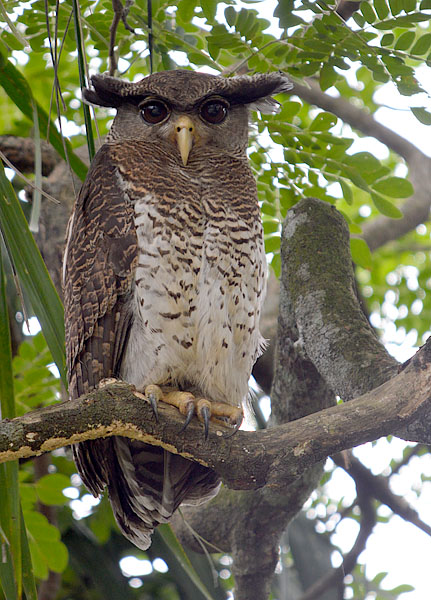
Apart from the fruiting tree, Sungai Sedim was surprisingly quiet. My usual Gunung Bintang trail provided very little opportunity to stop and utilize our birding gear. Not wanting to fight a losing battle, we decided it was time for a change of scenery. As we were making our way out of the Kulim district, a little detour to check on the roosting Barred Eagle-owls proved to be a most rewarding decision. I may be slightly used to the confiding nature of this incredible nocturnal hunter but for a first timer, difficulties in breathing and uncontrollable quivering are the usual reactions. Then only do awe and admiration kick in.


Since luck seemed to on our side, I decided to venture onto a nearby empty industrial plot to look for another creature of the night. A nightjar is not as impressive as an owl but it still has a lot of compelling qualities that make it simply quite amazing. Having said that, I was elated when we found a Savanna Nightjar roosting at one of its regular roosting spots.


Its cryptic plumage blends in perfectly to the concrete embankment and could have been easily overlooked if it was not known to roost there. It has eluded me during my past few visits and this surprisingly confiding individual certainly made up for all the misses. It seemed totally at ease in our presence and continued its afternoon siesta without a care in the world.


A visit to the paddy fields of mainland Penang yielded nothing much except for a huge flock of roosting Asian Openbills at the same spot where I last saw them. Instead of resting at the flooded patch, the storks perched on a nearby tree. With no way of reducing the distance, we left the flock after obtaining some environment shots.


In order to end my trips on a high note, a visit to the swamp forest of Air Hitam Dalam is usually what it takes. However, the Mangrove Blue Flycatchers that usually welcome my arrival were no where to be seen. In fact, I did not manage to even see one throughout the visit. Life, as I know it, almost came to a halt. My ‘guaranteed ’showstoppers have left me high and dry this time and I was utterly devastated. In fact my guest said I appeared to be more disappointed than him. It was relatively quiet at Air Hitam Dalam and the only photo I took was of an Indian Cuckoo lurking around the edge of the access road as we were making our way out of the locality.


An attempt to seek out some kingfishers eventually led us to the mangroves of Juru. However, things did not pick up at all and it was another disappointing visit. We did stop to observe a troop of Silver Leaf Monkeys and judging from their confiding nature, are quite accustomed to human presence.


A mother and her adorable baby was quite a delightful sight. Unlike the other members of her troop, she was a little reserved towards our presence and the reason was very obvious. And we did not push any further to obtain better images. The trip started extremely well but last bit was a little disappointing. But this is birding. You can never be sure of what you are going to encounter or miss.