Pages

Friday, 15 July 2016

Hide-and-shoot...(8-10/07/2016)

The drive from Cameron Highlands to Taman Negara Sungai Relau took slightly more than 2 hours. In order to reach our destination at first light, we embarked on our journey well before dawn. The cold mountain air and endless winding road could not dampened my spirit. It has been 7 years since my last visit to this birding paradise and I was savouring all the birding delights that are to come. When we finally reach our destination, the national park looked pretty much the same to me and that was certainly a good thing.


There is, however, one very noticeable difference. A small herd of Bantengs now roam the park headquarters compound. These native cattle are part of some reintroduction program and the freedom that they get to enjoy is because they are as tame as any domestic cattle can be.


The lone bull, although not as huge and intimidating as his bigger cousin the Gaur, is an impressive animal nevertheless. I would certainly not fancy bumping into a wild one in the forest.


Beyond this iron bridge lies Mother Nature’s gift to birders. The forest here is home to a magnitude of beautiful and intriguing species. It is a little piece of heaven on Earth that is more than capable of making a seasoned birder feel like a rookie birder all over again – overwhelmed by new and incredible birding sensations.


Ben and I had two and a half days of pure birding here. Taman Negara has never once disappointed me and it was not about to start now. We put in several hours of hide birding and photography each day and the results were quite satisfactory. This post will feature all the birds we obtained while staking out in the hides. The White-rumped Shama is one of the most confiding species we encountered. Famed for its divine singing abilities, this species is heavily trapped throughout the country. Fortunately for them, they are safe here from trappers as long as they stay within the boundaries of the park. The male not only sings well or also possesses a beautifully long tail. That is why it kills me to see them cramped inside cages. Although the cages used to house shamas are bigger than usual, they still rob these amazing birds of their birth given right – to serenade the natural world with their beauty and song.


We also had a chance to photograph the less impressive female...


And a juvenile completes the family album...


Yellow-bellied Bulbuls are not your typical bulbul. They have a preference for the lower levels of the forest. Being skulkers by nature, good views are somewhat a privilege. However with the aid of a hide and a little patience, we had plenty of that on this faithful trip.


They also have a tendency to behave like babblers with their vocal nature and foraging habits. Lacking the delicate-looking body structures of the canopy bulbuls, the Yellow-bellied Bulbul are certainly built for the treacherous and competitive life near the forest floor.


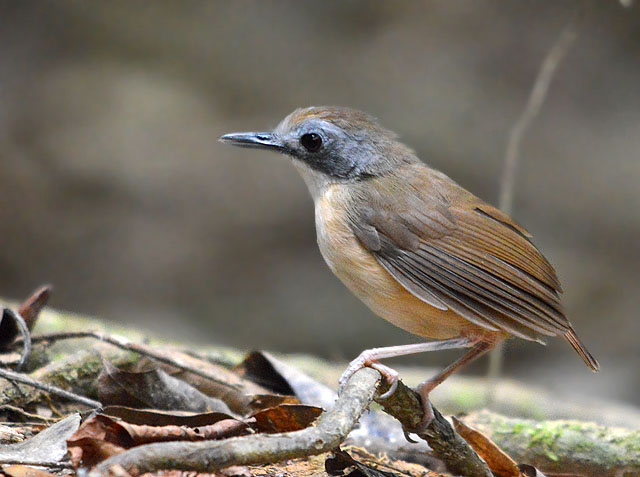
Being able to observe and photograph any babbler out in the open is already a blessing. And to get it up close and personal as well is beyond words. Babblers that frequent the forest undergrowth like the Short-tailed Babblers are notoriously difficult to observe and photograph. Hide birding can be taxing at times. Fortunately, the antics of these stump-tailed terrestrial birds kept us entertained whenever they were present.


Adorable as they may be, appearances can be deceiving. There is no doubt these birds are full of character. And they can be feisty at times too. These two individuals apparently could not see eye to eye. When all the displaying and threat posturing could not settle the dispute, a more physical approach had to be taken...


I have relatively few encounters with the Ferruginous Babbler despite the fact that they do occur in the neck of woods where I usually bird. Shy and active, most of my encounters are brief or obstructed views. You will not able to truly appreciate its beauty until you have a good look at it in the open. Graceful-looking and with a very pleasant combination of colours, the Ferruginous Babbler is a true hidden treasure of the forest.


The babbler’s upperparts is rusty coloured and much to the agony of birders, blends reasonably well with undergrowth vegetation. Its call like most babblers, is the usual tell tale sign of its present. Here in Taman Negara Sungai Relau, the single note call is frequently heard throughout the vicinity indicating the presence of a healthy population.


Hide birding is not as comfortable as it appears to be. Although you are seated and in the shade, the humidity and heat and as well as the cramped space will get to you sooner or later. And don’t forget the waiting part. Boredom will set in as quickly as the mosquitos and if you are unlucky, leeches too. But the main reason for putting ourselves through all this is a family of birds that undoubtedly is one of the most enigmatic and sought after in the tropics – pittas!


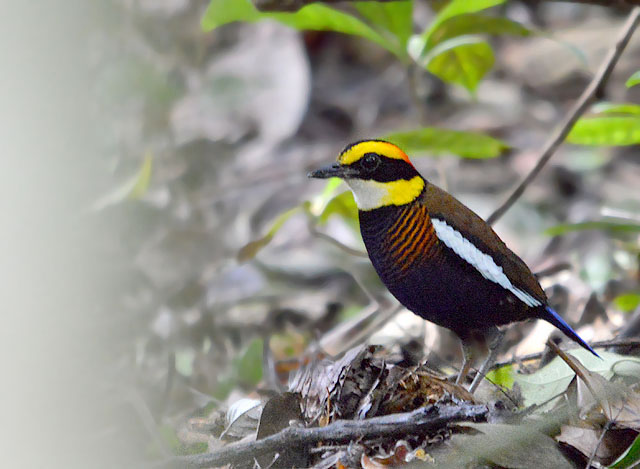
Both the Garnet and Malayan Banded Pitta are present at this birding site. We heard both of them every single day of our visit. The former is supposedly the commoner of the two but we are dealing with wild animals here and things do not always work out according to expectations. We only had one quick glimpse of the dazzling plumage of the Garnet Pitta in the end. However, much to our delight, the Malayan Banded Pitta provided a slightly longer view. Even when it is partly hidden by vegetation, this male made me giddy and quiver with anticipation.


I am not much of a praying person but at that moment, I got down on my knees and said a silent prayer. And it was answered. The male Malayan Banded Pitta hopped into full view. Now, the Giant Pitta may be the most revered of our Malaysian pittas due to its near mythical status but when it comes to aesthetic appeal, the male Malayan Banded Pitta has no equals. The flaming orange eyebrow and midnight blue underparts contrasting sharply with the orange breast bands is a sight that will be eternally embedded into your memory. This may not be my first experience with this alluring bird but it is by far the best.


Two shots was all that I was allowed to take. And just like that, the male Malayan Banded Pitta hopped back into the cover of the undergrowth leaving behind a vivid memory of splendour and beauty. He was not alone. But his mate only offered quick glimpses throughout the encounter. I should be thankful that Murphy sat this one out and it was the duller female that gave us the slip. Birding from a hide may not be my usual cup of tea but for a chance to observe this pitta I would be willing to step out of my comfort zone. Taman Negara Sungai Relau has so much more to offer than just hide birding and the birds we encountered while exploring other parts of the park will be covered in my next post.
Wednesday, 13 July 2016

Holiday blues...(06/07/2106)

I was really looking to this 4-day birding tour with my regular guest Ben as we would be exploring the pristine forest of Taman Negara Sungai Relau in Pahang. It has been 7 years since my last visit to this birding haven and that is an awfully long time. As it was the Malay New Year, the national park will only be opened on the second day of our tour. Since Cameron Highlands was along the way to Sungai Relau, I decided to let Ben experience birding there at the mossy forest of Gunung Brinchang – the highest point in Peninsular Malaysia that is accessible by car. I was expecting a crowd at this popular hill resort during our overnight stay but it cannot be all that bad or so I thought. It was a very long holiday break with Hari Raya, Heritage Day and Penang Governor’s Birthday. My intention of showing some of the montane species to my Singaporean guest could blow up in my face as the hill was overrun with visitors. Traffic congestion is the last thing any birder would want to face during a birding excursion.


This montane forest has been heavily marred by development and agriculture. I am not sure how much more Mother Nature can endure this onslaught. It is truly disheartening to see what has become of this locality.


Fortunately, there is enough left in this old girl to provide a couple of birders with some memorable experiences. The access road up Gunung Brinchang is one of the few places left where the natural environment has barely suffered under the hands of man. And it is along this mossy slope that we had some decent birding.


There are a few montane specialists that find refuge here. Although we missed out on all the rarer species, the commoner Golden-throated Barbet took centre stage and provided one of the main highlights. It was a close encounter but the constant movement of the bird and the harsh lighting made it difficult for me to capture better images.


We came across several birdwaves throughout the day but one particular wave had the birds coming towards us quite low and sometimes below eye level because we were overlooking a ravine. The Grey-chinned Minivet is not an uncommon bird but there is nothing common about the male’s remarkable plumage. His vivid red and black plumage is easily one of the most outstanding in the avian world. I can spend hours ogling at him especially when he is not flitting about his usual domain among the forest canopy. This is the kind of encounter that is responsible for keeping my passion for birding alive after all these years. This is also the kind of encounter that justifies the usage of profanity to describe this fucking incredible moment.


I do not like to see Blue Nuthatches in a bird wave. I get so enthralled with their antics and beauty that I usually miss out on all other species that come along. I have tried for years to get some decent images of this species but their hyperactive nature and preference for the canopy levels have always got in the way. Well, today was my lucky day. Following the minivet’s encounter, this oddly beautiful bird made sure that my adrenalin stayed at this heightened level.


Typical of nuthatches, they like to crawl upside down along tree trunks and branches. Yes, that makes them a delight to observe but a real hassle to photograph. None of my images had the bird right side up in the end. That would have been a killjoy normally. This time, however, I am elated to have finally obtained some reasonably good images.


We are spoilt for choice when it comes to accommodations here in Cameron Highlands. They come in all shapes and sizes – from posh hotels to basic dormitories. De’ Native Guesthouse was highly recommended by Hor Kee and it was not hard to see why. It is located conveniently within Tanah Rata but secluded enough to escape all the activities of the township. The guest house was rather basic but it serves its purpose well enough. And the surrounding environment, serene and lush.


Most of all, birding around the guesthouse was good. The compound will usually have a few of the common birds loitering around. One of them is the Everett’s White-eye. These birds greeted us almost every time we walked around the compound but being small and active, obtaining good images is a tall order.


The distinctive whistle of the Lesser Shortwing filled the vicinity throughout the day. We were fortunate enough to get this adorable species out in the open on one occasion and some of our best images of it were obtained. The Lesser Shortwing is common at most hill stations but their skulking habits among the dark undergrowth make them challenging subjects.


Sharing similar habitats and habits, the White-tailed Robin is another alluring resident of the montane forest here. A lone female foraging along the road leading to the guest house in the late evening wrapped things up for us for the day. Despite the holiday crowd and ongoing habitat destruction works, Cameron Highland turned out to be a good start to the tour. Our next destination is Taman Negara Sungai Relau – the main objective of the tour. That will be covered in my next post. Any visit to Taman Negara deserves a post of its own.

Tuesday, 28 June 2016

Best in Penang...(25/06/2016)

After weeks of weekend work, I finally found myself some free time for my usual Saturday birding. Although it was only a half-day affair, the swamp forest of Air Hitam Dalam once again live up to its reputation as one of the best, if not the best, forest birding site in Penang State currently. The majestic form of the White-bellied Sea-eagle greeted me as soon as I trekked onto the access road after first light. My intention to obtain better images of this raptor was dashed when a couple of morning walkers marched past. I do not have anything against morning walkers and I am sure there is a perfectly logical explanation as to why some of them have to clap hands as they walk (apparently there is and Google states the Chinese believe it helps to improve blood circulation). The eagle, as big as it may be, found the hand clapping unbearable and took flight. Google was right. The hand clapping got my blood moving alright and I did not even have to do the clapping myself...


I found a Yellow-bellied Prinia out of its comfort zone as it was belting out its territorial call. I guess the breeding season is the cause of this behaviour. This prinia is common throughout the land but it has a tendency to hide among tall grass and good views do not come along often. It is the call that usually gives away its presence. The call can be easily learned as you will certainly have plenty of opportunities to hear it in the field.


Air Hitam Dalam provides refuge for only one species of Malkoha and the silhouette of one flying overhead could only be that of a Green-billed Malkoha. Many years back, it shares this domain with the Raffles’s Malkoha. Unfortunately, I cannot even remember the last time I heard the latter’s mewing call here.  


This species tends to move for cover as soon it alights but not today. A second Green-billed Malkoha took the same flight path and I can only assume they are a pair. However, instead of hopping into the vegetation, it took a minute to soak in the soothing rays of the morning sun on an exposed perch. And that was all I needed to obtain a shot of this alluring bird in the open. The effects of the golden lighting completed the encounter. This image alone was worth the trip. Any others after this would be added bonuses.


The Crested Serpent-Eagles of Air Hitam Dalam are usually very tolerant to human presence. Unlike the Sea-Eagle, it will take a whole lot more than clapping of hands to get on its nerves. It was taking a breather in a shady part of the canopy when it caught my attention and there it remained for the rest of morning.


Along the river bank, the raucous laughter of the Collared Kingfisher can be heard on almost every visit. The bird itself can be easily seen as well. Being the commonest coastal kingfisher in Malaysia, I often do not give it as much attention as I should.


As the mid-morning temperature started to soar, I retreated to the boardwalks where the canopy of the forest provides much welcome shade. The melodious song of the Mangrove Blue Flycatchers can be heard throughout the forest. The dominant pair that resides near the rear car park will usually provide good photographic opportunities. Here, the male is vocally proclaiming his territory on a broken Nipah frond.


The boardwalk provided another highlight before I called it a day. The trilling call of the Ruddy Kingfisher will evoke excitement even in the most seasoned birder. As for me this time, I hastily abandoned my photo session with the Mangrove Blue Flycatcher and cautiously stalked my way towards the direction of the call. With every step I took, my heart beat a little faster. And then I caught sight of my quarry and I have no recollection about the rate of my heartbeat anymore. It was on an exposed perch just next to the boardwalk and the Ruddy Kingfisher once again allowed me to enter its secret little realm and for that I am truly grateful.


The Red King was humble enough to permit my efforts to capture his image from different angles. The encounter lasted about a few minutes but it seemed much longer to me at that time. And just like that, it called one last time before flying deeper into the forest. The silver lining on its back glowed with a torch allowing me to follow its movement. Where it alighted next was partially blocked by the vegetation. But it not matter. The earlier perch was perfect to me and the experience, priceless.


Thursday, 2 June 2016

Babbling over babblers (28/05/2016)

Birding in the tropical rain forest can never be short of surprises. You can walk the same forest trail for years and yet, it still has something interesting for you to enjoy. The forest of Sungai Sedim in Kedah is undoubtedly the best forest birding site that is easily accessible from Penang. It is still a healthy ecosystem and the presence of hornbills is proof of that. Although Hor Kee and I did not encounter any of these majestic birds on this trip, some of the smaller residents did keep us entertained for the entire morning. Babblers are well represented in the forest here. Most will have quite distinctive calls and songs which can be heard throughout the vicinity. Locating these active and skulking birds is another matter altogether. Chestnut-winged Babblers are one of the commoner babblers found here. Despite bumping into them a few times during our visit, the sneaky babblers only gave us this brief moment to photograph them.


A small birdwave brought in Brown Fulvettas. There is not much I can elaborate about the Brown Fulvetta apart that it is brown and it is a Fulvetta. But it does have a beautiful song that pierces through the dense vegetation of the forest like the rays of the morning sun.


The forest is not only a kaleidoscope of sounds but colours as well. The Grey-headed Canary-Flycatcher is an attractive bird and as the name implies, is an accomplished songster of both lowland and montane forests of Malaysia. We came across an individual that was hawking from a low perch but the lighting condition was a killjoy. My gear struggled in the dim lower storey of the forest and this is one of those rare moments that I question my preference to shoot without a tripod.


The Black-and-Yellow Broadbill is about as colourful as it gets for birds. But the call, although unique, is far from beautiful. It sounds more like an insect than a bird and delivered in a magnitude that almost rivals the deafening call of the cicada. Although it does forage closer to the ground level occasionally, the forest canopy is where it finds refuge and that is where you are most likely to see them. Perched 50 feet above the ground is not what one would consider to be a good photographic opportunity but a record shot is better than none when it comes to broadbills.


As far as peculiar calls go, the Sooty Barbet is one bird that will certainly come to mind. If one is not familiar with this species, you would not imagine a bulky bird like this will have a call that is not unlike the squeaking a tiny shrew. The call once learned will give away the presence of this barbet as it forages along the canopy level. It was the call that diverted my attention to a dead tree stump where 3 birds were exhibiting a very keen interest on a tree hole. Nothing much came out from the encounter except for a photo that managed to have all the birds in a single frame.


On the way back, we took a little detour to check on the resident Barred Eagle-Owl of Kulim Hi-Tech Park. During my last few encounters, the owl was resting on a low perch and that provided some very exciting moments and great images. This time, however, it was resting at the top most branches and even almost gave us the slip. I am happy to see that it is still around and the distance, although disappointing, could not deny me of a good ending to this birding excursion.