Pages

Thursday, 16 February 2017

A feast for the eyes

Most babblers are notoriously difficult to observe let alone photograph. The forest of Sungai Sedim in Kedah state is home to at least a dozen species of them. They will let you hear them from time to time just to let you know that they are doing fine. On this beautiful Saturday morning, a Grey-headed Babbler unexpectedly perched right out in the open long enough for me to point it out to my American guest, Bob, and to even take a few shots. This species is not common anywhere but in this locality, it has been recorded frequently. Grey-headed Babblers usually do not provide good views and this encounter was exceptional – to me anyway. And I could not have asked for a better way to start off our 2-day excursion.


During my last visit here a few weeks back, a fruiting tree along the Gunung Bintang access trail was coming into season. Upon our arrival today, some of my fellow birders were enjoying the spectacle of nature that had unfolded at the fruiting tree. The fruits are now ready to be consumed and the birds do not need an invitation to join in the feast. The first patron to catch our attention was a male Crimson-breasted Flowerpecker. In terms of aesthetic appeal, he is right up there among the best. Naturally, my guest was mesmerized by his beauty. And so was I...


The Yellow-breasted Flowerpecker is the commonest of all the flowerpeckers here. But it is only at fruiting trees like this, one can truly appreciate this little forest denizen.


For a brief moment, a Yellow-vented Flowerpecker discarded its sanctuary among the dense canopy of the forest and descended on the fruiting tree to fill its appetite. Gluttony is a deadly sin that few can resist and that includes captivating birds like the Yellow-vented Flowerpecker.


Apart from the Lesser Green Leafbird and Brown Fulvetta, the other patrons consisted of bulbuls. No less than 8 species were recorded and that is courtesy of one fruiting tree. Bulbuls are able to coexist because of the slightly different niche each species occupies. However, they will all come together at this natural phenomenon and provide a breath-taking sight. The most conspicuous and numerous species today was the Buff-vented Bulbul.


Some bulbul species can be an identification nightmare especially for a foreign birder. The white iris of the Cream-vented Bulbul best distinguishes it from all the other plain bulbuls found here. That is why I dubbed it the “White-eyed Bulbul” to all my foreign guests.


On the other of the scale is the Grey-bellied Bulbul. With such striking and contrasting colour, a glimpse is all it takes to nail its identity. A few were gorging on the fruits quite low down and indirectly provided stunning views to all that were present. It was an amazing experience even for a local like me.


We left the forest for the paddy fields in mainland Penang and along the way, we made a detour to the lair of the Barred Eagle-owls just outside the boundaries of Kulim Hi-Tech Park. Although the owl was roosting on a slightly lower perch, there was no way to obtain an unobstructed image. But an owl is an owl and every daytime encounter with these nocturnal predators tends to leave one absolutely enchanted.


Grey-headed Lapwings are one of the many attractions found along the paddy planting district of Permatang Pauh. Most parts of the fields are almost ready to be harvested and that makes any body of water within the area a prized commodity. One particular patch had a good concentration of waterbirds including the Grey-headed Lapwings and these lanky waders provided a good ending to a productive and memorable first day of birding around Penang.


The grasslands of Chuping in Perlis was the destination for the second day. Normally, it would be the picturesque sunrise over these lands that grab my attention but not this time. It was a “morning full moon”...


This birding site is the best place to observe and enjoy a number of northern specialities like the Plain-backed Sparrow. Much of its range has been reduced through the years and that is most unfortunate for the males are just exquisite. This confiding male was foraging on the tarmac next to our stationery vehicle and I bet my guest could easily detected the excitement in the tone of my voice.


Chuping is also famed for raptors and we did manage to record a fair number of them. However, good photographic opportunities were few. This Oriental Honey-buzzard was one of the few that did not slip past my camera.


When it comes to grace and beauty, very few raptors can surpass the male Pied Harrier. It is not a rare species but undoubtedly, one of the star birds of this birding haven. A male quartering the grasslands in search of prey has a hypnotic effect on you and you just cannot pry your eyes off him. We came across a hunting male twice on this trip and that alone made this trip worth the while for my guest.


The presence of a high number of Eastern Yellow Wagtails at a recently ploughed patch certainly got my attention as there is always a chance for the rare Citrine Wagtail. But I cannot be scrutinizing each and every single of the former just so I could increase my life list. Certainly not when I have a guest with me.


On the way back from Chuping, we made a detour to the virgin jungle of Bukit Wang in Kedah. Unfortunately, not much was about but a female Wreathed Hornbill did taunt us from among the foliage of the forest canopy. Each time she briefly revealed herself, my heart skipped a beat. I cannot help myself as hornbills are such fascinating birds. Bob, my guest from USA, has seen most of the hornbills species here in Malaysia but like me, this teasing female of a common hornbill species still got us all excited. Bob is an old-school birder and birds have been a lifelong passion for him. Although the number of photos obtained during the two days was nothing exceptional, the experiences provided by some of the encounters were. 

Friday, 10 February 2017

Duck Central

The former mining pools at Malim Nawar in Perak state proved once again to be the place for rare migratory ducks when a Northern Pintail decided to winter here this season. However, I was only made aware of its presence a few days before the Lunar New Year and whatever plans to twitch for this duck just had to wait. And the wait became almost unbearable when Dave came back on the first day of the New Year not only with images of the Northern Pintail but also Malaysia’s second Blyth’s Pipit. I found myself embarking on the 4-hour round trip to the site the first chance I had and with Hor Kee as my companion. Ducks rarely winter here in Malaysia and even when they do, the males will usually be in their drab eclipse plumage. This male Northern Pintail, on the other hand, was almost in full breeding plumage. For a waterbird enthusiast like me, that is almost like striking the lottery. Upon arrival, I immediately went for the Northern Pintail. My companion, having ticked off both birds on his last visit, tagged along to seek improvements shots of the Blyth’s Pipit and as it turned out, to provide moral support as the duck was no where to seen at his usual spot. And all the excitement built up in me during the journey here died off completely.


A careful sweep of the adjacent ponds was the next and only course of action. There is a God after all and among the reeds of one of the other ponds, the Northern Pintail was paddling leisurely whilst looking for breakfast. Life, is beautiful once again. Of the three rare ducks that this little piece of birding paradise hosted through the years, this male Northern Pintail is the most stunning in my book. The only thing lacking from his splendid plumage is the elongated tail feathers. That would have made it perfect.


The duck was reasonably confiding but the lighting was against me. The thorny scrub vegetation and the presence of temperamental Water Buffaloes prevented me from improving my position. Taking into account my miserable state of mind minutes earlier, I was not too disappointed with the natural elements that were not in my favour. I finally connected with a male Northern Pintail and it was truly an uplifting experience.


While I was being uplifted by a duck, a group of Selangor birders that arrived later came across the Blyth’s Pipit near where we have parked our car. As we were making our way out to search for the pipit, the Selangor birders were making their way in for the duck. Information was exchanged and my pace quickened as there was now a chance for a double mega lifer today. And the moment of truth came not too long into our search…


But it was not meant to be. Every single pipit that we managed to dig up the whole morning turned out to be Paddyfield Pipits including this one. I was not expecting much to begin with as the celebrity pipit was not seen for the past few days. I am glad that today someone saw it. Even if it was not me who was in the vicinity at that time - honest. I bet if I had look really hard from where I was crouched down observing the Northern Pintail, I would probably had the Blyth’s Pipit in my binoculars. But seriously, if I have to choose between the duck and the pipit it would undoubtedly be the former.


Anything that even slightly resembled a pipit received our undivided attention including Eastern Yellow Wagtails…


In between our stops for pipits and wagtails, a few other species did manage to garner our attention. Malim Nawar is the best locality in Malaysia for Bank Swallows – a scarce winter visitor. Although there is much debate and confusion as how to differentiate the Bank Swallow from the Pale Martin, I like to keep things simple and consider all 30 birds that were present today as Bank Swallows. That number itself would have brightened up any ordinary birding excursion. But today is no ordinary excursion.


Not much waders were present today and a lone “Swintail” Snipe (again, I like to keep things simple) momentarily distracted us from our search for the pipit.


A large raptor circling overhead turned out to be a Crested Serpent-Eagle…


Just before we called it a day, we returned back to the pond area for the Northern Pintail. He was no longer alone and was enjoying the companionship of 4 Garganeys. Although the Garganey is the commonest of our rare migratory ducks, 4 of them at a single locality is certainly a noteworthy record and a fine way to end yet another successful twitch for a rare duck at this locality.

Tuesday, 17 January 2017

Buffy the fish slayer

Owls, no matter the size or status, will always have a special place in my heart. I am sure I do not speak for myself as these nocturnal birds are both mysterious and beautiful. With traits like these you are bound to garner lots of admirers. Anyway, there is a little recreation park just outside Bukit Mertajam township in mainland Penang called Bukit DO that surprisingly houses not one but two species of large owls. For one reason or another, I never got round to visit the site until now. Both the Barred Eagle-owl and Buffy Fish-owl have been showing well of late and the thought having two of these owls at one locality is just too tempting to resist. I had some time to spare on this particular Saturday and since I was in the area, I might as well give it a try. With some pointers from Hor Kee and James Neoh, I found myself at the base of a huge tree where the Barred Eagle-Owls frequent. This place is a popular recreational venue. It was almost two in the afternoon when I arrived at the locality but there were still a number of walkers present. And when you carry gear like mine and constantly stare upwards, you are bound to attract unwanted attention. Once again, I would like to stress I am not antisocial but I do prefer to do my birding in peace. It is also probably why I have not visited this site till now. Despite a careful sweep of the area, I could not locate the owls. Although this species is not new to me, I cannot help but to feel a little disappointed.


Just down the road the Buffy Fish-owl has apparently taken up refuge. Lucky for me, it did not take long for me to locate it. The lighting was disappointing but I am glad the quick visit here was not a total washout. The Buffy Fish-owl is easily the commonest of our large owls but I have yet to grow tired of being in its presence.


I moved to flank the owl in my effort to obtain a better image and was rewarded. A small gap in the vegetation was my saviour. The owl, now unobstructed and in much better lighting, was an impressive creature to observe and photograph. I was also at a comfortable distance for the owl as it soon lost interest with this cumbersome human trespassing into its territory.
 

Some movement from a nearby branch turned out to be a second owl that was there the whole time and yet, managed to slip past my radar. I guess I was too preoccupied with the first owl to take notice of it and it was a youngster judging from the paler colouration. My day certainly just got a whole lot better…


Initially, it was suspicious of my presence and peered at me from its slightly hidden perch. I tried to appear to be as harmless as possible and slowly repositioned myself to capture its images.


Gradually, its suspicion grew into curiosity. Much to my surprise, it flew and alighted on an exposed perch in front of me. I took a step back. This may not be a good thing. The parent bird surely must be watching this intently. Owls are very capable of inflicting harm to humans and the unfortunate case of an ornithologist losing an eye to his main passion in life is a grim reminder. A quick glance at the parent bird revealed no such intentions and I continued to soak in this memorable experience. Owls are truly remarkable birds and I am glad to have visited this modest location for its nocturnal inhabitants. The encounter left me feeling hopeful for bird life that has found a way to survive within such close proximity of humans. It may not be their preferred choice but it could well be the only one left for some of them.

Thursday, 5 January 2017

Starling Central

It was a gloomy morning at Sungai Sedim when I started off my first birding excursion for the year. Definitely not the kind of start one wishes for. I am not sure if it was the cold air or the coming rains but the birds were not out and about. I had to work hard to show some forest denizens to my British guest, Rod. It was not a total let down as we did managed to experience some of the bird life here but it could have been better. A lone Crested Goshawk perched aloft a tall dead tree provided the only photo from this locality for me. As the raptor gazed towards the approaching rain clouds with a sense of uncertainty, we birders knew what had to be done and it was to seek better pastures elsewhere.


A detour to check on the Barred Eagle-owls of Kulim has become part of the routine after any visit to the forest of Sungai Sedim. The weather improved very little and the light drizzle made this roosting owl even more sluggish. A quick glance over the shoulder to make sure what these humans were up to was all the owl was able to muster. And it was back to sweet slumber from then on.


The waders at Bagan Belat have certainly found a new area to roost and feed. My last visit here was a disappointment as the regular thousands of roosting waders were absent. The outcome today was the same and the magic of Penang’s only Important Bird Area could be drawing to an end. The foul weather trailed us all the way to Air Hitam Dalam. The Mangrove Blue Flycatcher did his best to try brightened up a gloomy day and despite the rain, performed admirably for a couple of visiting birders. The last destination for the day was the paddy fields of Permatang Pauh in mainland Penang. Even from a distant, the pale colouration of the White-shouldered Starlings stood out like a beacon in the dark as they foraged among a clump of medium-sized trees in the middle of the fields. After the umpteen time, I was elated I managed to capture the images of this rare migrant. It may not be what one would consider to be a quality shot of this handsome male but I am not complaining. The day was finally turning around and so did the weather.


A drab-looking starling was next to held my attention and I knew it was the juvenile Rosy Starling that has been entertaining birders for the past week or so. For the second time this season, the Rosy Starling firmed took its place in my birding excursions. One thing that I have noticed about this scarce migrant is its preference to forage on the ground and often enough it can be seen together with mynas and not other starlings. However, its choice of company this time is somewhat questionable – a Brown Shrike.


Unfortunately, the one starling that I was really hoping to see remained elusive. A careful and tedious sweep of the flocks of Daurian Starlings present could not produce the desired male Chestnut-cheeked Starling. The sky began to darken again and rain was emanon. A lone female Daurian Starling that stayed back at a berry bush instead of joining others of her kin at a roosting tree found her way to my memory card.


A number of Pink-necked Pigeons were also present at the locality. They continued to feast on the berries despite the rain drops that have now trickled down from the heavens above. This species may be the commonest of our green pigeons but the male is undeniably striking. It would have been a sin if we did not spend time observing the water birds that were present today as well. Temminck’s Stint, Grey-headed Lapwings and Black-winged Stilts may be regular migrants here but they certainly deserve some affection. 

Saturday, 31 December 2016

Ending the year with a bang

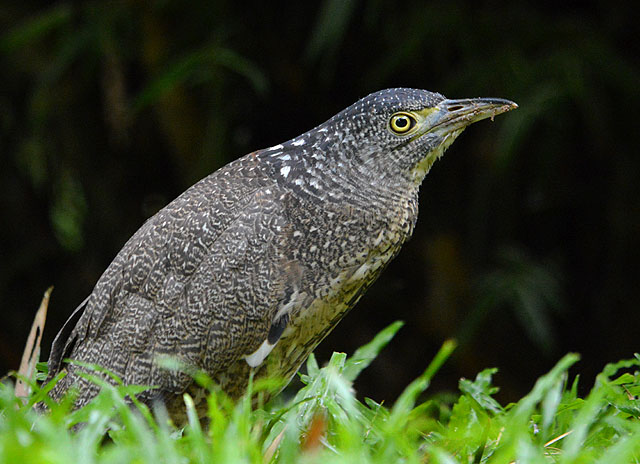
I do not fancy birding where there are lots of people. I prefer the onslaught of leeches and ticks than the stares and ridicule of those who cannot come to terms why a fellow human being can be into birding. Anyway, when another juvenile Malayan Night-heron decided to spend its winter in a landscaped garden at the Penang Botanic Gardens for the second consecutive year, no amount of human irritation could have kept me away. This was not a regular birding excursion. It was a quick visit to this popular tourist destination specifically for this uncommon migrant. Today is New Year’s Eve and as expected, the road leading into the gardens was congested. I took my faithful iron steed and that saved me the frustration of getting stuck in traffic. Unlike last year, it took me, James and Kevin (whom I bumped into at the locality) quite a while to find the bird. I had to admit that at one point during our search, the thought of dipping out on this one as well did creep in. But all ill feelings evaporated when we caught sight of the heron strolled out of hiding and positioned itself underneath a dense clump of bamboo.


The bird showed very little fear of man – just like the one last season. Gradually, it started to hunt and we just made ourselves comfortable and waited for the heron to present better photographic opportunities. In which it did – much to our delight.


This particular spot in the gardens could be a regular wintering location for this heron. I do not spend much time here. I have stated the reason at the starting of the post. Through the years, there may have been others before the discovery of the first one last year. The environment is ideal and food is definitely abundant judging by the rate of the heron’s successful acquisition of prey. Well whatever the reason, I feel blessed that this island home of mine, despite all the destruction to its natural habitat, is still able to provide sanctuary to intriguing birds like the Malayan Night-Heron.


I thought that by now I would be used the sight of a Malayan Night-heron foraging on an open lawn. Last year, I made several short trips here to spend time with the first juvenile. But no. It is still exciting to see it up close and personal. This year has been a roller coaster ride in terms of birding. There are just as many ups as there are downs. But I am glad to able to end the year on a high note and it is courtesy of this confiding Malayan Night-heron.


I would like to wish a Happy New Year to all my followers and readers.