Pages

Friday, 23 April 2010

22/04/2010: Past reflections re-visited

When I was first started to photograph birds during birding trips, I was using a modest digi-scoping setup. Good images were hard to come by due to the moderate quality of my telescope and compact camera. And to make things worse, I had to hold my camera against my telescope with only the aid of a home-made adaptor. Despite all the hassle, I was quite happy at the time that I was able to capture permanent memories of my birding trips. With time and a whole lot of practice, I did manage to make the best out of my setup like this shot of a resting Black-winged Kite taken at Kuala Muda.

Digi-scoping active moving birds can be quite frustrating as it was quite difficult to follow the movement of the birds. I considered myself quite lucky when this image of a male Blue-winged Leafbird taken at Temenggor forest reserve turned out better than I had expected.

One of the advantages of using a digi-scoping setup is the reach of the optics when compared to a DSLR setup. I can still recall the time I had to photograph this foraging male Laced Woodpecker from quite a distance at the mangroves in Kuala Gula and thanks to the reach, I was quite happy with the images.

Sometimes I do regret not venturing into bird photography earlier because there are quite a number of species that presented themselves to me only once so far like my one and only sighting of the Indian Roller at Kuala Gula – a species that is locally common only at the north-eastern region of Peninsula Malaysia.

And how can I forget about my Hoopoe sighting in my home state. The same individual was seen only twice in the same season at Sungai Burung. This is not only an attractive species but it is also a rare one as well. Now all I can do is hope that one day I will be able to capture its images with my current DSLR setup.

The Indian Pond-heron is one of the more recent additions to the Malaysian checklist. I had the privilege of photographing the first ever record for Penang Island and of all the places, this mega rarity decided to winter at the air field of the Penang International Airport. It took a while for the airport security to realize that it was the “feathered birds” that I was after.

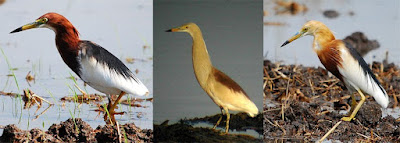
As per Choo Eng's request, here is my natural shot of all 3 species of Pond-herons in a single frame...

Here is a digitally altered shot to show the differences between the Chinese (L), Indian (M) and Javan (R) in full breeding plumage - the only time when you can safely tell the 3 species apart.
The Milky Stork is a globally endangered species and encounters with this species were far and few. However, I did manage to enjoy a few close encounters and capture quite a few decent shots of the birds that were re-introduced back into wild at Kuala Selangor Nature Park and Kuala Gula Bird Sanctuary. These birds are quite accustomed to humans and are not as wary as the completely wild birds.

Monday, 12 April 2010

10/04/2010: Pondok Tanjung (Perak)

This locality is one of the last few remaining swamp forest and it has been a few years since my last visit. This used to be one of my favourite haunts but my last visit was not a happy one. There was a new road cutting through the forest reserve and I could not even locate the forest trail that I used to bird along.

Anyway, together with Choo Eng and Muin, we decided to try out this locality and see if there is still hope left for this once excellent birding site.

Parts of the old road can still be seen as we drove along the new one and it brought back memories of another time where I spend hours in the leech infested forest trail observing fascinating species like the Rufous-tailed Shama and Grey-chested Jungle-flycatcher. I really regretted not being able to capture any of the images as I was still with my digiscoping set-up at the time.

This road always had its share of road kills in the past and today was no different. The unfortunate casualties this time was a Collared Scops-owl and a Banded Krait. What an undeserving end to such fine specimens.

We also found a few logging trails in the area and that is not a good sign.

This female Bronze Grass Skink kept us occupied for quite a while.

The highlight of the trip was this handsome Pig-tailed Macaque and he really put on a show for us. All the shots were taken from the safety of our vehicle…

And those fangs are the reason why…

We recorded almost 40 species of birds but most only provided glimpses and sound. With my telephoto lens still at the service centre (Come on Sigma. It’s been a month. You’re killing me here), it is no surprise that I did not have a shot worth showing except for this female Whiskered Treeswift taken at the Batu Siputih Forest Reserve. This locality is about 20 km away from Pondok Tanjung which looks quite promising and I can foresee a full day’s trip in the near future.

Monday, 29 March 2010

27/03/2010: Pulau Burung & Permatang Nibong (Penang)

It has been a very hectic month for me in terms of work and on the very last weekend, I finally managed to find the time to do so birding. I decided to give Pulau Burung a visit and upon my arrival, I received a rather rude reception. The local authority had conducted a cleaning up operation and quite a big part of the marshlands lost its habitat especially at the edge of the access road. To them, it is maintaining the place. To the birds, they lose part of their home. To me, I lose my little piece of heaven on earth. The best thing about this locality is the birds here can be unbelievably tame at times. The clearance of the habitat will now force the birds to keep further away from the access road. This could spell an end to all those fantastic close encounters if the locality fails to grow back to its former state.

The birds were much fewer than usual "thanks" to the maintenance work. With my telephoto lens away for repairs, I had to rely on my 200mm lens for the time being and I'm really struggling. It is times like this that I truly miss my beloved lens. Anyway, the Lesser Whistling-ducks were still in their healthy numbers.

The White-browed Crakes were still foraging in the open but much further away from the access road.

The Black-winged Stilts performed their marshland ballet to help brightened up a gloomy day and I don't mean the weather.

However, there is still hope for the place with this image of an extremely confiding juvenile Paddyfield Pipit. Even with my short lens, I could obtain reasonably good shots. The magic of Pulau Burung...

I also came across a pair of Mangrove Pittas calling from across the river. The distance and shy nature of the birds prevented me from obtaining any good shots. But like I always say, any sighting of pittas in the wild is a magical one and this one is no different.

Later in the morning, I decided to visit the paddy fields at Permatang Nibong. Among the commoner Chinese Pond-herons, I managed to pick out single birds of both the Javan Pond-heron and Indian Pond-heron.

I also came across a striking male Watercock in full breeding plumage but he was extremely shy – typical of the species.

The word must be out that Penang is ideal place for Asian Openbills because the lone Asian Openbill here was joined by 9 other companions recently.

I am not sure if the storks are here to stay but the sight of 10 Asian Openbills soaring about in Penang skies is something I would really love to get used to.

Monday, 1 March 2010

20/02/2010: Pulau Burung (Penang)

Initially, I thought I wouldn't be able to bird this morning as I had my annual Chinese New Year poker night with my buddies the night before. I guess age must be catching up with us as we called it the night much earlier than usual. The dilemma of choosing a site to bird at the last minute did not surface as the thought of possibly having a Red-throated Thrush was good enough a reason as any. I arrived at the locality slightly later than usual to conduct my second attempt in finding this rare vagrant but it was another letdown. However, you'll never end up empty handed from any trip to this birding paradise. Not when you have elusive species behaving like this - a White-browed Crake right out in the open...

Later on in the day, I did bump into a few more and they were in their more typical behaviour...

A pair of Collared Kingfishers provided me with a very memorable encounter by being extra confiding...

Now if the Black-capped Kingfisher was to follow them, then I'll be pretty worried...that I'm dreaming all of this.

This Blue-tailed Bee-eater alighted so close to me that I could even get a clear head shot...

Quite a number of birds were taking advantage of the beautiful weather to get a good sunbath like this juvenile Large Hawk-cuckoo.

I found another cuckoo enjoying the same activity further along the mangrove access road and it was a beautiful Green-billed Malkoha. The long tail of this species has always intrigued me from the days when I first started birding. In fact, it was at this locality that I saw my first Green-billed Malkoha about 2 decades ago.

I waited patiently in my car hoping that it will gradually move to a better position for me to photograph but when it finally did, it had its back towards me.

My favorite Black-winged Stilts were also out and about and with such great lighting conditions, I couldn't help myself but spend some time photographing them. I even managed to capture all 3 different plumages of this graceful wader - breeding male, breeding female and non-breeding plumage.

The ever-confiding Wood Sandpipers are always in the mood for photography.

I came across a resting Crested Serpent-eagle immediately after taking a bend along the access road. I was just as surprised as it was and I left it is peace after taking a few shots as the angle was little steep.

I did come across a pair circling low above the mangrove forests later on and despite the almost overhead sun, I was rather happy with how the images turned out.