Pages

Monday, 10 December 2018

Soaked to the bone


The weather has not been promising of late with heavy downpours a regular feature each evening. To provide memorable birding tours at a time like this will be no walk in the park. My latest guests are from England and forest birds are mostly what they seek for their two-day birding excursion in northern Peninsular Malaysia. The lush jungles of Bukit Wang in Kedah state was the first locality of the day. The weather was not an issue but the birds, were. We had a few exciting but brief encounters that included uncommon species like the Malayan Night-Heron and Bat Hawk but none managed to make their way into my memory card. Lucky for me, this British couple appreciates the experience as much as they do the birds and the ambience shrouding Bukit Wang is impressive to say the least. However, they signed up for a birding tour and my reputation was at stake here. There is one place I can count on in times of need and it is the mangroves of Sungai Bate. The swampy terrain houses a number of exquisite species and it did not take long for the first one to appear. The Mangrove Blue Flycatchers are one of the most obliging species of this stakeout and the pair was just amazing on this gloomy day.


One particular branch seemed to suit their fancy and both took turns to alight and pose on it.


The regal plumage of the Stripe-throated Bulbul has yet to go stale with me (I doubt it ever will) and several images were obtained today without the slightest hesitance. The overcast sky was a blessing in disguise as it blocked out the harsh lighting conditions of midday.


I even fell in love with the images of the commoner Abbott’s Babbler taken today. It could be the lighting or the mere fact that I did not have one single image worth sharing from the morning excursion at Bukit Wang.


The White-breasted Waterhen towers over the rest of the birds present at the stakeout and naturally, it usually gets its way.


When the Mangrove Pitta finally appeared, the reaction of my guests almost vanquished all my guilt from the disappointing morning. Even the White-breasted Watermen had to give way to the king of the block. And his majesty was in perfect form having recovered from his post breeding moult.


Swaying its way to the stakeout, the Forest Wagtails are adorable and striking birds that made the visit to this birding hotspot complete. A mossy latch incidentally provided a fresh backdrop and we pit our photography skills against the constant movement of the birds.


The Malaysian Pied-Fantail is not a regular patron here but its inquisitive nature got the better of it and provided a reasonable shot before continuing with its frantic foraging style deeper in the swamp forest.


A detour to the paddy fields of mainland Penang before concluding day one of this birding endeavour yielded an unusually obliging Grey-headed Lapwing. This locality is one of its strongholds here in Malaysia. But the Grey-headed Lapwing is suspicious of human presence and it does not take much to send an entire flock of these migrants fleeing to a distant patch.


Brown Shrikes are also winter visitors but unlike the lapwings, they occur in a variety of habitats throughout the country. And this one, wrapped things up for the day.


The next morning, we found ourselves at another pristine forest in Kedah state. Pedu has all the potential of a great forest birding site and I was counting on that to compensate for yesterday’s let down. However, the weather was dark and wet upon our arrival. The fruiting fig trees were a hive of bird activities but the poor lighting was a hindrance to photography. The Thick-billed Flowerpecker is one species that I do not have enough images of. Despite present in good numbers, it was near impossible to capture minute and active birds in this condition. As usual, there were bulbuls gorging on the fruits. No amount of gloom can ever drown out the electrifying present of the Scaly-breasted Bulbuls. This poor effort to capture the beauty of the bird does no justice to it at all.


Another fruiting fig tree deeper in the forest held the attention of some of the shy giants that call this place home. The majestic hornbills, despite their large stature, can be frustrating shy. It was a distant shot but to have two species of these amazing birds in one frame is no mundane affair. Both the Oriental Pied and Black Hornbills are common residents here. And this is my first image of the latter despite countless visits to this locality through the years.


There were moments of magic that reminded me why I bother to take the four-hour round trip to this locality so regularly. One was courtesy of a pair of Banded Woodpeckers. It was a prolonged encounter with the loving couple foraging in close proximity to each other. When the birds took a breather from the hunt and rested on a dead tree, we took the time to truly appreciate their striking plumages.


Another highlight of the visit here came in an unlikely form. It was a Giant Forest Scorpion and the name was no exaggeration. We found the formidable creature crossing the access road and did our best to obtain some images before it disappeared back into the lush tropical rainforest. If looks could kill, we would be in deep trouble. The sinister claws, the wicked tail and the overall appearance of the scorpion is just pure evil. However, looks can be deceiving and it is quite harmless if you let it be. The encounter produced mixed reactions of awe and fear. But for me, it was more of the former.


The weather worsened later in the morning with the occasional drizzles getting heavier. I had to make a call and I abandoned the notion of waiting for the weather to improve. I decided to take my guests to a spot with a view to consume our packed lunch. The unobstructed view of Beris Lake must have made quite an impact on the British couple and lunch lasted longer than expected as they soaked in the view whilst enjoying some local coffee. The experiences are just as important to them and there is more to life than just birds – something I often find hard to comprehend.


Our next location turned to be a disaster. For once, I appreciate the gazebos built around the Air Hitam Dalam Educational Forest. A heavy thunderstorm caught us in the middle of our walk around the locality and we had to take shelter in one of these gazebos while the wrath of the storm struck down on us with unforgiving intensity. Cold, soaked and frustrated, we had no choice but to wait it out for almost an hour. When the rain lessened, we started to make our way home but not before swinging by the paddy fields again. There, I found my rainbow at the end of the storm and it was a handsome male White-shouldered Starling. I do not have enough images of this irregular winter visitor and this one, despite the obstructing twigs and leaves, is my best effort to date.


The sight of a Long-tailed Shrike may not be of much significance in the southern half of Peninsular Malaysia. Here in Penang, this beautiful bird is locally extinct and now only occurs here as rare migrants. This record shot pretty much depicts our birding excursion today and the poor shrike, soaked to the bone, provided the ending for our two-day birding expedition. The shrike certainly did not hope for this foul weather at its wintering ground and neither did we. The rain did hamper our efforts to observe some of the alluring bird life found in the forests here but the Greater power at work did provide enough moments to ensure my guests will have treasured memories to accompany them home.


Tuesday, 27 November 2018

Bunting hunting...

With a number of first records popping up in the neighbouring country of Singapore, I cannot help but to feel a little envious. If there any birding site here in Malaysia where you have a fighting chance for first records (or just really rare ones), it would be the grasslands of Chuping in Perlis state. And there is where I went with Hor Kee for my latest birding excursion. The anticipation of a good haul got the better of the two of us and we arrived at the location much earlier than expected. There was not much do at this hour except to admire the full moon floating above the sweeping grasslands...


The mist started to lift when the sun finally crept up the horizon. And the reed bed suddenly came to life with the chirping of birds. It is a known roosting site for weavers and munias and this is where we sought out our first target of the trip – buntings.


When it finally got bright enough, we began our tedious search. Scanning through hundreds of Baya Weavers and munias for something different at this light was no easy task. Every stalk of reed probably had its own weaver swaying to and fro according to the wind direction. And when parts of this massive congregation took flight, it was a one big bundle of feathers.


We gave up the search for buntings about an hour later and I took the time to admire this little spectacle of nature. This is by far the biggest concentration of Baya Weavers I have ever come across in my life. When one of them wandered close to our position, the photography opportunity that was provided did not go unappreciated. It may not be a breeding male but it still an attractive bird.


The reed bed did not only hold finches. Reed-Warblers find sanctuary here as well. However, these little brown jobs are notoriously difficult to see let alone photograph. Their calls are usually the only sign of their presence and the scarce Manchurian Reed-Warbler was certainly present. Our moment came when one of the warblers alighted on a pylon within the reeds and it turned out to be a Thick-billed Warbler – another uncommon species.


The tiny state of Perlis is the only place where this winter visitor is more regularly recorded. I have only seen it a few times and today’s encounter was the longest one for me so far. Obtaining an unobstructed image was difficult but I am happy with the results today.


From the dense reed beds, we wandered to open ploughed fields for our other target of the day – skylarks. However, the closest we came to anything resembling a lark were the ever abundant Paddyfield Pipits.


There was a fair number of wagtails present today as well. Judging from our luck today, I did not have much hope for getting my first Citrine Wagtail among the flocks of Yellow Wagtail. But there was no harm trying and we scrutinized every one of the wagtails. The temperature has soared to a blistering level by then but it was nothing compared to the consecutive disappointments we had to endure. My would-be lifer of a Citrine Wagtail will just have to wait another day.


It was good to see the commoner waterfowls back at the ponds. There has been a steady increase in recent months and I hope views like a Common Moorhen lazily paddling along the deep blue waters will become a regular feature again.


Chuping did not really live up to its reputation as a raptor's haven today. The raptors were around but there was no encounters that left a lasting impression except for this female Common Kestrel resting on a rubber sampling. The heat wave was apparent and the distance was a little too far for any chance of a good photo. But it has been a while since I last encountered this graceful raptor at rest and it was the only raptor moment for this trip.


It could be too early to pass judgement but it seems like the number of Asian Pied Starlings present nowadays are on the decrease. Although it is not officially in the Malaysian checklist, this beautiful starling is full of character and could always brightened up any excursion – especially a slow trip like this one.


The Red Collared-Dove on the other hand is doing very well and flocks of up to 100 birds are getting to be a common sight.


Another species that is doing well not only here in Chuping but throughout the country is the Cattle Egret. This species outnumbers all the other big water birds and flocks of these highly adaptable species can be seen moving from plot to plot in search of food. Recently ploughed fields is its favourite along with other variety of birds due to the easy access to their food source.


By lunch the heat was almost unbearable and we seek greener (and cooler) pastures elsewhere. Bukit Wang was the closest locality and we drove along the newly paved access road for the first time. From what we can see, the level of destruction from the ongoing construction work was not too severe and hopefully it stays that way. As for the birds, not much was about as the heat here offered little relieve as well. It may not have been the most rewarding of trips to the northern frontier but that is birding. Sometimes you win and sometime you lose. And once in a blue moon, if you are lucky enough, you might hit the jackpot.


Thursday, 15 November 2018

Konnichiwa...


Air Hitam Dalam is a just little patch of forest in northern mainland Penang that happens to be the best birding site closest to home. The migratory season usually brings some goodies to this local patch of mine but this season, it has been exceptional so far. Unfortunately, I neither had the time nor the good fortune to enjoy the bounty. Black-backed Kingfisher, Violet Cuckoo and Zappey’s Flycatcher managed to elude me during my visits here. These birds are not lifers and they are not rare. However, they are uncommon enough to get me visiting a forest site during the hottest part of the day – twice (including this trip). Of the three birds, missing the exquisite male Violet Cuckoo (just to rub in the salt, others have seen the whole damn family on several occasions) pained me the most. On this visit, I went to where he was more likely to show and waited.


Naturally, he gave me the slip again. But I faired slightly better today. I got the juvenile Violet Cuckoo momentarily at the top most part of the canopy miles away. Better than nothing I guess...


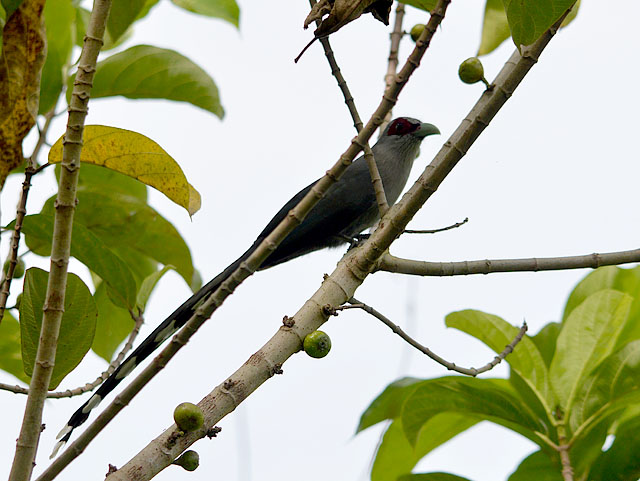
While waiting for the Violet Cuckoo, another cuckoo did come my way and it was an impressive Green-billed Malkoha. I must have made myself unobtrusive enough to have this usually shy bird forage so close to my position. If not for the lighting and vegetation, this would have been a very nice capture.


A mix troop of Silver and Spectacled Langurs kept my mind off the cuckoo momentarily. The Silver Langurs were a bit shyer but it was still interesting to observe this inter-species behaviour between two mammals. This Spectacled Langur, on the other hand, was certainly living a carefree life here.


I decided to move from the spot before I was totally overwhelmed by boredom and took a slow walk next to the river. Not much was about due to the time of the day except for a foraging male Common Flameback. It may be the commonest woodpecker in the vicinity but an adult male like this one deserves some attention.


The rising temperature does bring out a family of birds from hiding and they are the raptors. A handful of species were recorded today but only one provided any real chance of capturing a decent photo and it was the migratory Black Kite. This site plays host to these northern migrants again this season and will continue to do so if there are no drastic changes to the surrounding environment.


I was not the only one who took noticed of the raptors. The presence of predatory birds certainly did not go down well with the resident Large-billed Crows and they went on a mobbing spree until most of the raptors were beyond their air space.


I casually wandered back to the Violet Cuckoo hoping for a miracle which did not come my way. Frustrated and fatigued, I was about to call it a day when a Square-tailed Drongo-Cuckoo alighted just in front of me. It was not the cuckoo I was hoping for but things being the way they are, this was a much welcomed encounter.


This common migrant is often bold and confiding. When it shifted position, it flew towards me and not the other way round. I was taken a back and once I regained my composure, I took a few more shots despite the strong back light hampering my efforts.


The Square-tailed Drongo-Cuckoo lingered in the vicinity for quite a long period of time. Another trait this species has shown to me before.


Since there was nothing else about, I decided to follow the movement of the cuckoo. It was relatively easy as it was foraging at a leisurely pace. Then a second bird came into view and for a moment, I thought I was seeing double. If it was any other day, this would have gotten me all excited. However, the Violet Cuckoo has given me quite a bitter pill to swallow and it would take more than this to remedy my situation.


A brownish bird was flitting about the nearby understorey and my fascination with the cuckoos came to an abrupt stop. It turned out to be a Paradise-Flycatcher and with all the recent splits, identification is no longer straightforward. Even worse when the bird is a juvenile or female like this one in front of me. Upon further scrutiny, I felt that this Paradise-Flycatcher is somehow different from the usual Blyth’s and Amur Paradise-Flycatcher. A quick check with my mates through our group chat (the wonders of modern technology) revealed that it was indeed a Japanese Paradise-Flycatcher.


I have only a couple of encounters with this scarce migrant and this juvenile naturally had my undivided attention. It certainly lacks the resplendent of the adult male and God willing, one day I will have the privilege to observe him in the flesh. Until that day comes, I just have to be contented with this youngster who was performing well indeed.


There was an Asian Brown-Flycatcher foraging nearby but it did not possess enough finesse to divert my attention for long.


The Japanese Paradise-Flycatcher remained in the vicinity long enough for Hor Kee to make a beeline to this locality from home (and at the time of writing, so did Dave). Together with a couple of other birders, we enjoyed the companionship of this no doubt latest attraction to this modest birding locality. Being much rarer than the Violet Cuckoo, this young Japanese certainly made this ad-hoc trip a memorable one in the end.