Pages

Tuesday, 5 February 2019

Celebrations are coming!


I woke up at dawn to the persistent vocalizations of the Asian Koels in the compound of my humble abode. Apart from signalling the commencement of the breeding season, it also meant that the Lunar New Year is fast approaching – 3 more days to go to be more precise before we usher in the year of the Pig. Celebrations aside, I have a couple of half day tours to fulfil before then and unlike most other businesses where there will be a mad rush before the closure for this festive season, there is no significant difference in the pace I conduct these tours. After all, there is no rushing Mother Nature. On both days, I took the same circuit and coincidentally, all my guests were British. At the mangroves of Sungai Batu in Kedah state, the stake out provided the usual goodies like the ever-mesmerizing Mangrove Pitta.


It was good to see the Puff-throated Babblers being regulars again at the stake out. There is something about these little terrestrial babblers that keeps even seasoned birders like me intrigued.


The White-breasted Waterhens are getting quite aggressive of late. This rail is known to have a darker side and I have yet to witness this behaviour until now and it is worrying.


I am not sure if it is because of the Waterhen but the Abbott’s Babblers appeared to be quite wary on both the days I was there.


The resident Mangrove Blue-Flycatchers do not linger at the vicinity as long as they used to. And only the female bird provided any photographic opportunities.


Thankfully, the adorable Forest Wagtails were still just as confiding as they sway their way into the life list of my guests.


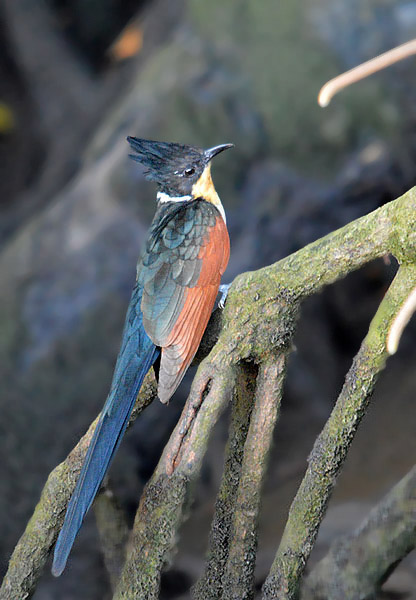
The area surrounding the stake out was surprisingly good as well. I usually stop to show my foreign guests the impressive stretch of mangroves at this locality without much hope of finding anything exciting in terms of birds. Well, not when you just had an hour of exhilarating birding at the stake out. Imagine my surprise when we stumbled upon a beautiful Chestnut-winged Cuckoo resting in full view among the exposed roots of a mangrove tree. It just goes to show again that you can never be sure what to expect when it comes to birding. And this unexpected encounter with a confiding Chestnut-winged Cuckoo turned out to be one of the highlights of the trip.

A handsome male Yellow Bittern hunting next to a canal provided some additional excitement to the excursion. It was a slightly distanced observation but bitterns do not come out into the open like this often. The unobstructed was good enough a reason for us to spend some time with this common species. However, my images of the encounter certainly had room for improvement.


I cannot recall seeing the Black-capped Kingfisher at this locality but on both mornings, one was seen hunting at literally the same spot. It was as wary as ever and despite the amount of time spent with this striking winter visitor, good photographic opportunities were far and few. My guests were old school birders and the visual treats provided the Black-capped Kingfisher will definitely do it for them.


The Common Kingfisher is the only kingfisher that occurs in England and here in its tropical wintering ground, it is overshadowed by our commoner and more impressive species of kingfishers. Nevertheless, a lone female that was hunting at a commercial fish pond gained some of our attention.


The freshwater swamp forest of Air Hitam Dalam in Penang state was the other location that was part of the circuit. One of the most distinct calls of this site belong to a bird that is more often heard and seen. And when you are lucky enough to obtain good views, the Lineated Barbet is quite a sight. This one was resting lower than usual and the slightly obstructing foliage served as a good reminder that we could have had it worse.


A lot more unobtrusive than the barbet, the Asian Brown Flycatcher can sometimes be overlooked. Lacking colours and charisma, it is not much of a sought after species. But a confiding individual like this one can still brighten up my day.


The hot and sunny weather will usually have raptors taking advantage of the hot air thermals here. And to conclude my blog post for this time is a common raptor that undoubtedly is majestic in the air. The resident pair of Crested Serpent-Eagles were busy proclaiming their territory with their far-carrying calls as it is the breeding season. One half of this regal pair flew relatively close to my position and the image turned out reasonably well despite the apparent heat wave.


The traffic woes back to the Pearl of the Orient on both days tested my patience but nothing unexpected with the festivities just a couple of days away. I may be a little late I wishing but then again, the Chinese New Year is a 15-day celebration. So, a Happy and Prosperous Chinese New Year to all those celebrating.

Wednesday, 30 January 2019

Urbanized Owls


My first tour of the year brought to the hilly forest of Sungai Sedim in Kedah state. With the fruiting trees coming into season again as expected, my American client Michael was in for a treat but was not aware of it yet as I picked him from a hotel in the middle of Georgetown City. It was his maiden birding trip to my Malaysia and nearly every bird that came to the fruiting tree was a lifer including the common Cream-vented Bulbuls.


Red-eyed Bulbuls are another common species of the forest here and as expected, a few were gorging on the fruits available.


Uncommon would best describe the Ashy Bulbul and the black mask undoubtedly enhances its appeal. It is seen sporadically at fruiting trees here and its presence today was well appreciated.


With some many varieties of bulbuls sharing the same home, some are bound to evolve and fill up niches that are not so typical of bulbuls like the Yellow-bellied Bulbul. The dim lighted lower storey of the forest is where it frequents and patronizing fruiting trees is about the only time where it reveals itself more than usual.


The star bird at the fruiting tree today was the splendid Grey-bellied Bulbul. It stood out from the rest for its vibrant colouration. Naturally, it had Michael’s undivided attention.


There were a number of flowerpeckers present at the fruiting tree as well. Due to their minute size, good photographic opportunities were far and few. For some unknown reason, they seemed to be particularly restless today. Anyway, the only image that was decent enough to be posted here is of a handsome male Orange-bellied Flowerpecker.


The only sunbird you will usually find patronizing fruiting trees in Sungai Sedim is the Plain Sunbird. The common names of some birds can be misleading but not for this species. The only sign of splendour, present on all male sunbird species, is a small patch of iridescent green on the forecrown. This shot, despite all its flaws, shows that patch well enough.


While we were entertained by the feeding frenzy at the fruiting tree, the territorial calls of gibbons echoed through the vicinity. Captivated, Michael was disappointed when we could not locate a single one of them despite being in such close proximity. Then, like an answered prayer, a lone individual suddenly swung into view and it was an Agile Gibbon.


Shortly after, the reason for the boldness exhibited by this usually wary animal was known. There was another fruiting tree in bloom and like I always say, gluttony is a deadly sin few can resist. And the encounter with this amazing primate was one of the highlights of the trip.


There was one more mission I need to accomplish before concluding this half day excursion. My guest expressed his desire to see a Barred Eagle-Owl and lucky for him, I knew exactly where to fulfil his desire. The location is a modest suburban park but it is home to pair of these intriguing night birds. It did not take long to locate the owls this time as they were roosting on a smaller tree. As usual, it was an exciting lifer for my foreign guest.   


The second owl appeared smaller and I assume should be the male bird. However, his roosting perch was more concealed and there was no way to obtain any better images without the risk of disturbing the roosting pair. Anyway, the Barred Eagle-Owls did more than enough to provide the ideal end to this short excursion and a good start to hopefully another year of hopefully rewarding tour excursions.


Tuesday, 22 January 2019

Counting waterbirds...


The emergence of the Chinese Egrets in Penang Island revived my passion for tidal habitats and the birds that find sanctuary there. I used to spend hours on end at the mudflats of Bagan Belat back in the day. Back when hundreds or even thousands of waders were present at this coastline. Sadly in recent years, the objects of my obsession have shifted to rather inaccessible areas. This and the destruction of most of the good wader sites in my home state has kept me away from indulging in wader watching. Each January, the Asian Waterbird Count (AWC) takes place throughout the continent and on this beautiful Saturday morning, I decided to do my part.


The tide was about right and the weather was good. But as expected, not much variety of waders were present at the extensive mudflats of Bagan Belat. Common Redshanks were the most numerous species present and it has been that way for quite some time.


A huge flock of white birds with black wings started to fly out from the mangroves and alighted beyond the edge of the mudflats. The birds were too far for me too positively identify them. Habitat may be ideal but they sure the hell were not Milky Storks – not in this kind of number anyway. Asian Openbills are a better bet and this is the first time I am encountering them in a marine habitat.


Eventually some of them flew over to my end of the mudflats and their identity were no longer in doubt.


One can always hope of something rare when gazing at flocks of waders out in the mudflats. Imagination can only take you so far but when seen well, it is not easy to misidentify a Common Greenshank for a Nordmann’s Greenshank.


All the egrets present were scrutinized to make sure I do not overlook a would-be rarity. I have recorded the globally vulnerable Chinese Egret here once before but today, only the Great Egret provided any form of excitement from this family of birds.


The resident pair of Brahminy Kites were up to their usual routine of scavenging and the occasional piracy of egrets’ fresh caught preys. However, what goes round comes round and the kites have to put up with the constant mobbing of the House Crows.


A fair number of Whiskered Terns were also present and the river mouth seemed to have their undivided attention today. A short walk along the rocky wave breaker got me into a better position to photograph these angelic and graceful birds. It is not easy but the good lighting helped tremendously.


Poetry in motion – the bird and not the photography…


After the AWC, I swung by the swamp forest of Air Hitam Dalam only to find a group of schoolchildren making their presence felt along the canopy walk. This location holds the status of an educational forest but judging from the level of noise and disturbance this group was making, I doubt there will be much education to be learned from this trip. The wintering Square-tailed Drongo-Cuckoo has been quite tolerant to human presence so far this season but nothing could have prepared it for the commotion that was now taking place. Inevitably, it was nervous and skittish and a record shot was all I could muster.


The male Scarlet-backed Flowerpecker is an exquisite creature despite his common status. Naturally he had my attention and from the look of things, I had his too (in a bad way). Not today, huh bud?


By the later half of the morning, the temperature started to soar and so did some of the birds. More Asian Openbills were seen again and this time at much closer proximity.


Poetry in motion – again the birds and not the photography…


Ever wondered how this stork got its name? Apparently only mature birds will sport this distinct gap between mandibles.


When a striking adult Brahminy Kite leisurely glided into view it was deja vu again. First the Openbills and now this common raptor.


I was just thinking to myself that there is another species that often patrols the sky above the swamp forest here this time of year and just like a staged performance, in came a trio of Black Kites from the adjacent paddy fields.


The kites were probably back to rest after the morning’s hunt and their favourite site is the row of big trees across the river. Enjoying the sight of a tree full of Black Kites is something you rarely get to say especially here in Malaysia.


This male Common Flameback signalled his arrival by uttering a series of his loud territorial call. Although this species is a regular here, I have always adored his vivid colouration. Today, he was particularly obliging and I think I took some of my best images of the species to date.


After the exciting encounter with the Common Flameback, I was ready to call it a day. The heat of the midday sun was starting to wear me out. But, this birding hotspot was not quite done. A male Banded Woodpecker alighted so close that it gave me a startle. This species can be exceedingly tame here at times and this was certainly one of those occasions. He was somehow attracted to a clump of Nipah Palms and most probably is about food. A dried palm frown coincidentally provide an interesting backdrop for the photo.


By that time, lighting was getting harsh. Despite the confiding nature of the woodpecker, some of my images somehow do not quite hit the mark. Nevertheless, like the woodpecker, I took my time to gradually move out of the vicinity. My last visit here was rather mundane but today was a whole different story. And it did not even involved one single uncommon species.


I would have missed the last bird of the day had I not seen it fly onto the perch. Indian Cuckoos are common migrants and there are at least two individuals wintering here this season. It is no award-winning photograph but sometimes, experiences matter more. And observing this handsome male Indian Cuckoo resting among the shadows of the canopy foliage is an intriguing experience indeed.