Pages

Wednesday, 24 November 2021

Jewels of the marshlands


In a time when checklists are being reduced, the Bronze-winged Jacana added itself to Penang’s when it started breeding in the marshlands of Batu Kawan earlier this year. For now, this locality is a wildlife haven especially for water birds. Earmarked for development, there is no is telling when this site will join the rest of the birding hotspots that has diminished in my lifetime. The COVID-19 restrictions for the past six months prevented me from giving these new residents the welcome they truly deserve. Finding myself with some time to kill last Saturday morning, I set out on this long overdue quest.


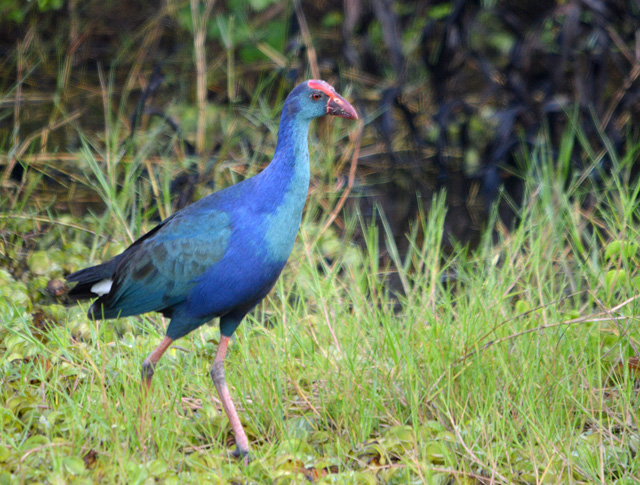
I was surprised to find a number of Grey-backed Swamphens foraging out in the open. Although I drove as slowly as I could, my approach made them retreat back to the edge of the reed beds. Luckily, they were still in close proximity and their stunning appearance momentarily distracted me from my search for the distinguished lily trotters.


I made myself comfortable in my stationary vehicle and observe these sizeable birds go about their routine. I cannot recall the Grey-headed Swamphen to be so confiding. But then human presence is undeniable here. May it be construction workers, anglers or birders. I guess the birds have grown accustomed to all the commotion. Anyway they are undeniably beautiful and as the morning sun gradually rose above the horizon, the colours of the Grey-headed Swamphen start radiate with utter brilliance.


A pair of White-breasted Waterhen were sneaking about quietly near the vicinity of my car hoping not to get detected. But it will be difficult to overlook the contrasting plumage coloration of this common rail even with the distracting Grey-headed Swamphens in the near distance.


When I regained my composure, emotion of another nature began to set in. Anxiety has now pushed aside my feelings of exhilaration because there was no sign of the Bronze-winged Jacanas. It was then that I noticed another stationary vehicle close by. I casually drove over as I could tell it belonged to another birder and was immediately pointed to a foraging Bronze-winged Jacana. And the rest, as they say, is history...


The jacanas tend to move about the locality and I think there are two adults present as they were seen together at one time. They seemed to be constantly foraging as well. Photography was a little more challenging than I had anticipated. Images with motion blur or subject’s head stuck between the marsh vegetation are not exactly appealing images. But the lighting was beautiful today and this photographic woe is thankfully not something a little perseverance cannot overcome.  


The first time I saw the Bronze-winged Jacanas on Malaysian soil was along the banks of Timah Tasoh Lake in Perlis. Back then, they were miles away. In the more recent past, small numbers of this scarce resident were discovered at Chuping which is also located in this tiny state. Though the observation distance was a major improvement, much was still left to be desired. And now, here in one of my local patches, I am ogling at Bronze-winged Jacanas in all their splendour at close range. Surreal is definitely the word that comes to mind. Birders usually associate radiance and beauty with forest birds. If you have ever seen the Bronze-winged Jacana in good light, you know that it is far from the truth. Come to think of it, a few of the residents of this vast marshland are indeed no less spectacular than their forest counterparts.


However when it comes to vocal abilities, the marshland denizens are no match for the songsters of the forest. Despite all its aesthetic appeal, the call of the Bronze-winged Jacana is nothing more than nasal notes.


Bright sunlight will supposedly bring out the best of the plumage colouration and it does, to a certain degree. But for me, the Bronze-winged Jacanas are dazzling birds regardless of what lighting condition they may be dancing under.


In the duration of my visit to the Batu Kawan marshlands, a rather determined female Yellow Bittern hunted for breakfast and did not budge from one particular spot. I could not be sure if she has been very successful there or the opposite. 


It has been a long time since I last enjoyed a memorable encounter with a Common Greenshank. One was wading along a shallow canal and provided a commendable performance. Although it is a stark contrast from the colourful Bronze-winged Jacana, this common but elegant wader provided one of the main highlights of the trip.


I cannot blame the Common Greenshank for a being a bit narcissistic as it admired the reflection of its own sleek form.


Unlike the Common Greenshank, the Wood Sandpiper is a pure freshwater species. You are unlikely to find one plodding along a coastal mudflat somewhere but you can definitely find one in a marsh like this.


Although water birds held the limelight for this trip, a few other species of birds did manage to momentarily have my attention. The Blue-tailed Bee-eater is always a treat to come across in the field. The striking colouration and graceful sallies are near impossible to ignore.


I almost tripped over this overly confiding Zebra Dove that was resting along the pavement next to the vast reed beds. There may be a little exaggeration in my statement but this adorable little bird was barely an arm’s length away and showed very little intention of taking flight from my approach.


For my next destination, I decided to swing by the paddy fields of Permatang Pauh and what greeted upon arrival took my breath away. Surprisingly, it was not an extraordinary bird. It was not even an animal. But a surprisingly beautiful scenery.


Unfortunately, the birding could not provide the same sense of astonishment. It was not to say a poor excursion but I was hoping to catch up with something uncommon rather than just the regular species. Large birds are usually the first ones to be sighted for obvious reasons. And the Asian Openbill is a big and common bird.


Flocks of these peculiar storks was encountered throughout the paddy fields and the confiding ones reminded me just how much I miss birding during the government’s partial lockdown to curb the pandemic.


The angelic egrets are a regular feature here and like the storks, they are rather conspicuous in this open landscape. The Cattle Egret is the smallest but commonest one of them all.


On the other hand, the Intermediate Egret will usually occur in smaller numbers. Furthermore, it is often mistaken for the commoner Great Egret as both species bear some resemblance to each other.


And talk about the Great Egret, here is one providing a ‘reflections of wings and inspiration’ moment as the stately water fowl stalks a flooded patch for prey.


As I wandered further into the paddy fields, I came across even more impressive and large water birds. This Purple Heron looked uncomfortably out of place standing in the middle of this recently planted field.


The Grey Heron is not quite a regular occurrence here and the big fellow’s presence did not go unappreciated despite the harsh lighting.


Although not quite in the same league, Pond-Herons have their own appeal nevertheless. However, one has to wait for the right time of the year when these migrants don their respective breeding plumages to appreciate their true beauty and ascertain their identity.


Flocks of migratory Black-winged Stilts were also back here as expected for the winter. They are not large birds but their sheer numbers, vocal nature and distinctive appearance make them rather conspicuous. Set against the natural backdrop of paddy fields, it is always a delight to observe these graceful waders.


A Stilt with blackish nape is a just cause for getting excited. Pied Stilts, after all, have made their way into the Peninsular Malaysian checklist. But this individual is not going to increase my dormant life list.


Where there are Black-winged Stilts there will usually be Grey-headed Lapwings and they took no effort to hide their disapproval of my intrusion. A lone individual was a little more tolerable and for that I am most grateful.


A careful scan along the muddy stretches did not yield much except for this Little Ringed Plover in non-breeding plumage.


There was one particular patch that was bustling with bird activities and naturally, I decided to have a better look. It turned out to be a flock of Eurasian Tree Sparrows having a feast at the expense of the farmers. Recently germinated paddy seeds were easy pickings and as these raiders continued with their onslaught, the heat of midday started to take its toll on me. I am not sure if the days are getting warmer or my heat tolerance level has dropped due to spending too much time indoors of late. As I made way home, my thoughts inevitably wandered back to the mesmerizing encounter with the Bronze-winged Jacanas and their shimmering plumage.


Friday, 29 October 2021

Back into the field...


After more than 180 days, I finally ventured out into field for some much needed birding. The government eased the travel restrictions between states and myself, fully vaccinated. The Air Hitam Dalam Educational Forest remained relatively the same since the last time I was here. However, there was one difference. I had to follow the new normal and donning a medical mask is very much be a part of everything I do nowadays - including birding.


A Crow-billed Drongo was shadowing the movements of a pair of Plaintain Squirrels attracted by the insects flushed by the mammals. Although the only image obtained during the encounter could not reflect the true beauty of the Crow-billed Drongo but to watch it hawk among the foliage of the riverine trees was a great start to the day.


I admit that my identification skills are not as sharp as they should be as they have not being put to use for a long time indeed. But no matter how long I have been kept away from birding, there is no mistaking a Green-billed Malkoha. When it swooped across the access road with its long tail trailing and all, it certainly made me realize how much I miss this unusual hobby of mine. And just before the cuckoo disappeared into the swamp forest, it was kind enough to leave me with more than just a memory.


Shortly after, a true test of my identification skills took place. Flitting about the foliage of the canopy level, a little brown job looked set to giving me a hard time. Initially, I struggled. Prominent wing markings tried to complicate my thoughts. Unexpectedly, the bird dropped down to a smaller tree and good were now available to me. And the identification of this juvenile Asian Brown Flycatcher, solved.


The Malaysian Pied-Flycatcher after having terrorizing the small insects in the vicinity decided to take a breather on a somewhat expose perch. One does not see this notoriously active bird stationary like this all that often and taking a moment to appreciate it was the least I could do.


A lone male Common Flameback created such a ruckus that it would it impossible to ignore. Come to think of it, with that striking plumage of his, it would still be impossible to ignore him even if he was as quiet as a church mouse.


Although I mostly derived inspiration from birds, this attractive flower has a certain appeal to it and it was enough to even distract my attention. Or maybe it is just because I have been cooped up indoors far too often of late.


As usual, the bubbly song of the Olive-winged Bulbuls filled the locality. I managed to catch one enjoying the rays of the morning sun nearby the elevated boardwalk. Rain has been a regular feature of late and the warmth would be inviting indeed. I guess we could both use a little sunshine in our lives now.


The heat of late morning began to soar and so did some of the raptors that were present here today. Sounding remarkably like a mewing cat, the Brahminy Kite reveals its presence with this distinctive call. The resident pair appeared shyer than usual and I knew better than to press on for better images.


Back from their breeding grounds up north, the Black Kites are once again soaring over the swamp forest and paddy fields of this birding haven. A fair number was recorded but they kept their distance most of the time. This slightly more confiding individual provided a close but brief display of aerial agility. Just enough to lift my spirit.


Asian Openbills also took advantage of the hot air thermal to move from one feeding area to another. These peculiar storks have very much settled down in this part of the state and their huge silhouettes traversing along the skyline are a common sight. I guess absence does make the heart grow fonder and I marveled at the Asian Openbill as though they were still the rare visitors of yesteryear.


One species that has always been a common winter visitor since the first day I took up birding is the Brown Shrike. Perched on top of a short tree, she (told by the barring on her underside) was probably scanning for potential prey. She was confiding and allowed me to shoot contently. That is until a couple of day trippers decided to stroll past with their MP3 player in toll. And people wonder why I am antisocial when birding...


Bright lighting certainly helps with photography but too much of a good thing can sometimes be the exact opposite. A female Plaintive Cuckoo resting in a low bush undoubtedly after a heavy meal was the last bird of the trip. Identification was anything but straightforward typical of female cuckoos. The harsh lighting and inevitable shadows compounded my frustration. But I packed up my gear a happy man. It is good to be back and hopefully, with more field trips to post in the days to come.


Friday, 15 October 2021

Hard disk birding - Chapter 1


As the title of this post implies, it has come to this. The movement control order in place to curb the ongoing pandemic and my own resolution to stay clear of the virus has kept me from indulging in one of my true passions in life. It has been nearly six months since my last birding adventure and that is unprecedented. The thing that scares me the most is that it feels like I am beginning to accept this life. A life without birding. And that will not do. Fortunately, my archive of digital images enables me to travel back in time to some of my more notable birding experiences. Although it is not as captivating as the real thing, in a time like this beggars can’t be choosers. These reflections of wings and inspiration help to keep my passion burning and for that, I am most grateful.

It was a moonless night and the windswept Eucalyptus Trees swayed eerily to the rhythm of Mother Nature’s will. A slight rustling among the leaf litter immediately caught the attention of the resident Brown Wood-Owl as nothing escapes its acute hearing. Despite having just fed told by the blood-stained talon, it will take more than usual to satisfy the hunger of this nocturnal predator on a chilly night like this. Together with a few companions, I documented the owl’s activities as long as it permitted me to intrude into its realm of darkness. The encounter took place in the forest of Bukit Larut many years ago. But the memory remains so vivid that every time I dwell in it, I could almost feel the caress of the cold mountain ambience once again.


With the rat securely clasped in its talons, the mighty Eastern Imperial Eagle carried itself effortless above a sea of green to feast in leisure at a secluded spot within the vast paddy planting district of Permatang Pauh in mainland Penang. A murder of crows half-heartedly harassed the raptor for a short distance before diverting their marauding attentions to some other unlucky victim. A lone birder struggled to maintain his composure as this memorable encounter unravelled before him in order to immortalize some bits and pieces of the experience to serve as a way to revisit this faithful day in years to come. Like today, twelve years later.


The sit-and-wait approach to wader watching is not fool proof. In fact when it comes to birding, nothing is. However on a beautiful Saturday morning along the bleak and muddy shoreline of northern mainland Penang, the rising tide pushed a Great Knot almost to my lap. This wader is a regular winter migrant to this area but in small numbers. And to have one foraging so close was just incredible. I have half-hidden myself quite uncomfortably among the rocks of a wave breaker before dawn and the luck of the draw this time made sense of all the aches I put myself through.


With a name like this, one would probably assume that the Amur Stonechat spends a whole lot of time in rocky habitats. Anyway, I find the ones wintering here in Peninsular Malaysia to have a preference for grassy stalks. Just before they migrate back north to breed, the males will start to look their best by donning their breeding plumages. The agricultural lands of Chuping in Perlis state play host to a healthy number of Amur Stonechats each season like this male in partial breeding plumage. He was quite vocal as the breeding season beckons and on this occasion, was true on his name.


The approaching thunderstorm darkened the sky but the anticipation of encountering more fascinating bird life along the access road up to the summit of Bukit Larut pushed me to carry on. Then the piercing territorial call of the Pygmy Cupwing filled the forest undergrowth and the gamble I took could pay off after all. This gloomy and densely foliaged domain can hide the bird well but decades of birding has made me a patient man. With only the call among the vegetation as my guide, I followed the movement of this adorable creature for a substantial period of time. My effort was rewarded when the Pygmy Cupwing momentarily abandoned its skulking persona and revealed its true beauty on an exposed perch.


Truth be told, the vibrant colours of the Blue-throated Bee-eater alone would be sufficient to make it an exceptional bird but Mother Nature has bestowed upon it aerial agility rivalled by few. Blue-throated Bee-eaters are summer visitors to Peninsular Malaysia and I can find them terrorizing winged insects in scrubland habitats throughout mainland Penang at the right time of the year. Their mid-air hunting forays are quite a spectacle and dragonflies form most of its diet here. And as the name implies, an occasional bee or two will suffer the same fate as well.


Of all the frogmouths that occur here in Peninsular Malaysia, the Blyth’s Frogmouth is probably the commonest. However, for this particular family of nocturnal birds, common does not mean easy. Its distinct call can be heard in several of my regular haunts but through the years, I was only fortunate enough to see it on a few occasions. On one such occasion, my companions and I came across a confiding female at the edge of a forest in Kedah state during a pre-dawn excursion. Her terrifying stare should send chills up the spines of most humans. But birders, are a breed apart and will find beauty in this unlikely animal.


I can consider myself lucky that I can come across the Black-naped Tern on a regular basis. Having stayed all my life in Penang Island, crossing the Penang Bridge is a normal routine for us islanders. And from the bridge is where these resident terns can be seen. However photographing the Black-naped Tern is near impossible here and judging on how people drive, hazardous to your wellbeing. My best photographic efforts come from the pelagic trips off the coast of Tanjung Dawai. Safely aboard a fishing vessel, I can acquire digital memories of this elegant tern with peace of mind.


An eagle in flight is awe inspiring and few representatives of the natural world can surpass the sight of this formidable predator soaring in the sky with its powerful wings. Identify the bird of prey accurately and you will achieve true enlightenment. However for the migratory Aquila eagles, scrutiny is usually required before their identities are revealed. And a racing pulse offers no aid in the process. On this occasion which took place in the paddy planting districts of mainland Penang, the Greater Spotted Eagle remained in view long enough to prevent any mistakes from the observer. Despite being the commonest of the three species that is known to occur, there is no denying the majesty of this winter visitor.


Among the diminutive woodpeckers that occur here in Malaysia, the Grey-and-Buff Woodpecker is the most exquisite in my book. Sporting a wicked crest, intricately marked upperparts and a flaming red forehead for the males; it can even give the big woodpeckers a run for their money. Because of its small size, it is often kept from view by the dense vegetation of the canopy from which it calls home. During one faithful day at the forest surrounding Pedu Lake, a confiding male provided a moment of magic for me and my companions. And in terms of forest birding, an encounter like this can very well be a once in a lifetime experience.


Monday, 5 July 2021

A lily-trotting rarity


I have not been out birding as often as I used to but reports of a pair of Bronze-winged Jacanas at the marshlands of Batu Kawan awoken something in me that has been dormant for too long. It was just a matter of time before I made my way to seek out this scarce resident. Unlike in neighbouring Thailand, only a couple of sites in the northern state of Perlis is where this species has been recorded with any regularity in recent years.

It was a gloomy morning and with no signs of the jacanas upon arrival, the atmosphere was less than cheerful for my company and other like-minded birders. A White-browed Crake almost had us fooled when it caused some movement among the floating vegetation. But a Bronze-winged Jacana is just too stunning to be mistaken for anything else.


Migratory Reed-Warblers, as the name implies, find refuge here in the reeds as well. However, they can hide remarkably well if they want to. Today, only the Black-browed Reed-Warbler managed to find its way into my memory card.


When the celebrity birds finally revealed themselves, the joy was short-lived. Perhaps the presence of too many humans did not go well with the Bronze-winged Jacanas and they kept a safe distance throughout our observation. The poor lighting condition only compounded my dismay. Emotions aside, there is no denying the significance of this first state record. Enjoying the true resplendence of this lily trotter will just have to wait another day.


The pair was showing signs of breeding and we were even given a short courtship display. Inevitably, throng of bird photographers came for these beautiful water birds and some were overly enthusiastic and creative in their quest.  Shortly after our visit, Malaysia came under lockdown again due to the pandemic. I guess it was a blessing in disguise as the stricter movement control order gave the Bronze-winged Jacanas a chance to raise a family in peace. At the time of writing, the chicks have long fledged despite all the disturbances the nesting pair had to endure initially.


Without any indications of improvement shots for Bronze-winged Jacanas, I started to give the other species present their due attention. Unfortunately, there were not many around. A lone Asian Openbill was close enough for a record shot but not close enough to evoke anything else.


My best effort today should be of this adult Purple Heron resting all so elegantly among the reeds. It remained unperturbed by my presence and on a trip where good images are hard to come by, this common but striking heron provided the magic.


A good number was present in the vicinity today including juveniles pointing to a successful nesting season. Penang, my home state, is one of the busiest in the country. It is constantly being developed and sometimes at an alarming rate. Call me a pessimist but I can see no happily ever after for the colonies of Purple Herons here. It is just a matter of time before development displaces this wildlife refuge.


The absence of some of the usual water birds today was disheartening and the walk along the access road was long and tedious. A Malayan Pied-Fantail literally stopped me at my tracks when it suddenly alighted on the road not far from me. It was not exactly in pristine condition. Probably had a rough day so far as well but it did well enough to brighten up the day.


Chestnut Munias are the commonest munia species here and a small flock foraging along the edge of the reeds had my undivided attention. Like the Fantail, they were confiding and provided some cheer before the rains concluded the trip.


Three months have past since that gloomy morning with the Bronze-winged Jacanas. Due to the increased severity of the coronavirus in the country, it was my last birding excursion. It is a dark time now and life is shrouded with uncertainties. However, I always believe nothing lasts forever. Not even a global pandemic. To wrap things up for this time is not an image but rather, a cliché quote by Friedrich Nietzsche - that which does not kill us makes us stronger.