Pages

Friday, 12 June 2015

My Garden Birdwatch 2015

It is time to put on your citizen scientist’s coat and give a helping hand to the conservation of bird life in Malaysia. This year, My Garden Birdwatch (MYGB) will be held on the 20th and 21st of June 2015. All you need to do is record and count all the birds you see from your garden for 30 minutes on any of the two dates. It is as easy as that. To register yourself for this significant survey or for more information, please do visit the MYGB website. Below is the image of one of commonest birds in Malaysia that can be found in most residential areas, the Pacific Swallow. Usually ignored by most birders due to its abundance, this graceful aerial feeder has adapted perfectly to living alongside humans. It certainly does brighten up my day every time I see it glide overhead as I head out to work in the morning.


Tuesday, 9 June 2015

G'day, mate! (08/06/2015)

It will have to take a very special bird to get me to wake up a few hours earlier than usual on a working day and twitch for it before going to the office. The Horsfield's Bronze-Cuckoo is one such bird. Earlier in the week, at least 10 of these rare cuckoos were recorded in Singapore which is their highest count in history. Birders up north are hopeful for at least one of them to make its way up here and one certainly did. With only four confirmed records in Peninsula Malaysia so far, this austral migrant shook my world when a single bird was discovered by Hor Kee yesterday morning at the Pulau Burung Landfill in mainland Penang. Unlike usual migratory birds, this species migrates only at this time of the year to escape the harsh winter of southern Australia. The months of May to August are the best time to see them at their wintering grounds which rarely included Peninsula Malaysia. This cuckoo qualifies as a mega lifer for me but with only a window of one hour to relocate a small brownish bird among the dense scrubland of the landfill, it will not be an easy twitch.


Despite Hor Kee and Choo Eng's pointers of the cuckoo's locality and habits, I had a tough time searching for my quarry. And to make things worse, time is a luxury I do not have today. With each passing minute, my optimism grew weaker and disappointment slowly crept into my soul. Just about then, a small brownish bird with longish wings and tail flew awkwardly above the scrubland and alighted not far from where I was. A quick glance with my binoculars confirmed its identity. What better way to start off a work day than with a successful twitch for a mega lifer. I heaved a sigh of relief as I captured my first ever image of the Horsfield's Bronze-Cuckoo. The 40-kilometre southward journey was certainly worth all the effort.


With the cuckoo in sight, I lost myself in the moment, as expected, and trekked off the beaten trail into the scrublands in my work clothes. The urge to get closer for better shots was simply too strong and a promise I made to myself to keep myself presentable for work was forgotten. By the time I realised it, my shoes and trousers were covered with earth, dew and grass seeds. But, I also managed to obtain much better images of this rare visitor and that was what matter the most.


It was relatively easy to follow and observe the cuckoo due to its confiding and sluggish nature. There are times when it was constantly on the move and I can only assume it was foraging. It was also quite alert towards bigger birds flying overhead. A good look at the red iris indicated that it was a male bird. He was a handsome specimen with the greenish sheen above and the subtle barrings below. And of course, the diagnostic eye-stripe completes his look. A switch of location by the cuckoo resulted much to my advantage. I could then photographed him against the green background of the scrub vegetation and the excitement of this short but memorable trip escalated to a whole new level.


The cuckoo was also getting comfortable with my presence and much to my delight, started to preen and even showed off his chestnut outer tail feathers to a gawking Penang birder...


Some movement on a nearby bush distracted my attention momentarily. My hope for a second Horsfield's Bronze-Cuckoo was dashed when it turned out to be just a Zitting Cisticola.


The cuckoo shifted one last time before he flew deeper into the scrubland. The choice perch this time was quite ideal because it was a dead twig and in good light. The timing for the cuckoo's departure could not have been any better as well. With it out of sight, I hastily started my journey back as I could still make it to work on time. It would have been a very different story if the cuckoo had stayed on and continued to mesmerise me with his presence. Back home my better half asked me what I would have done if I failed to find the cuckoo and that question required some thinking. After a significant pause, I replied that I would go to work when the time came regardless of the outcome of my search. I am not sure if she was fully convinced because I was not. Six months is a long time to go through without a lifer. Then came this cute, little Australian cuckoo that felt it was time to put some life back into my dormant life list. Thank you and welcome to Penang, mate!

Sunday, 31 May 2015

Saved by the bill...(23/05/2015)


I have been neglecting a few birding sites in Penang of late and so, I decided to head south this time to Bukit Panchor State Park. This locality used to house quite a number of lowland forest species but it has deteriorated tremendously in terms of bird life. To be honest, the only reason why I still visit this place is hoping to find something short of a miracle - the Giant Pitta. But even that hope is now diminishing. During the past two visits, I only managed to shoot one single bird respectively. For this trip, I ended up empty handed and after two hours of trekking through the forest, I decided to move on to another locality. As I was about to reach the car park, I could hear an emcee making announcements and music been blasted at a decimal that would even drown out the far-carrying territorial call of the Great Argus. By the way, this used to be the only place in Penang where this spectacular pheasant occurs. Only God knows what other events go down at this state park and how frequently. I am not saying these events are bad but if you are going to hold them amidst the wonders of nature, show a little appreciation and respect. If not, why bother to hold them at such a locality in the first place? 


I was in a foul mood when I left Bukit Panchor and since I was in dire need of some quality birding time to get over this state of mind, one birding site came to mind immediately - Air Hitam Dalam. It was past mid morning when I finally arrive and after greeting a couple of birding friends at the car park, I decided to head to the elevated boardwalk. 


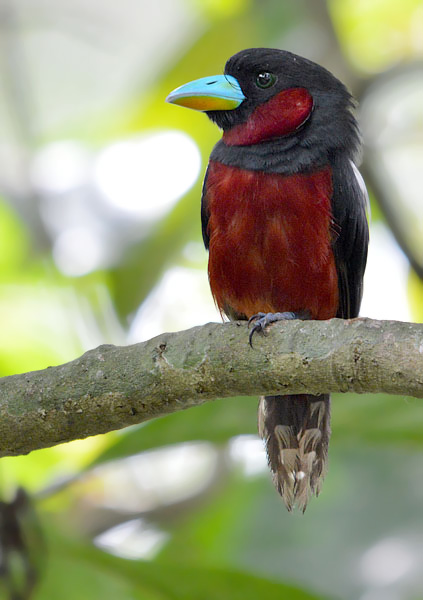
The striking colours of the Black-and-red Broadbill stood out like a sore thumb even from a distance. I slowly inched my way closer. Much to my delight, it was unperturbed by my approach and went about its business. The magic of Air Hitam Dalam prevailed yet again and I was rewarded with an encounter of a lifetime with this exceptional avian beauty. 


The encounter started off with the broadbill very close but unfortunately, in very strong backlight.


I made a request, as politely as I possibly can, for the broadbill to shift to the other side of the boardwalk where the lighting was better. Astonishingly, it obliged. Now, that's a good girl!


This broadbill is relatively sluggish and it tends to move about at a leisurely pace. During my observation, it foraged along every level of the forest from the undergrowth to the canopy.


When it has an insect prey in sight, it steps up a gear and goes into overdrive. Due to the lighting conditions, most of my images of it devouring its prey were blur and soft. All except for this one, that is. 


Eventually, the broadbill moved deeper into the forest and out of sight. I tried to make amends for ignoring the other species that came along during my time with the broadbill and it included notable species like the Blue-winged Pitta and Streak-breasted Woodpecker. But in life, sometimes you only have one shot and you have to seize the moment because you might not have a second chance. A female Ashy Tailorbird that was busy preparing for the breeding was very little compensation. 


The colour of the native Green Crested Lizard can certainly catch your attention...


If not for his deafening territorial calls, I would not have noticed this male Asian Koel that was perched slightly lower than usual. Head on, this cuckoo was hidden from sight but from the side, I managed to find a less obstructed angle to capture his images. This is certainly one bird that you hear more often than you see and I am happy with this encounter. 


At the rear car park, the female Mangrove Blue Flycatcher was venting out her frustration of being ignored the entire morning from an open perch. When all else fails, the 'in-your-face' approach will not...


Air Hitam Dalam has an under-utilized canopy walk. It is nothing compared to the behemoth structure at Sungai Sedim and probably about ten meters above ground and one hundred meters long. I have only been on this canopy walk a couple of times since it was built. I wanted to capture some shots of this educational forest from a different perspective. My godfather frequently reminds me to include shots of habitats and other things in my blog as it will make it more interesting. 


And guess who was also enjoying the view from the canopy walk area. If I did not know any better, I swear the broadbill was following me around this time and not the other way round...


Again it was exceptionally tame and comfortable in my presence and looking absolutely gorgeous even with a loose feather sticking out from its crown. 


For the second trip in a row, I was blessed with the opportunity to observe and enjoy this fascinating bird at such close quarters. To wrap things up for this time, here is one last image of the broadbill. 

Wednesday, 20 May 2015

Oh, what a bill! (16/05/2015)

I woke up to the sound of the alarm on my iPhone and the rhythm of the falling rain on the roof. I was in a solemn mood as I contemplated on the fate of my birding plans for today. By the time I got myself ready, the rain almost dwindled to a stop and the dawn chorus started to fill the surrounding areas of my humble abode. Although the chorus consisted mostly of the bubbly calls of the ever-common Yellow-vented Bulbuls, it was music to my ears and all the motivation I needed to head out the door for my next birding adventure. The hilly forest of Sungai Sedim in Kedah was the choice location this time and it was a beautiful morning there unlike the gloom weather back home in Penang.


A handsome male Rufous-winged Philentoma was busy establishing his territory from the lower storey of the forest with his mournful disyllabic whistle. As confiding as he may be, the poor lighting condition was simply too much for my gear to overcome and I had to settle for these slightly mediocre images.  


Before I started bird photography, I would be absolutely delighted to be able to record three species of Trogons on a single trip. A female Red-naped Trogon provided flitting glimpses as she moved along the canopy level but I did not have the chance to even focus my camera on her. This female Scarlet-rumped Trogon, on the other hand, was sitting still for a prolonged period of time but there was only a narrow gap among the foliage to photograph her.


It was an all-ladies affair for the trogons as the third and final species was also a female. The female Diard's Trogon is one of the most striking of all the female Trogons. She was calling from deep within the forest when our paths crossed. Almost at eye level, it would have been a reasonably good shot if she was just a little closer. None of the trogon images today were good enough by any standard and I cannot help but to feel a little disappointed.


The Orange-backed Woodpecker is probably the largest woodpecker you will get to encounter here at Sungai Sedim. The male of this species is also one of the most vibrantly coloured woodpeckers in Malaysia. Usually vocal by nature, this woodpecker is conspicuous whenever it is present. However, good photographic opportunities are not easy to come by. Take this male for example. He stopped just long enough for me to take a single shot before he disappeared back into the forest.


Apart from game birds, only two other birds actually walk on the forest floor in Malaysia. One is of course the enigmatic Malaysian Rail-babbler and the other, the Black-capped Babbler. The former is on my list of birds that I need to shoot before my time on Earth is done but no such luck today. It was the latter and it is nevertheless, a bird that I would love to shoot as well. I anticipated the path that the bird will take and waited at a slightly more open area of the undergrowth. However, instead of the babbler, this butterfly came along and happily alighted not too far from where I was lying in wait.


One of the most widespread and adaptable birds in Malaysia is the White-rumped Munia. Its habitat ranges from the paddy fields of the lowlands to the primary forests of the mountains. With such an impressive range of habitats, it comes as no surprise that the population of this little seed-eater is doing well. This lone individual was foraging on a small tree as I was making my way back to the car park. It was already midday and I was drenched to the bone in my own sweat and dripping blood from multiple leech bites on my legs. I guessed I had enough of birding along forested trails for the day.


With the weather still holding well, I decided to do some afternoon birding at Air Hitam Dalam in mainland Penang. This locality is now probably the hottest spot for bird photography. Even at this hour, I was greeted by a few birding friends at the car park area. I did not linger at the car park though. I wanted to see if anything was about from the stretch of elevated boardwalk that cuts through the swamp forest. To come across a confiding Black-and-red Broadbill just beyond the boardwalk was more than I could ever wish for. In birding, sometimes wishes do come true…


Unlike my previous encounter, it seemed like the broadbill was not going anywhere soon. And neither was I, naturally. It foraged, preened and danced among the foliage of a particular group of trees in the vicinity. As for me, I made myself comfortable and soak in the moment. And of course, took as many photos that this amazing and adorable creature would allow me to.


The two-toned bill of this species is really something else. Just look at it. It is turquoise on the top and yellow on the bottom. All the other broadbills have one-toned bills. There is no other bird in Malaysia that has a bill like that. The very first time I saw the Black-and-red Broadbill, it was along the lower slopes of Cameron Highlands. Only part of the head was visible but one good look at the bill and its identity was revealed.


The lighting conditions put my gear and my photo-taking abilities to the test. The dense foliage was another major hindrance as most of the time, the broadbill was slightly obstructed. But an up close and personal encounter like this is somewhat of a novelty to me. So, almost the entire afternoon was dedicated to the broadbill and it was time well-spent indeed.


A male Ashy Tailorbird did wander close to where I was observing the broadbill. By then it has been more than an hour and I could managed to drag myself away from the latter and shower the tailorbird with some attention.


This is a picture of true bliss and contentment. A Collared Kingfisher indulging in a late afternoon sunbath.


A walk along the river trail produced nothing much but this flying shot of the resident Brahminy Kite. This common but striking raptor wrapped things up for this time and it was another rewarding excursion courtesy of a couple hours of sheer birding pleasure with a confiding broadbill at my favourite site in Penang.