Pages

Tuesday, 4 October 2011

Kupang-Gerik, Perak (01/10/11)

It has been more than a year since my last visit to this logging trail which is sadly the only way we have access to this pristine area of tropical rainforest. The day started off on a quite positive note when a Peregrine Falcon flew overhead. Every other bird that was up and about in the area immediately took cover from the mere sight of this deadly predator. Unfortunately, the falcon alighted on the canopy level of the tallest tree around and well beyond my gear’s comfort zone.

The locality was also filled the loud and distinctive calls of the Hill Mynas. After putting in some effort to locate the birds, I was slightly disappointed with the results. Although my subjects were rather close, the only way I could obtain a slightly clear image was to shoot between small gaps of the tree’s foliage. This species is a highly-prized cage bird because of its ability to mimic human speech and other sounds. And it is because of this talent that its population has been greatly reduced from many of its former strongholds.

A pair of foraging Scaly-crowned Babblers provided the main highlight for the trip. My preference for non-flash photography always made it quite a challenge for forest photography especially when it comes to babblers and their active nature. I had to rely heavily on continuous shooting and with a whole lot of luck, hopefully a few shots will turned out good. Anyway, this is the best shot out of the whole lot.

A pair of Red-bearded Bee-eater tantalizingly hawked for insects along the logging track and provided some colours and excitement to the trip. This pair of forest gems was the last birds we managed to photograph for the trip.

There was another encounter worth mentioning during the trip and it involved a snake. All three of us could have sworn that it was a cobra as the meter-long serpent raised its hood before slithering into the undergrowth. Choo Eng’s quick action resulted in a few record shots and a herpetologist researcher back home thinks it could be a juvenile King Cobra or an Indo-Chinese Rat Snake after reviewing the images. And I thought reptiles would be easier to identify...

Monday, 12 September 2011

10/09/2011: Mainland Penang

A predawn tropical downpour altered my plans for some forest birding later in the morning and I visited the marshlands at Pulau Burung instead. Unfortunately, things were rather slow at this locality and I diverted my attention to the commoner species. The Pacific Swallow is certainly a regular here and today it provided quite a number of excellent shots like this one.

A pair of Little Grebes was more obliging than usual on this wet and gloomy morning. I noticed a particular piece of drift wood where the Grebes frequently return to rest. So, I positioned my car nearby and just observe and photograph these adorable water birds from a reasonably close distance.

Much to my delight, the pair carried on their routine despite my presence and I had a very rewarding photo session.

On my way out of the marshland, I made one last stop to photograph a Paddyfield Pipit that was resting next to the access road. Since the discovery of the Blyth’s Pipit, every pipit that I come across nowadays deserves a second look – just to be sure.

My next destination was the mudflats at Batu Kawan. A small number of migratory waders have made their way here and to enjoy their tropical vacation. These two Lesser Sand-plovers were squabbling over a small piece of exposed mud when there was more than enough mud banks to go around. Come on, guys!

A flock of large birds circling low above the nearby mangroves caught my immediate attention. Besides, there was not much about anyways. When the flock turned out to 14 Lesser Adjutants, this mundane trip suddenly became a lot more interesting. I must admit that I have a soft spot for waterbirds – especially the big ones. And the Lesser Adjutant is the tallest (second only to the Sarus Crane, once a winter visitor but sadly not anymore) in Malaysia which only means that this stork is right up there among my all-time favourites.

I really had to put my driving skills to the test because the storks were circling away from me and I desperately needed to reduce the distance between us in order to get into a better position for photography. To accomplish that I had to maneuver around potholes and trenches in the fastest time possible while keeping an eye on my quarry. Luckily, I managed to in the end and obtained some my best shots of this species to date.

Although it can be locally common at a few other localities, it is seldom encountered in my home state of Penang and this number is by far the highest count as well. Some may find this species rather unattractive but I, on the other hand, find it to be most impressive and majestic – especially in flight. Beauty is in the eye of the beholder and to me there is no such thing as an ugly bird – even if it has a bald head.

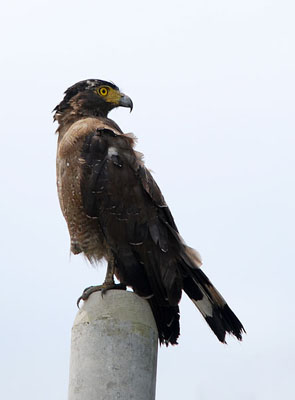
Just before I called it a day, I made a detour into Juru to see if there was anything about and I bumped into an old friend and from previous encounters, happens to be one of the most confiding Crested Serpent-eagles ever.

Every bird photographer yearns to capture their subjects on a natural perch and the eagle must have read my mind and shifted to a nearby mangrove tree.

Ideally that natural perch should not obstruct any part of the subject. And like a model taking hints from a photographer, my subject moved to a more exposed perch. I guess asking it to move one last time to a clean background would be pushing it a little too far.

Wednesday, 7 September 2011

07/09/2011: Permatang Nibong (Penang)

With the migratory season about to go into full swing, I was quite eager to check if there are any rarities among the early arrivals to the paddy fields here. However, only the commoner migrants were encountered today like this Common Sandpiper. The migrants are certainly starting to trickle in and I am looking forward to a fruitful season – hopefully.

This male Cinnamon Bittern is doing what he does best – trying to conceal himself from an immediate threat and this time, an approaching birder.

A flock of White-rumped Munias was helping themselves to the ripe paddy seeds when I managed to capture a few shots of this particular individual that came closest to my stationery car.

The highlight of this short excursion was a male Pink-necked Pigeons that was resting among the scrub vegetation. He was quite confiding and the low perch provided a good photographic opportunity.

He may be common but still, a very handsome fellow indeed.

Wednesday, 24 August 2011

20/08/2011: Sungai Dua (Penang)

Initially, I wanted to pay a short visit to the swamp forest at Air Hitam Dalam but accessibility to the site has gotten much worse since the last time I was here. The boardwalks certainly look fragile and are very much overgrown. So, I decided to get back into my car and check out the adjacent scrublands and paddy fields instead.
The Black-thighed Falconet is the smallest raptor in the world - a title it shares with its Borneon counterpart, the White-fronted Falconet. Like its larger relatives, this minute falcon is an accomplished and deadly predator as well. I have been waiting for an opportunity to photograph this species from close quarters since the day I took up photography but it has always remained beyond my equipment’s "comfort zone". Despite having to shoot against a dull sky, I am still rather happy with the images I have managed to obtain as this is the closest distance so far.

A stretch of barbed wire fencing appeared to be a favourite haunt for a couple of Plaintive Cuckoos. Although it is quite a common species, it is more often heard than seen. In fact its old name was the Brain-fever Bird and that particular name is also used by a few Hawk-cuckoos as well. When I was young, I have the good fortune of being able to experience this cuckoo’s namesake which at that time, I found it to be both humorous and fascinating. There was a resident pair that made their home within my parents’ neighbourhood and their persistent calls during the breeding season can be heard throughout the day and even the dead of the night. Lucky for them, they usually stay out of sight because I am pretty sure there is a bounty on their heads for all their midnight choruses.

Suddenly, I picked out a Greater Coucal foraging nearby and decided to try my luck with it. Since I have touched on the subject of old names, Crow-pheasant is an apt name for the Coucal. It certainly looks like a Crow but it forages like a Pheasant. Hence, the name. Life was certainly much simpler in the olden days. Anyway despite its large size, it is also more often heard than seen - typical of the Cuckoo family. Although it was rather confiding this time, the dense vegetation and its constant movements hindered my efforts tremendously. At the end, there was only one single shot that I could be slightly proud of.

When the Coucal made its way deeper into the scrub vegetation, I found that one of the Plaintive Cuckoos was still on the wire. I re-positioned my car as close as possible to it and gave it my full attention this time. The vicinity was certainly good for hunting because I saw it taking at least 4 caterpillars from the ground during my watch.

It tolerated my presence throughout my observation. I really wish I could get a little bit closer but the terrain was a little steep for my car and I doubt it will still be as confiding if I made my approach on foot. So, I made the best of what is being offered and here are a few more images of this beautiful cuckoo.
The successful forays of the Cuckoo must have attracted this White-throated Kingfisher and it alighted on a nearby post – hoping to get in on some of the action.

This Cattle Egret is gradually moulting into its duller non-breeding plumage. Cheer up, buddy. They will grow back next year.

I just had to be sure that there is no hidden surprises among the flocks of domesticated ducks making their way into the paddy fields to forage. I know that it is just wishful thinking but if I were a wild duck and instead of chilling out on a lake in central Thailand for my winter vacation, I somehow ended here in a paddy field in Malaysia, I would follow the locals closely and try to blend in.

Thursday, 18 August 2011

The Openbills are back in town (13/08/11)

A quick visit to the paddy fields at Permatang Nibong produce the first sighting of Asian Openbills for the season. For the third consecutive season, these enigmatic storks have chosen my home state of Penang as their off-breeding vacation destination. This flock appears to be the same five individuals from the previous season and there is not much difference in terms of colouration and plumage. Anyway from the look of things, the status of Asian Openbills in Malaysia could well be on the way in becoming regular non-breeding visitors in small numbers. Welcome back, my friends.

Thursday, 4 August 2011

30/07/11: Pulau Burung (Penang)

I decided to make a short visit to this locality although it is still a little too early for the migratory waterbirds. As I was making my into the site, I was greeted by a lone Brahminy Kite having some breakfast on one of the overhead electrical cables.

And just a short distance away was a Stork-billed Kingfisher on the very same cable. I guess the hunting must be good along this stretch.

Long-tailed Macaques are a common sight here especially along the mangroves. This mother and child are enjoying the warms rays of the sun after a rather chilly and wet dawn.

In the absence of the migrants, I focused my attention on the residents like this young adult Purple Heron. It is rather uncommon to see this species right in the open and I took full advantage of the situation and took as many shots as possible. Most of the images did not turn out as good as I was hoping for due to the poor lighting conditions.

The number of Little Grebes within the vicinity has increased due to the influx of young birds from this year’s breeding season.

I did come across a few early arrivals to this locality including this juvenile Little Ringed Plover.

On one of the side roads leading to the coast, which I shall christen Fantail Lane, has at least 5 Pied Fantail feeding the flies and other insects along the road. The insects were attracted by the rubbish and they provided an endless supply of food for these flycatchers. Three of the fantails, immatures of slightly different ages, were rather confiding. My stationery car soon became just a part of environment to them.

One of them even came as close as the base of my car tires…

A small flock of Baya Weavers caught my attention as they foraged along the tall grass. The males are showing signs of moult signaling the end of this year’s breeding season.