Pages

Wednesday, 21 December 2011

20/12/2011: Sungai Sedim (Kedah)


I have only gone a short way up the Gunung Bintang access road when I came across a splendid male Siberian Blue Robin foraging just up ahead and this is a species I long to have in my archives. At this early hour the lighting was terribly poor and I had an impossible time trying to focus my camera on the bird. Then something scared the living daylights out of the Robin because it suddenly dived into the undergrowth while emitting alarm notes. And I was pretty sure it wasn’t me. While I was still trying to figure out what took place, I noticed a slithery movement on the road and it was the culprit that made me miss my shot – a Variable Reed Snake. However, it was too small to possibly hunt the Robin but I guess it was a case of better be safe than sorry for the Robin.


That little episode got things rolling for this trip and what a trip it turned out to be. During my 5-hour visit, I managed to record two lifers and more than 60 species including a few very notable records. Unfortunately, the key word here is record. My first lifer, a female White-throated Rock-thrush, stayed in sight long enough for a positive identification only. I did manage to take a shot of my second lifer, the Brown-chested Jungle-flycatcher, but the image turned out to be pretty insignificant. Not only because of the poor quality but it only showed the back of the bird.

I could hardly contain my excitement when I came across a pair of foraging Chestnut-backed Scimitar-babblers. Apart from the fact that this is the first time I have seen this species here, they are truly striking birds and always a delight to observe. I guess you just have to take my word for it…


This male Orange-breasted Trogon on a slightly exposed perch was probably the best bird image of the trip.


A total of 4 Hornbills were recorded at the locality today. The Rhinoceros and Bushy-crested Hornbills were heard calling. A pair of White-crowned Hornbills flew just above overhead with the dense forest canopy between my camera and them. It has been almost 8 years since my first visit to this forest reserve and the distinctive calls of the Helmeted Hornbill can be heard on almost every visit. You can only imagine the amount of pleading and swearing that went down when I took this shot of this amazing bird.


One image did turn out quite to my liking but it was not of a bird. This beautiful Dragonfly was resting about eye level at the forest edge and the green foliage provided the prefect background.


This millipede making its way about some thickets wrapped things up for a memorable trip despite the disappointments from a photographer’s point of view.


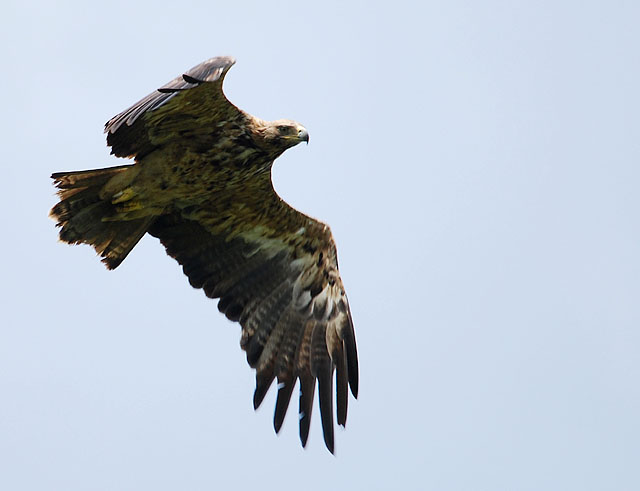
On the way home, I made a quick detour into the paddy fields at Kubang Semang to check on the Temminck’s Stints only to find the patch been completely planted with new paddy shoots. However, an immature Eastern Imperial Eagle circling over the fields put on quite a performance and unlike photographing forest birds, it is almost impossible to miss a bird as huge as this right out in the open.


Monday, 19 December 2011

17/12/2011: Mainland Penang


Upon my arrival at the marshlands at Pulau Burung, I spotted the silhouette of a large raptor perched on an electrical cable and it turned out to be one of the resident Changeable Hawk-eagles. Using the cable as a lookout point to hunt, it particularly ignored my presence and concentrated fully on the task at hand. Unfortunately, the lighting conditions prevented me from obtaining better shots and that was a real shame as this is probably the closest I have ever been with this bird of prey.


Whilst photographing the eagle, a second eagle alighted on the cable that was directly above my car but out of my field of view. There was nothing I could do to about it because at that close distance, any movement from me or my car will certainly spook the eagle. After a few minutes, the second eagle probably did not feel comfortable in my presence and flew off. And I continued to admire and photograph the first eagle to my heart’s content.


I was delighted to see the two Garganeys settling in well here and hopefully, in time to come will gradually become less wary. Until then, distance observations like today will just have to do.


Meanwhile at the ‘Little Stint Corner’, there was a high level of bird activity. The Little Stints were foraging along the slightly flooded patches as usual. Unlike my previous visit, the stints came quite close to my stationery car and provided a fair share of good photographic opportunities.


The Long-toed Stints are also another regular at this patch and I guess the condition here really suits both these species of stints.


I find it a little odd that at this time of the year this Little Ringed Plover has not even started to moult into winter plumage. Perhaps it’s just a little reluctant to shed this striking plumage for the much duller one. 


At my second birding locality of the day, the paddy fields of Bandar PERDA, it was again a raptor that started things off. For the third consecutive season, the mighty Eastern Imperial Eagle is spending the winter here. Welcome back, big guy.


When I drove along the adjacent paddy fields of Kubang Semang, the Grey-headed Lapwings certainly made their presence felt with their alarm calls long before I actually laid eyes on the first flock of these uncommon but regular winter visitors.


The graceful Black-winged Stilts are also back for the winter and like the former, filled the locality with their distinct calls as well.


A slightly flooded and muddy patch of the paddy fields certainly appeared quite promising to me. When I got closer, my hunch was right and I noticed several waders foraging in the vicinity. There were the usual Little Ringed Plovers, a few Wood Sandpipers, Common Sandpipers and Long-toed Stints as well. As I was scrutinizing the waders, I thought to myself that I could sure use a Temminck’s Stint now. And one came into view.


I wasn’t sure if I was hallucinating until a second bird decided to join the first one. It saved me the task of having to pinch myself. This is my second only sighting of this rather uncommon species and it certainly became the highlight of the day. And just as I thought things can’t get any better, I spotted a lone third Temminck’s Stint foraging slightly further away. I have a feeling this migratory season will be a good one – a very good one indeed.

Tuesday, 13 December 2011

The Honeyguide


The Malaysian Honeyguide is undoubtedly one of the rarest and least documented resident bird species in Malaysia. During our maiden visit to the Bukit Wang forest reserve in Kedah back in 2010, Choo Eng heard the Honeyguide’s distinct call and it was the first indication of its occurrence here. In fact, the call is usually the only telltale sign of its presence because it usually takes some effort and a little luck to successfully trace the call back to the bird itself.

In time, we realized that it was a male bird and he has this habit of returning to the same spot to call for prolonged periods. This “singing perch” provided excellent views of the Honeyguide as he will be quite tolerant to human presence. Numerous birders from every corner of the country and beyond came to enjoy the opportunity to observe this rarity in the flesh and it is all courtesy of this particular behaviour.

The decision of the local council to repair a hut that was next the singing perch was the reason the Honeyguide kept out of sight momentarily at one time. I guess all the commotion was simply too much for the poor bird to tolerate. And just when it seems that all was lost, he reappeared at another singing perch about a few hundred meters from the original location. It is at this second location that most birders managed to obtain reasonably better images due to the easier shooting conditions there.

Now almost two years since our very first encounter, the bird has apparently left the area again. And from the look of things, this time it is for good. The actual reason behind the latest disappearance remains a mystery but one thing is for sure, the Malaysian Honeyguide is once again a rare denizen of our forest.

Thursday, 1 December 2011

30/11/02011: Pulau Burung (Penang)


A third trip to the marshlands of Pulau Burung for the Garganey was inevitable when the Selangor birders reported not one but two of them a few days back. If that is not a strong enough reason, they also reported a Pectoral Sandpiper – a wader that is high on my wanted list since it was first recorded in Malaysia back in 2007 at this exact location. It was a beautiful morning when I arrived at the site and the resident Black-winged Stilts, which have been avoiding the marshlands lately, are back to grace the area with their poise and beauty.


Once I set my priorities straight, I went after the Pectoral Sandpiper first and stationed myself at the “Little Stint Corner”. The stints have been showing themselves quite well to most birder and today was no different. However, they remained at a distance throughout my time there.


While waiting for my would-be lifer to show, I took a few images of the commoner waders like this Common Sandpiper to ease the tension and to help pass the time.


A Little Ringed Plover admiring its reflection on the water and so did I.


There was also a couple of Yellow Wagtails foraging around but unfortunately, there were no signs of the much rarer White Wagtail that was recorded by others including the Selangor birders.


When I finally came to terms that I will not be having a lifer here, I decided to try my luck with the Garganeys. Unlike my previous attempts, I had lady luck on my side this time and managed to pick out two slightly different looking ducks from the regular Lesser Whistling-ducks. Initially, the Garganeys were paddling near the center of the marshlands. I then decided to adopt the sit-and-wait approach and hope for the best. Much to my delight, I managed to gain their trust and they gradually wandered much closer to the water’s edge. So finally, after seven long years since my first sighting, I have been given the opportunity to capture the images of these scarce migrants.


It is often difficult to separate the eclipse male, female and juvenile from each other and the two of them looked quite similar to me at first. Upon further scrutiny, I found one of them showing a darker face region and undertail as well as with a darker and more diffused breast pattern. Since it is also the one that usually follows the other paler duck, I can only assume that it is the eclipse male identified by Dave when he first discovered the duck. As I do not have enough field experience on the species to come to a conclusion, I decided to leave things as they are and just enjoy the moment. And it is moments like this that will be reflected upon for a lifetime.


One thing I did notice during my observation is that when they yawn or open their bills; it looked like they were laughing and I can’t help but to smile back. This short visit turned out to be quite rewarding in the end despite the earlier disappointments.


Tuesday, 29 November 2011

26/11/2011: Bukit Wang (Kedah)


The Selangor Bird Group decided to visit this locality as part of their group outing to the north and being the “locals”, we had every intention to greet the visiting birders with our usual friendly hospitality. However, Mother Nature had other thoughts and it poured for almost three hours at daybreak. The entire group had to seek shelter in one of the huts but we took the opportunity to catch-up with old friends and meet new ones. 


When the rain subsided, the group finally got to experience the birds found here. Although it could have been better, I guess the locality did provide a memorable experience for our guests in the end.

The resident Bat Hawk gave a much-welcomed performance and posed long enough for everyone to enjoy excellent views.


The only other bird that I managed to capture was this Dark-sided Flycather hunting from the edge of the forest. 


The main highlight of the trip, surprisingly, was not a bird but it does fly. To more precise, it glides. Colugos are arboreal mammals that are found only in the forests of Southeast Asia. They are very unique creatures and possess flaps of extra skin between their limbs to enable them to glide great distances through their forest homes. This pair was seen resting on one of the tree trunks and at that distance, our group was no threat to them at all. So in return, we were rewarded with prolonged views of this beautiful but elusive glider.