Pages

Showing posts with label Shortwing. Show all posts

Wednesday, 13 July 2022

Well, what do you know...


There was a time when Cameron Highlands was a haven for both birds and birders. Fast forward to the present day and you will usually have traffic congestion greeting you upon your arrival, development everywhere and an unbelievable number of people present. In short, they brought city living up to this hill station. This trip was a family vacation more than anything else. For my better half, it was her first outstation trip since the lockdowns. The colours and fragrances of the floral gardens and the rolling hillslopes of the tea estates certainly had her attention. I naturally agreed to everything that was in her itinerary. Getting in her good graces in exchange for some birding time never once crossed my mind.


I managed (or should I say allowed) to sneak out twice during our stay here. The first was an afternoon affair and it was along an isolated road close to our accommodations. Hopping about the undergrowth was a small ball of feathers and I knew exactly it was. The ever-adorable Pygmy Cupwing was the first true montane species I encountered on this trip and I could not have asked for a better start. As usual, the skulking nature of the bird and the cover provided by the dense vegetation tested both my patience and photographic gear.


My lucky break came when the Pygmy Cupwing was done tormenting me and alighted on an exposed perch. In full view, it is undoubtedly a cracking bird. And I thought to myself perhaps there is still some magic left here after all.


The Lesser Shortwing is another skulker of the mountainous regions and its distinctive and melodious call is a common sound in this habitat. To enjoy good views, one usually has to work (or pray) really hard. And for my efforts this time, a view that I really should not complain about but the obstructing vegetation hampered what could have been a decent image of a handsome male bird.


Away from the hustle and bustle of Brinchang town and potentially a good birding area, I was grateful to have found this “local patch” to satisfy my birding addiction. Here the natural habitat remains relatively untouched and the sounds of Mother Nature filled the vicinity instead of human activities. It reminded me of the Cameron Highlands of old and the nostalgia brought back unforgettable memories of a teenage birder experiencing the avian wonders this place had to offer.


I froze when I came across an open space among the forest. There was a slender and black mammal lying on the ground in a distance and it appeared to be feeding. As I lifted my binoculars, I could hardly contain my excitement. However instead of a fearsome Black Panther as I so wishfully hoped for, it was just a domestic dog. Luckily I was alone and my pride, intact.


The Mountain Tailorbird, apparently, is no longer a Tailorbird but it is still a warbler. Whatever it is, this bird is difficult to photograph because it is restless and small. The individual I came across today was rather inquisitive and a little more confiding than usual. And I pulled every trick in the book to try to finally obtain some images of this montane denizen. The images obtained were not exactly award-winning material but it did not matter. This Mountain Tailorbird was the bird of the day for me.


Not only did I managed to photograph the Mountain Tailorbird but the little guy lingered around for quite some time before disappearing back into the forest. Initially, I did not expect much from this short excursion but it turned out to be quite the opposite. Like I always say, expect the unexpected when it comes to birding.


Flowering bushes will often yield the Black-throated Sunbird which is the only sunbird here in Peninsular Malaysia that has adapted to life in the mountains. And the iridescent throat, in certain angles, had yours truly gawking at one of the most easily encountered birds in Cameron Highlands.


A quick glance at my watch and it was time to head back. An early dinner with the family awaits at the famed night market of Cameron Highlands. And keeping your end of the bargain especially after a birding excursion, is one of the keys to a happy marriage. Despite that, a soaring raptor is almost impossible to ignore and this one turned out to be a resident Oriental Honey-Buzzard. To the unwary, it can be dismissed as the commoner Crested Serpent-Eagle because of the similarities in plumage.


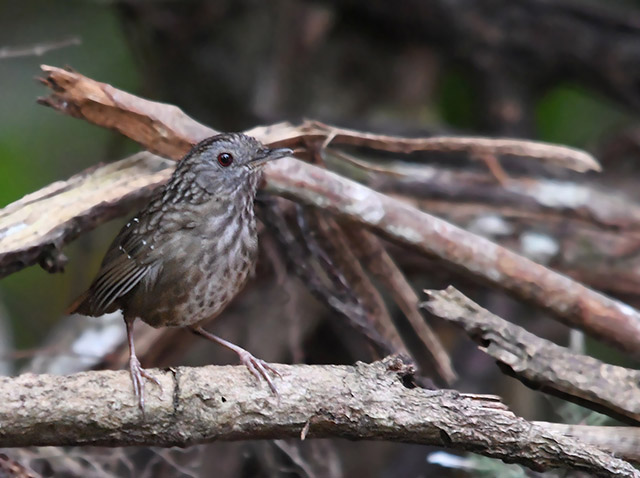
The next morning, I was blessed with another hour of birding and I arrived at my local patch at first light. The dawn chorus was absolute music to my ears and one particular call had my immediate attention. It belonged to yet another skulker of the undergrowth and effort was certainly required before I had visual of the Streaked Wren-Babbler. It was still dim and my photographic gear struggled to obtain some digital memories of this encounter.


Determination and luck eventually produced some decent images. It has been ages since I last enjoyed such views of a Streaked Wren-Babbler. Despite the urge to carry on with the excursion I could not bring myself to do it and continued to enjoy the performance.


The tail markings of the White-tailed Robin are prominent even when seen in a gloomy environment. However to appreciate the true splendour of a male bird, he has to be in enough light for his colours to shine. Which he was but only for the briefest moment.


I caught sight of some movement along the edge of the access road and proceed to investigate as discreetly as possible. When I was greeted by a clear white throat, it was none other than a Rufous-browed Flycatcher in search of breakfast. Then it dawned on me. Almost all the photographic opportunities here so far involved species that frequent the lower storey of the forest. And that is often not the case because these birds tend to be more elusive than their arboreal counterparts.


The Silver-eared Mesia to me is the perfect epitome for montane birding. Beautiful and charming, no visit to the mountains is complete without this common but stunning species stimulating your senses with its presence. And the Silver-eared Mesia was a fitting end to my birding quickies at Cameron Highlands. Although birding was not a priority this time, I enjoyed some fascinating moments with the birds that still called this diminishing paradise home.


Wednesday, 16 August 2017

Birding Marathon (Part III)

Since my main targets for the trip were securely in the bag, the final day of my birding marathon was conducted at a more leisurely pace. I even had time to soak in the breath-taking landscapes that surround Fraser’s Hill. I get carry away with my birding especially during long trips like this when I am far from my home state. Perhaps with age, I might be able to broaden my passion for other things as well. Perhaps there is more to life than just birds. Who am I kidding? It will always be the birds. Always have and always will be.


The Silver-eared Mesia is the rightful mascot for this hill resort. Colourful, charismatic and common throughout the locality; no visit to Fraser’s Hill is ever complete without encountering them. Our first locality this morning which was a bungalow compound, was literally overrun with flocks of Silver-eared Mesias. I think I can consider myself to be a seasoned birder but these cheerful birds still can get me all excited.


Birders often take them for granted. I am occasionally guilty of this too but not this morning. The Silver-eared Mesias were given their due admiration and affection. In return, the birds provided a display of colours and beauty that was simply spectacular and a bit nostalgic. As a kid, I often wandered when I will finally lay my eyes on the exquisite colours of this gorgeous bird. Since it only occurs in mountains along the Titiwangsa range, it took me a while. Anyway, it was nice to be momentarily transported back to those carefree days. Birding does not only excite but it rejuvenates as well.


The Long-tailed Sibia is a common sight here as well. What it lacks in colour is made up with grace and charm. The sight and sound of a flock in flight, that marks their arrival each time, can never be mistaken for anything else. At rest, it is an exquisite looking bird but it suffers the same fate as the Mesia because of its common status.


Chestnut-capped Laughingthrushes were everywhere as usual and yet I still cannot resist taking a shot or two. What can I say? I am easily smitten by anything with feathers especially those that look like this.


The shyer Malayan Laughingthrush usually requires a little more effort in order to capture its image. One was seen foraging in the open and it brought out the colours of this Malay Peninsular endemic. Due to its preference for the gloomy lower storeys and slightly wary nature, the subtle colouration of this bird is often concealed. A moment to admire its true beauty was the natural thing to do.


A lone White-thighed Langur casually moved alongside the bungalow and momentarily distracted me from the birds. Animals living in the mountains tend to be more confiding than their lowland counterparts and this docile mammal does not seem to mind the attention it was receiving.


A sizeable bird glided down from the canopy and no optical aid was required to identify it. The Fire-tufted Barbet is the biggest barbet in Malaysia with eyelashes that will put most ladies to shame. It certainly had my undivided attention. At such close proximity, the Fire-tufted Barbet is truly impressive. Rare birds are always exciting but for me, sometimes even the common birds are capable of escalating my senses to ecstatic levels as well – especially when they perform remarkably well like this barbet.


The Fire-tufted Barbet wanted to make sure it was the star of this little patch and provided views from the front as well. And I would be a fool not to oblige.


A stroll along the more isolated roads away from the weekend crowd produced a few small bird waves. However, the only species that found its way to my memory card was a pair of Blue-winged Minlas. Not all that uncommon, this plain but attractive tree babbler can be seen combing through the vegetation of montane forest in small flocks. This pair was at the canopy level when they were spotted and inevitably, photography was challenging. There was a particular shot I took with strong backlight that surprisingly, caught my fancy.


The Rufous-browed Flycatcher seemed to be everywhere today as well. If it I was up to me, I would have named the bird with something to do with the conspicuous white throat. Even from the depths of the understorey in which this flycatcher makes its home, the first thing you will notice is the white throat. Anyway, I find this species adorable and delighted that the population is thriving here.


It rarely visits the higher storeys of the forest and that makes it an ideal subject for photography. Lighting conditions can sometimes hinder your efforts but luckily, we had very little issue with this today. In fact, these may be my best images to date.


I wish I could say the same about another little brown job but the Buff-breasted Babbler was wary throughout our stay at Fraser’s Hill and seldom offered any photographic opportunities.


The Pygmy Cupwing got the better of two grown men last evening and we just had to give it another try. We positioned ourselves the best we could and waited. But the juvenile Lesser Shortwing was the first to arrive and this time the lighting was so much better. The more I look at it, the more this youngster gained my affection. Its confiding nature had a lot to do with that as well.


A second Lesser Shortwing made an appearance and this one was an adult female. The juvenile did not receive any motherly love from this new arrival. In fact, they got into a bit of a squabble at one time and I can only assume, there are no blood relations between the two.


As for the Pygmy Cupwing, it did show up eventually but like last evening, was in no mood to be photographed. The Lesser Shortwing and the Pygmy Cupwing may be somewhat similar in appearance and thrive in the same type of habitat but their personalities were as different as night and day. On one occasion, the Cupwing stood still slightly longer than usual. I managed to squeeze the shutter once and was surprised to see the image being reasonably good. Gotcha!


As my 3-day birding marathon came to a close, Victor suggested we be normal tourists for a moment and immortalized this incredible trip by taking a photo of ourselves at the iconic clock tower of Fraser’s Hill. It was certainly incredible and the 800-km round trip was worth the effort. The drive back from long trips always give me ample time to reflect. And I certainly had plenty of reflections of wings and inspiration to ponder upon courtesy of this time’s birding adventure.

Saturday, 12 August 2017

Birding Marathon (Part II)

It has been three long years since my last visit to the renowned montane birding site of Fraser’s Hill. During that time, a few changes have taken place with the local birding scene. The most notable one is undoubtedly the regular appearance of Grey-breasted Partridges at one particular photography stakeout. By now, most if not all Malaysian birders would have enjoyed the stellar performances of this once elusive game bird. So finally, I found myself staring at a patch of bare earth next to the forested compound of a private bungalow on a cloudy Saturday morning.


It was a long wait. Lucky for me, I had Victor for company. While waiting for my main target of the trip to appear, some of the commoner species kept me entertained and helped pass the time. The Malayan Laughingthrush is by no means rare. However, it is shyer than the ever-present Chestnut-capped Laughingthrush and I do not have many photographs of it. Naturally, it had my attention...


The most prominent species present at the site was undoubtedly the Chestnut-capped Laughingthrushes. Flocks of these colourful and loud birds can be encountered throughout this hill resort and much of the charm of this locality is owed to these birds. Chestnut-capped Laughingthrushes have an aura of mischief surrounding them and that makes them a delight to observe. The mountain air does not pass through my lungs all that often and this common montane bird still does it for me after all these years.


The Emerald Dove is a common bird that occurs in a wide range of habitat from mangrove forest to montane forest. The bird is no stranger to me but it is nevertheless a beautiful bird. Close and intimate views of it out in the open like this is rare to come by. This male, told by his complete greyish crown, strutted about with total disregard of our presence and I enjoyed my best ever encounter with this highly terrestrial dove to date.


At stakeouts like this I usually have the aid of my tripod to support my gear and that made videography possible. Here is the male Emerald Dove indulging in breakfast captured as best as I could with my modest setup.


When he flew back into the forest, I thought that would be all there is to it. But Mother Nature had other plans. Moments later, an Emerald Dove emerged from the adjacent forest and took to the stage again. Initially, I thought it was the same bird. That was until I had a look at the crown. The second bird was a female and suddenly, I was presented with a golden opportunity to capture good images of both sexes.


At one point, a Rufous-browed Flycatcher appeared briefly at the locality. Size does matter when it comes to the law of the jungle and the petite flycatcher was seen off by the larger birds present.


As the hours passed, anxiety grew within me. I occasionally shuddered at the chilly caress of the cold mountain wind. My posterior grew numb after such a prolonged period on a concrete slab. Despite it all, I was determined. I have been waiting for this moment for too long to give up so easily. No, it would take a lot more than this to break my yearning. Then, out of the blue, a flock of Grey-breasted Partridges scurried through the undergrowth and popped into view. Upon further scrutiny, I realized the flock consisted of three smaller juveniles and an adult bird. Seeing this partridge family in front of me going about their business was just amazing. I am in awe. Life can be beautiful at times...


Once I managed to take back control of my emotions, I focused on obtaining images of this encounter as best as I could. The presence of too many birds can be a bad thing as well as you might not know which one to shoot first. Anyway, I made sure I took some images of the chicks that foraged without a care in the world.


The adult was more cautious but still confiding enough for me to obtain its images. I have had a handful of encounters prior to this but they were made up of glimpses. This is by far the closest and most memorable one so far. Fraser’s Hill is an amazing place and its magic has provided me with numerous defining moments through the years. And this episode with the Grey-breasted Partridges is certainly one of them.


I just wonder how I could put off this trip for so long. It could be due to my hectic working schedule or my guided tours. Perhaps it is because I am not too keen with the ‘festive’ atmosphere that comes with every recent significant discovery at a photography stakeout. Whatever the reasons may be, I am absolutely thrilled that I am here now witnessing and documenting this spectacle.


Once the partridges retreated back to their forest domain, we seek our fortune elsewhere in this birding paradise. My attempts to find my first ever Marbled Wren-Babbler failed miserably – again. A family flock of 3 Red-headed Trogon offered some relieve for my disappointment. The sight of a male bird foraging along the forest canopy is like a flaming entity floating about a sea of green. As usual, I was so mesmerized by striking male that I completely overlooked the duller female and immature.


My birding network has informed me (it pays to be nice to your fellow birders) prior to the trip that the Grey-breasted Partridges usually appear twice a day and we returned to the stakeout again in the afternoon only to find a pair of partridges already foraging at the locality.


Fortunately, these birds are now quite accustomed to human presence and our lumbering approach did not alarm them. No chicks were present this time but there are some plumage variances between the pair and I am not sure if it is due to gender or age. I can only assume the one with the reddish throat is the male...


And the other slightly duller bird is his mate...


This encounter lasted longer than the one in the morning - much to my delight. The absence of young birds running around at neck-breaking speeds meant I was not constantly distracted. It also gave me a chance to record a video clip and it was of the ‘male’ bird foraging.


When the second performance of the partridges concluded, we made our way to another secluded area of the hill resort and were duly rewarded. Owls are fascinating animals and they never cease to capture my imagination and admiration. Now, picture one that is active during the day and adorable like a kitten and you will have the Collared Owlet. The characteristic 4-note call of the Collared Owlet can be heard echoing throughout the hill resorts of Peninsular Malaysia. Obtaining good views of this little fellow is another thing altogether. In birding, sometimes things just happen perfectly and we were very lucky to come across this confiding individual calling on a reasonably low perch next to the access road.


Despite our intrusion, it remained unperturbed and even continued to call. I inched closer and shot from a different angle hoping to improve the results. It is hard to believe that such an adorable animal is a formidable predator striking fear in all other creatures of the forest it can overpower. This is an absolutely amazing encounter and one that is up there among my all-time best.


Unfortunately, the presence of the Collared Owlet attracted not only the attention of a couple of birders but a female Black-throated Sunbird as well. The owlet may be adored by its human admirers but to small passerines like the sunbird, the hatred for the owl runs deep. The sunbird mobbed its sworn enemy with such intensity that the latter retreated deeper into the forest almost immediately. And we were left staring on an empty branch but the owlet has left a lasting impression on me. I am not the type that is easily moved by cute and cuddly creatures but in this case, I was giddy like a school boy.


There was a fruiting tree nearby but only one bird came for the fruits and it was a Black-browed Barbet. The resonating call of this species is very much a part of the sounds at every hill resort but only the temptation of an easy meal will draw it down from the safety of the tallest canopy and offer birders a chance to truly appreciate its splendour.


Since we are talking on the subject of splendour and beauty, there is a remarkable bird found here that has almost no equals when it comes to aesthetic appeal. Strikingly plumaged and full of character, the Sultan Tit is Mother Nature’s answer to the Mona Lisa. Unlike the painting, this is a living work of art. As fate would have it, this confiding Sultan Tit lingered in a dimly lighted part of the forest for a prolonged period offering us amazing eye level views.  But my gear struggled in the lighting condition and my images in the end, did no justice to the bird.


Eventually, it did wander into brighter areas where its true beauty could finally be captured by my modest gear. But the vegetation was dense and I failed to obtain any unobstructed images. Well, life is not always fair and you learn to roll with the punches.


We were losing daylight rapidly but there was still time for one last stop before calling it a day. It is rather ironic with the fading light, this next location is a stakeout for extremely active little brown jobs. Today’s results so far have left us feeling invincible but our sense of immortality did not last. A Pygmy Cupwing put us back in our place. I still have trouble believing that a bird can be christened with such a name. I guess if you have to name a bird a Cupwing, this bird would be it. Anyway, this feathered egg was just simply too fast and our humanly reflexes had no chance at all. I can consider myself lucky that one out of the dozen of shots I took of a Grey-throated Babbler that wandered into view later turned out reasonably well.


Another ball of feathers appeared just as we were about to leave and it sported a plumage somewhat foreign to me. A quick glance with my trusted bins and there was no doubt it was a juvenile Lesser Shortwing. I cannot recall if I have ever encountered a young of this terrestrial species before but I certainly have now. It was rather obliging as well but time waits for no man and it soon got too dark for anymore birding to be indulged. However, tomorrow is a brand new day and who knows what awaits the Penang Birder in this blessed land. That will be covered in my next post.