Khao
Yai National Park is a pristine landscape that provides sanctuary to countless
species of flora and fauna. I knew about this park even before I started
birding. Naturally, I was excited for my maiden visit and what it has in store
for me. We were just minutes from the main entrance when our guide did a
detour. We stopped just outside the borders of the park because that particular
locality is a known birding hotspot. As always, have faith in your guide. True
enough, the diagnostic wing beats of a hornbill echoed across the vicinity and
very few things in life can rival the emotional whirlwind caused by coming face
to face with a Great Hornbill first thing in the morning.


I
have been birding a long time and through the decades, I have come across a
number of truly remarkable species. And believe me when I tell you this
behemoth of a bird deserves a place right up there among the best. And it has
been too long since I last saw one in the wild.

The
smaller Oriental Pied Hornbills were also recorded in vicinity. Naturally, they
were overshadowed by their bigger relative. And I only began to take notice of this
male once the Great Hornbill was gone.


Another
species that I cannot help but to take notice are the Red-breasted Parakeets. Apart
from increasing my global life list, they occur here in exceptionally high numbers.
However, they seem to always perch on
the tallest trees and good photographic opportunities were hard to come by.

.jpg)
Parakeets
are also known to mate for life and this pair certainly appeared to be in the loving
mood judging from their public display of affection.
.jpg)
Eventually
I did find a lone male perched lower than the rest. It may not be the perfect
shot but it will do.
.jpg)
This
locality is also the domain of an impressive nocturnal predator and we were
fortunate enough to be shown a roosting individual. This trip has been great so
far when it comes to owls. This was the fourth species and I can confidently
say the best although there are two more days before this Thai adventure ends. The
Spot-bellied Eagle-Owl bears some resemblance to the Barred Eagle-Owl back
home. But it is bigger and a lot more imposing. When it looks our way, I am
grateful I do not form part of its diet.
.jpg)
.jpg)
The
Spot-bellied Eagle-Owl alone was a good enough reason to delay our entry into
the home of wildlife which is the tagline of the national park. Every bit of
birding inevitably effects the lives of the birds that we birders revere. The
goal is to keep our intrusion to a minimum. Not only for the sake of the birds
but also to give to others a chance to enjoy what you have just experienced.
.jpg)
.jpg)
We
spent roughly two day exploring Khao Yai National Park and the one of the first
birds to greet our photographic intentions was the diminutive Collared Owlet. Ironically,
every owl encounter so far in our trip took place in the daytime. But I for one,
am not complaining.

Any
habitat that houses hornbills should and must be conserved. The park
authorities here are doing a great job and these winged rhinos are still able
to roam freely (and safely) within its borders. A male Great Hornbill gorging
on a fruiting tree just next to the access road is proof of that.

Resting
comfortably in the canopy level of the forest was this male Wreathed Hornbill. The
lighting was getting harsh by then and the bird was not exactly close. Still, it
was a picture of bliss as we observed him preening and watching the world go by.

Another
male was recorded during our exploration of the park. Although this species not
be able to conjure up as much emotions as the Great Hornbill, the photographic
opportunity provided was so much better.
.jpg)
.jpg)
.jpg)
One
glance at the Black-crested Bulbuls found here and any Malaysian birder will
notice the red throat that this subspecies possesses that is absent from the
ones back home.


Whenever
the opportunities present themselves, I would try to improve my images of these
‘red-throated’ Bulbuls.
.jpg)
.jpg)
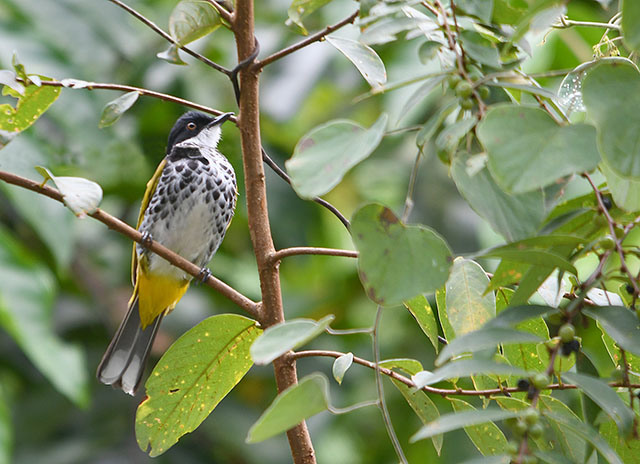
Quite
a number of Bulbuls require scrutiny to determine their identifications. This
is pretty much the case for the Puff-throated Bulbul until I found out from my
guide that the similar-looking Ochraceous Bulbul, a species I am very familiar
with, does not occur here.

I
guess sooner or later I have to man-up and write about these two particular species of Bulbuls that I encountered in central Thailand. There are four
almost-identical Bulbul species that occur in this country. Luckily, the Olive
and Buff-vented Bulbuls (which I have encountered both before) are restricted
to the southern region. In Kaeng Krachan National Park, I tried my best to
obtain a record shot of the Baker’s Bulbul but it got the better of me on every
one of those few occasions our paths crossed. I fared much better in this
national park and obtained what should be (after I have given my all in
confirming the identification) Grey-eyed Bulbuls.


Fruiting
trees are always a good place to stop for a look. We were fortunate to come
across a few next to each at one of the camp grounds. Naturally, we spent a
considerable amount of time here. And lucky we did. I had a brief encounter
with the Golden-crested at the last national park we visited. This time, we had
a pair and they stayed considerably longer. By the way, a pair of Common Hill Mynas also alighted on the same tree but they were out of the picture - naturally.


Although
not exactly ‘feather-counting’ quality, I obtained the improvement shots I so
badly wanted. There is this occasional occurrence in birding when once you
finally unblocked a species that you have been trying to do so for many years, it
will no longer be as difficult anymore. My second Golden-crested Myna in four
days - unbelievable.

Here is an image of the female which finally received my attention when the male moved further away.

The
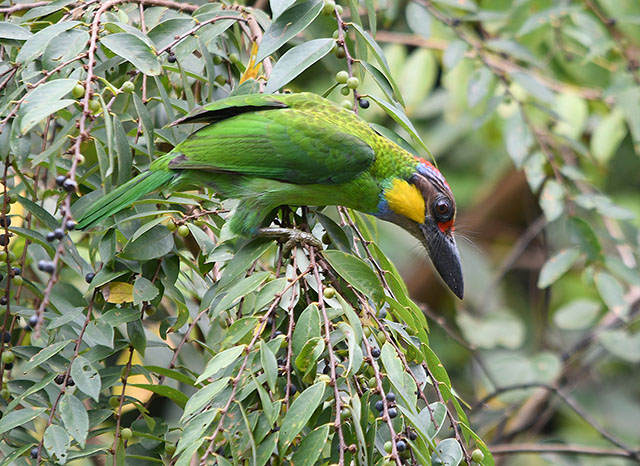
fruiting tree also attracted three species of barbets and all of them new to
me. The Green-eared Barbet is probably the most confiding and when any member
of this family of birds performs well, one must take full advantage of it. Lord
knows barbets can be difficult to photograph due to their preference for the
highest canopies.

.jpg)
The
plumage coloration of the Green-eared Barbet may not be as striking as some of
the others but being new to me is novelty that surpasses beauty.
.jpg)
Because
of the recent split, the Blue-eared Barbet was replaced in my life list by the
Black-eared Barbet. There was not much reason to celebrate when the Blue-eared
Barbet was re-entered back into my life list here in Thailand. Perhaps it was
the least interesting to me and I did not put much effort in obtaining a
photograph. The Moustached Barbet, on the other hand, had my full attention. The
availability of food also made it forgo its natural instincts and provided
excellent views which was a true blessing. And emotions certainly ran high for
us at the fruiting trees...


In
Southeast Asia, there are very few species that can rival Hanging-Parrots in
terms of cuteness. Past experiences with the Blue-crowned Hanging-Parrot back
home have taught me that they are not exactly easy to photograph. In this neck
of the woods, the Vernal Hanging-Parrot replaces it and we were delighted to find
a small flock patronizing one of the fruiting trees. I could not help but to
feel a little disappointed because I think they were all females or immatures and
none of them had a red bill.
.jpg)
.jpg)
.jpg)
.jpg)
It
was the same outcome when we encountered these parrots again suggesting it was
the same flock. One of the birds ventured exceptionally low, upside down and
looking simply adorable. And the disappointment gradually faded away.
.jpg)
.jpg)
Then
I caught sight of a single bird resting a little further from the flock. Unless
my eyes (and camera) betrayed me, it had a significantly redder bill. But the blue
tinge on throat does not give me enough confidence to call it a male.
.jpg)
I
think it is safe to say that the Black Giant Squirrels in both the national
parks we have been to are exceptionally confiding by nature. With fruiting
trees as an enticement, one can almost reach out and touch them on the tail.

.jpg)
.jpg)
The
Finlayson’s Squirrel is another stunning species drawn to the fruits and capturing
a few images was and including it in my post was the least I could do. One
thing that I noticed here is there are not as many birders present when
compared to Kaeng Krachan National Park. Even at the fruiting tree we basically
had the place to ourselves.
.jpg)
To
be continued…


.jpg)
.jpg)


.jpg)
.jpg)
.jpg)