Pages

Showing posts with label Snake. Show all posts

Monday, 16 March 2026

Thailand Part 1: A feast fit for a King


Six long years has passed since my last birding trip abroad. It was an amazing adventure to Cambodia taking place just before the dreadful Covid-19 pandemic. The same companions for that trip sent me an invite to join them for another one and this time, to the jungles of central Thailand. It was going to be an eight-day exploration of a variety of habitats from the coast to the hilly interiors. A couple of months later, I found myself touching down at Suvarnabhumi Airport to meet up with Nigel, Kok Siong and our guide Arjin before heading to our first destination of the trip – the river banks of the mighty Chao Phraya in Bang Ban district.


A few days before we embarked on this journey, our guide promised us two things in our Whatsapp group. Pied Kingfishers to kick off the tour and Giant Freshwater Prawns for lunch to celebrate this striking lifer. And he delivered both as promised. Although the lighting was harsh, the aerial agilities of the Pied Kingfishers were still a breath-taking sight.


Unlike any other Kingfisher I have encountered before; this species hunts by hovering high above the waters before plunging down to capture prey close to the surface.


I am no stranger to heat as I lived all my life in this region but it was really hot here in central Thailand. With the scorching heat along this river bank, shade is a prized commodity. However, in the days to come, I have learned to welcome the heat as it played a significant role in the productivity of our birding endeavours.


Brahminy Kites were also present in the area but I doubt they are any threat to the kingfishers. This common but beautiful raptor scavenges as much as it hunts and a river like this would be able to provide a living for it.


Although the succulent river prawns were calling our names from a nearby restaurant, we spent a considerable amount of time at the river bank. One of the main reasons was because we were waiting for decent opportunities to capture the Pied Kingfishers perched. And a male bird, told by the full band across his chest, finally let down his guard and provided the memories we were seeking.


You would think this paragraph would now be about the much-anticipated local cuisine but we were held back again. However, it was not by a bird. But a Golden Tree Snake with a freshly caught Tokay Gecko. In fact, this rare sight almost overshadowed the performance of the Pied Kingfishers – almost.


Shortly after, we left the snake to savour the meal to come in peace and proceeded to have our own little feast. The prawns did not disappoint as well and it was a good start indeed for the three of us.


Since we are on the subject of food, we got to taste any array of local dishes throughout the tour. Our bird guide apparently is also a knowledgeable food guide – much to our delight. Well fed birders are happy birders and happy people are more easily pleased than hungry, cranky ones. Yes, our guide had certainly put much thought into this strategy.


Now back to the birds. We were taken to an urban park within Bangkok city next. In fact, Chatuchak which is a popular tourist destination, is not the kind of place one would expect to visit during a birding tour. But you always got to have faith in your guide especially one as accomplished as Arjin. Soon we were surrounded by a Black-capped Kingfisher and Indochinese Rollers providing ample flight shots for all the photographers present. Unfortunately, this endeavour was a little beyond the capabilities of my modest setup. The Indochinese Rollers did linger around the vicinity and resting birds are just as beautiful in my book.


Eventually I was lured away from the others by a pair of foraging Black-collared Starlings. It may be a common species to the locals here but it does not occur naturally in Peninsular Malaysia. It was a delight to observe and capture them going about their daily routine and rather vocally if I might add.


The Siamese Pied Starling is more familiar to me because it is not uncommon in the northern Malaysian states like Perlis. Like its larger cousin, this species also possesses a personality and aesthetics that is hard to resist.


Great Mynas here are the equivalent of Common Mynas back in Peninsular Malaysia. It is probably amusing to my guide and other local birders that I show so much interest in Great Mynas. Status aside, I find this species to be visually appealing.  


Elvis is in the house...


House Crows are rare or absent from this part of the country and to take their place are the bigger Large-billed Crows. The latter is no longer a common sight in Penang and a confiding individual like this one deserves a mention in this post.


Little Herons are just as common here as in Malaysia and can be found foraging along the edge of the ponds of this park.  


As always, birds are top priority for me wherever I go especially in a foreign land. But this Finlayson’s Squirrel had enough appeal to momentarily distract my attention. This species also goes by the name Variable Squirrel due to their highly variable plumage colouration and a pale variance like this individual is exquisite.


A sizable Water Monitor Lizard had its afternoon siesta interrupted unintentionally be a foreign birder exploring its territory.  


One bird that truly tugged my heart strings here in Chatuchak Park was the adorable Spotted Owlet. And any diurnal sighting of an owl is usually a mesmerizing affair.


We have encountered this species before during our trip to Cambodia and observing it again after all these years certainly brought back memories of our Cambodian adventure. And now, this little fellow has become an integral part our Thai adventure as well.


At nightfall, we reached the coastal salt farming district in the outskirts of the city. Tomorrow is a big day as we will be hunting down one of the main targets of the trip and that will be covered in my next post.


The checklists of birds recorded:

1. Bang Ban riverside

2. Chatuchak Park


Wednesday, 26 June 2013

Ready, set, go! (22-23/06/2013)


The last time I participated in a bird race was the annual Fraser’s Hill International Bird Race (FHIBR) back in 1995 and we got a commendable third place then. For the benefit of those not familiar with the term Bird Race, it is basically a competition to see who records the most number of bird species within a certain locality in a given time frame. In the case of the FHIBR, each team is given 24 hours to record to do it within the borders of this renowned hill resort – renowned for its rich birdlife that is. The criteria are simple – at least 2 members of a team must see and agree on the identification of the bird in order to put it down. Birds that were heard do not count. The arbitrators, race officials and checkpoints play an important role in maintaining a certain standard and order to the competition but as with all bird races, a lot is dependent on the integrity of the participants.

When Choo Eng invited me to join him for this year’s FHIBR, I obliged as it has been quite a while since my last one. The third member of our team was none other than James Ooi – one of the members of my team during the ’95 race. Siew Thye came along as a non-participating member (each team is restricted to 3 members only) and it was a rather good experience for him. We decided to call ourselves team Penang Aquilas in honour of these magnificent raptors’ recent regularity of wintering in our home state of Penang. Besides, it was an intimidating name as well. 


As expected I did not have much time for bird photography. Heck, we didn’t even have much time to eat and bathe! Jokes aside, a bird race is like birding on overdrive and it can be rather tiring at times. But it is definitely not short on excitement and drama. Anyway, one of the birds that I did manage to photograph was this common resident – the Oriental Magpie-robin.


Come to think of it, the commoner birds were the majority that I photographed this time. The Mountain Bulbul is almost a certainty here at Fraser’s Hill but I remembered well that we missed out on this species during the ’95 race. I guess luck plays an important – as usual.


The Large Niltava is a rather attractive flycatcher of the montane forest and can usually be seen hawking for insects along the access roads and bungalow compounds. The male bird possesses a brilliant blue plumage that can only be truly appreciated when he is seen in good light. The female, on the other hand, has the brilliant blue colouration reduce to the collar and head region only.


Another common flycatcher of this hill resort is the Rufous-browed Flycatcher. Occasionally overlooked due to its smaller size and duller colouration and as well as its preference for hunting among the shadows of the forest under storey. Its sweet but soft whistling notes are usually one of the indicators of its presence.


The highlight of the trip in terms of bird photography is courtesy of a bird species so strikingly-coloured and attractive, it leaves you no choice but to believe in the existence of a greater being. Only He with his divine power is capable of creating such a heavenly work of art in a form of a bird. A bird called the Sultan Tit. Bright yellow colouration contrasting beautifully with the remaining black plumage and a wicked crest. Enough said.


Here’s a photo of my team mates in the thick of action…


Other than the birds, we also managed to photograph a rather curious Small-toothed Palm Civet that was checking us out from the safety of the overhead electrical cabel…


And a confiding Keelback Snake momentarily distracted us from the race.


I bet you’re wondering how we faired in the race. Well, we managed to record 68 species altogether and it was good enough to make the Penang Aquilas champions for the 26th FHIBR! The weather was rather dry and hot during the entire race and the birding was not as good as usual. We had to really dig deep to come up with the result but it was certainly worth all the effort. Other than the bragging rights of being the winners this year, we also received trophies, binoculars, fieldguides and cash prizes. Not bad for 24 hours of intense birding!


Wednesday, 21 December 2011

20/12/2011: Sungai Sedim (Kedah)


I have only gone a short way up the Gunung Bintang access road when I came across a splendid male Siberian Blue Robin foraging just up ahead and this is a species I long to have in my archives. At this early hour the lighting was terribly poor and I had an impossible time trying to focus my camera on the bird. Then something scared the living daylights out of the Robin because it suddenly dived into the undergrowth while emitting alarm notes. And I was pretty sure it wasn’t me. While I was still trying to figure out what took place, I noticed a slithery movement on the road and it was the culprit that made me miss my shot – a Variable Reed Snake. However, it was too small to possibly hunt the Robin but I guess it was a case of better be safe than sorry for the Robin.


That little episode got things rolling for this trip and what a trip it turned out to be. During my 5-hour visit, I managed to record two lifers and more than 60 species including a few very notable records. Unfortunately, the key word here is record. My first lifer, a female White-throated Rock-thrush, stayed in sight long enough for a positive identification only. I did manage to take a shot of my second lifer, the Brown-chested Jungle-flycatcher, but the image turned out to be pretty insignificant. Not only because of the poor quality but it only showed the back of the bird.

I could hardly contain my excitement when I came across a pair of foraging Chestnut-backed Scimitar-babblers. Apart from the fact that this is the first time I have seen this species here, they are truly striking birds and always a delight to observe. I guess you just have to take my word for it…


This male Orange-breasted Trogon on a slightly exposed perch was probably the best bird image of the trip.


A total of 4 Hornbills were recorded at the locality today. The Rhinoceros and Bushy-crested Hornbills were heard calling. A pair of White-crowned Hornbills flew just above overhead with the dense forest canopy between my camera and them. It has been almost 8 years since my first visit to this forest reserve and the distinctive calls of the Helmeted Hornbill can be heard on almost every visit. You can only imagine the amount of pleading and swearing that went down when I took this shot of this amazing bird.


One image did turn out quite to my liking but it was not of a bird. This beautiful Dragonfly was resting about eye level at the forest edge and the green foliage provided the prefect background.


This millipede making its way about some thickets wrapped things up for a memorable trip despite the disappointments from a photographer’s point of view.


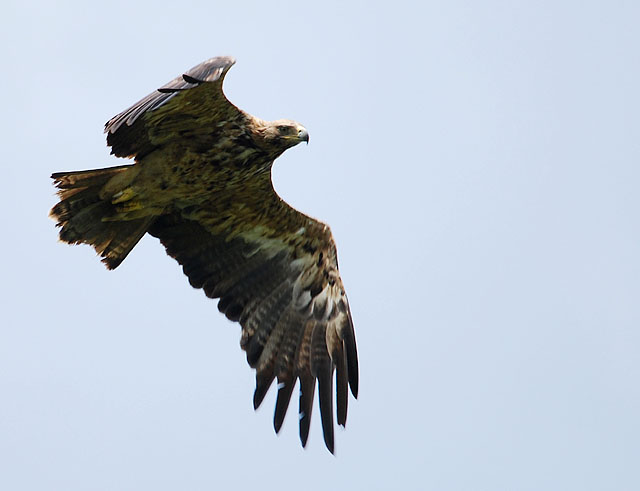
On the way home, I made a quick detour into the paddy fields at Kubang Semang to check on the Temminck’s Stints only to find the patch been completely planted with new paddy shoots. However, an immature Eastern Imperial Eagle circling over the fields put on quite a performance and unlike photographing forest birds, it is almost impossible to miss a bird as huge as this right out in the open.