Pages

Showing posts with label Knot. Show all posts

Wednesday, 18 March 2026

Quest for the Holy Grail


At the break of dawn on the second day of our tour, we were enjoying a simple breakfast and a glorious sunrise at the vast expense of salt ponds in the Khok Kham conservation area. And what can be found in such a habitat you may ask. Allow me to enlighten you. This is the wintering ground for a remarkable and rare little wader known as the Spoon-billed Sandpiper or more affectionately called the Spoonie.


Birds leaving roosting sites to forage in first light can be breath-taking. And it is no different here. I was especially drawn to the flocks of Painted Storks making their way towards the coast. There is no denying I have a soft spot for large water birds. Even more so if they are uncommon to me.


When there was finally enough light to begin our exploration of this important bird area, we carefully walked into the salt farm along the bunds. Flocks of waders that started to congregate in the shallow ponds were an indication of things to come and I could hardly contain the excitement building inside of me.


Now finding a Spoonie among the thousands of other peeps was not going to be easy. But we had help. A local guide that goes by the name of Tee weaved his magic scope and after about thirty minutes, we were staring at the unique bill of this critically endangered species.


In order to obtain any decent images, we had to rely on our field craft to reduce the distance. Here is Tee giving us some pointers on how not to be lumbering visiting birders and spook the subject away...


The observation did not last as long as I would have wanted when the entire flock of waders in that pond took flight and vanished. To be honest, I was still elated with this encounter as it was the closest and longest I have ever been with a Spoonie.


With the target in the bag, we began to open up to the other species that find sanctuary here. I do not encounter the Black-bellied Plover quite often and a lone individual resting along the outer edge of one the ponds was a welcomed sight.


A wary Pacific Golden-Plover did not provide any opportunity for an improvement shot.


I am a simple man and I tend to keep things simple in my life. Thus, I miss the days when Lesser Sand-plovers have not undergone the split. Having said that, here are some images of what should be Tibetan Sand-Plovers.


The Khok Kham conservation would be a good place to scan through the hundreds of confiding Sand-Plovers present here for the almost identical, Thailand’s first Siberian Sand-Plover but that task would be above my ‘bird’ grade.


The Curlew Sandpipers are rather confiding today as well. I took a keen interest in these common migrants for any stumpy-looking individuals or even better, have blackish bellies for the possibility of the rarer Dunlin. From this blog post, I am sure you know how it worked out.


Black-winged Stilts, especially the male bird, is the definition of elegance in the wader world.


The Marsh Sandpiper is another wader that oozes with poise and grace.


Here is a Pond-Heron in non-breeding plumage doing what Pond-Herons do. Next please...


The scenery at the salt ponds is actually quite lovely. Naturally, it took a while for me to realize that. Once I am in full birding mode, everything else becomes secondary.


We then sat down along a bund to take a breather and recuperate from the heat.  I always emphasize that successful birding is very much luck as well. A flock of waders suddenly alighted in the pond right in front of us and our man Tee triumphantly alerted us from a distance. I could hardly believe it when my eyes picked up the now-familiar jizz of a Spoon-billed Sandpiper. Point most certainly proven...


I could not be sure if this second bird is a different individual but it was a lot more confiding. I think we managed to crawl and slide our way to as close as possible without overstepping our boundaries.


The superstar appeared relax and was constantly feeding which at times, made it difficult to obtain images without the bill submerged in water.


Please forgive me if this post contains a high number of Spoon-billed Sandpiper images. It is not a new bird to me. In all my years of birding, I have recorded it twice before. But nothing like this. This is heaven-sent for a water bird lover like me and I took full advantage of what I have been given. The Spoon-billed Sandpiper is often considered the holy grail of wader watching in this part of the world. After this prolonged and intimate encounter, I can see why. It was a true privilege indeed.


The radiating tropical sun on our backs and a confiding Spoonie in front of our lenses. It does not get any better than this.


Once I have obtained more than enough images, I was able to let myself occasionally swap the camera with the binos and made this incredible encounter complete. And here is one final image of the Spoon-billed Sandpiper for good measure.


When the exhilaration of the Spoonie subsided, I started to take notice of the other waders present in the same pond. And a mixed flock of Great and Red Knots resting nearby was hard to ignore now.


The problem with roosting or resting waders is that you sometimes cannot isolate a single bird out for photography. For the knots, despite all my best efforts, I could only obtain images of a Great Knot alone.


Smaller peeps require some scrutiny to ascertain their identities. Red-necked Stints, due to their similarities to a Spoon-billed Sandpiper, provided some suspense on this beautiful, sunny morning. This image depicts the two species almost side to side. Hide the bill and most mortals would be in trouble.


Broad-billed Sandpipers sport distinct facial markings that make them slightly easier to identify. And they performed well for our photographic efforts. This wader site provided an incredible morning of memorable experiences and that is something I have been missing in recent years. It is sad but there are simply no wader sites left in my home state that can even come close.


For those unfortunate souls who dipped out on the Spoonie, there is a larger-than-life statue of the bird at the visitor centre that could perhaps provide some solace.


And from here, we took a long drive into the wild interiors of central Thailand. Kaeng Krachang National Park is the largest national park in the country and it was the next destination in out itinerary. Will our lucky streak continue? The answer to that will be in my next post.


Checklist of the birds recorded at Khok Kham: https://ebird.org/checklist/S307844600

Wednesday, 23 September 2020

The surf runner

September is usually a wet month for northwest Peninsular Malaysia and this year is no different. To visit the forest surrounding Pedu Lake at this time would be a gamble especially after it had rained the day before. However, the forest denizens of Pedu were not the primary targets for today’s excursion. The promise of a gathering of waders at the high tide roost of Kuala Kedah was. It will be the highest daytime tide for the rest of the year and we were hoping for a rewarding wader watch. Anyway, the weather conditions gave the lakeside environment at Pedu a mesmerizing aura. As Hor Kee, Michael and I soaked in the scenery, I said a silent prayer for the weather to hold until we have concluded our birding.


Apparently, we were not the only ones drawn to the view. A flock of five Large Green-Pigeons alighted on a dead tree overlooking the lake and took a prolonged breather as they prepare for the day ahead. These largest of our green-pigeons is not rare at this birding hotspot but encounters are usually of flocks flying powerfully above the forest canopy. Although all that I could obtained this time were distant shots, the flock still provided a good start to the day.


We found the usually deserted access road surprisingly busy this morning. In fact, this was the most number of vehicles I have ever encountered here before. Thankfully, the birds were still out and about despite the unprecedented human intrusion. Good photographic opportunities were hard to come by though. A flock of Hairy-backed Bulbuls patronizing a fruiting tree finally gave me a reason to lift up my camera again.


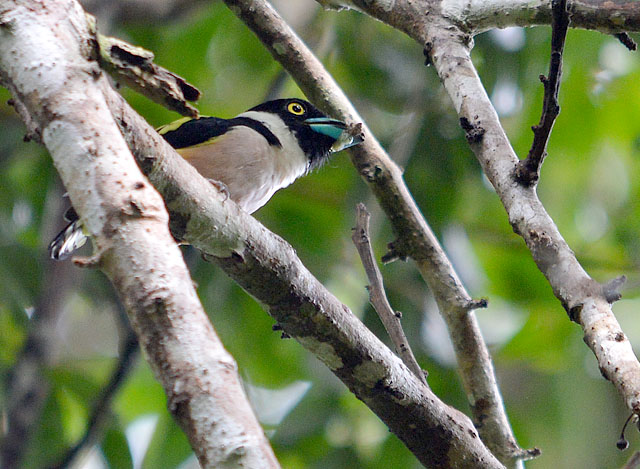
At a particular stretch along this forested road, a pair of vocalizing Black-and-Yellow Broadbills caught my attention naturally. Scanning along the canopy level yielded a female bird with a successful hunt. She enjoyed the rewards of her effort partially hidden from view and this was my best attempt in documenting this adorable forest gem.


While I was still observing the Black-and-Yellow Broadbill, a Banded Broadbill started to call and judging from the volume, it was particularly overhead. I managed to glimpse this yet another striking representative of this family of birds moving about the foliage of the forest. As I struggled to try and obtain better views, a flock of Dusky Broadbill announced their arrival with their persistent high pitched calls and my attention was then diverted to them. Dusky Broadbills are the rarest of them all at this birding locality and I took no effort to conceal my excitement. Like the other two species, which were still present, the flock foraged from the cover of the forest canopy. I could not take a single shot until one decided to alight on an exposed perch. There is a God after all...


Determination had me follow the movement of the Dusky Broadbills which was relatively easy because the birds appeared hesitant to wander far from my position. Dilemma set in when my ears picked out the mournful notes of the stunning Diard’s Trogon and it too was in close proximity. Unbelievable as it may seem, a Green Broadbill then started to call in the vicinity as well. For the first time in my life, I have four different species of broadbills present at a single spot. It was just incredible. Earlier on, we had a Black-and-Red Broadbill and that made it five broadbills today – another first for me. However, I could not break from the spell the Dusky Broadbills had me under. In the end, I managed another distant shot of the Dusky Broadbill and missed out on the rest. I guess too much of a good thing may not always be a good thing.


I know forest birding can be frustrating and photography, even more so. But today reminded me how enticing forest birding can be. A bird wave stirred up even more exhilaration with a pair of Black-winged Flycatcher-Shrikes being rather cooperative to my photographic efforts. I rarely get to shoot anything during birdwaves as the participants tend to be restless and these images were much appreciated.


Minivets, babblers, warblers and sunbirds slipped past my gear as they succumbed to the feeding frenzy of the wave. The Great Iora, a species I have been trying to obtain better images but without much success all these years, cruelly taunted me from the very top of the canopy level.


By late morning, things began to sizzle down. It was also about time for us to retreat from the forest and head for the coast to our next destination. A vocal Long-billed Spiderhunter had just enough charisma to hold us back momentarily as we admired its namesake. This forest dweller is not common anywhere but a particular group of flowering trees here in Pedu will occasionally be graced by its presence. The photographer in me was frustrated one last time here in the wilds of Pedu and this odd pose by the spiderhunter was the only image good enough to be shared.


I have been to the coastline off Kuala Muda in Penang state for birding before but this particular high tide roost is new to me. Sometimes, the journey to a destination is half the experience. In a way, I think it applies here.  First, we had to manoeuvre pass dozens of poultry as we walked through a somewhat open coop. Then wade along a submerged, narrow wooden bridge. One wrong step will land you in almost waist deep of tidal water. A sandy beach greeted us at the end of our little adventure and upon further scrutiny, thousands of roosting waders. More than four thousand individuals as a matter of fact.


My better equipped companions got down to work as they scanned and counted the waders present. I, without the aid of a scope, was busy gawking at this breath taking sight because it has been a long time since I marvelled at a spectacle of roosting waders.


I noticed two rather pale waders scurrying about the shoreline and the first thought that came to mind was Sanderlings. And Sanderlings they certainly were. The foraging pair was a fair distance away but this would only be my third ever sighting and the duo certainly had my undivided attention. With both my previous encounters from my digiscoping days more than 15 years ago, I have now being given the chance to finally obtain some images of this scarce migrant.


Sanderlings are known for their penchant for hunting right at the edge of the tideline – rushing in for a quick jab or two into the sand when the tide goes out and a making a hasty retreat when the tide returns. This behaviour is a good indication that the pale peeps you are looking at is a Sanderling. And I just love the way these surf runners teased the raging waters of this ‘super’ high tide.


A Red-necked Stint momentarily joined one of the Sanderlings and it provided a good comparison shot between the two species. A Sanderling sporting its pale winter plumage is not that difficult to identify. It is basically an oversized Red-necked Stint and of course, there is always its surf running habits.


True to its nature, the Sanderlings stuck to the far end and there was no way of reducing the distance between us without scaring off the rest of the waders. When the adrenalin started to wear off, I diverted my attention to the other waders present. Although this was a distant shot, it depicts two very similar species together – the Great Knot and Red Knot. In breeding plumage, there is no mistaking the vivid colouration of the smaller Red Knot. This one still has traces of its breeding colours but in the near future, there will only be subtle differences to tell the two species apart.


The Greater Sand-Plover is not rare but care must be taken to identify it positively. The smaller but much commoner Lesser Sand-Plover look remarkably similar and just to make things interesting, these plovers can be variable in size and built. When seen together, the Greater Sand-Plover is usually distinguishable and there is little doubt of this one’s identity.


Earlier in the post, I made a comparison between the Sanderling and the Red-necked Stint as the latter is one of the most abundant winter migrants in Peninsular Malaysia. I scrutinized the flocks of stints present the best I could just so I do not overlook the remarkably similar (here I go again) but much rarer Little Stint. Or God forbid, a Spoon-billed Sandpiper. The joys of wader identification are boundless...


Anyway, all stints including the Red-necked Stints are certainly adorable. Despite their minute size, they are accomplished long distance travellers. Wader migration is one of the wonders of the natural world and there is certainly more to these little bundle of feathers than what they appear to be.


Here is one bird that is more easily recognizable – a dark morphed Pacific Reef-Heron (yes, it is now a heron). And it was a true goliath when roosting next to the waders.


As the waders grew accustomed to our presence, we shifted to a more strategic position to continue our observation. A lone juvenile Lesser Sand-Plover wandered exceptionally close and provided one of the best images here at this Kuala Muda high tide roost.


Just when I thought there was nothing else I could expect from the Sanderlings, one gradually made its way towards us. And I shuddered in anticipation for what is to come.


A wintering Sanderling may not possess much colouration. But there is beauty in simplicity and the individual dashing about this bleak coastline in front of me is undeniably beautiful. The sand had a colour tone dark enough to compliment the fair appeal of the Sanderling. It has been quite a day of birding especially with the broadbills and all at Pedu but the moment provided by this confiding Sanderling surpassed all else.


The roosting flocks became restless when the nearby fishermen prepare to venture out to sea again. When all the commotion could not be tolerated any longer, the waders took flight in unison. A mass of wings and feathers swirled across the coastal sky before vanishing beyond the horizon. Nothing remained but the reminiscence of an endearing little Sanderling.