Pages

Showing posts with label Dowitcher. Show all posts

Tuesday, 29 November 2016

The one that didn't get away

Air Hitam Dalam has been struggling to return back to its former self after the uprooting of one of its main trees. This morning’s birding excursion was off to a very slow start. My guests this time were from England and they have been residing here in Malaysia for the past 6 years and have a significant number of our bird species under their belt. And that only made matters worse. Under performing birding sites can be stressful. Even a family of Mangrove Blue Flycatcher could not improve the situation much. The next location was the mudflats of Bagan Belat where my guests were hoping for their first ever Nordmann’s Greenshank and I was determined to see their wish fulfilled after the disappointing start. The weather was beautiful and the tide ideal but despite a careful search, no Nordmann’s Greenshanks were found. Fortunately, the mass gathering of waders at this high tide roost was a spectacle by itself.


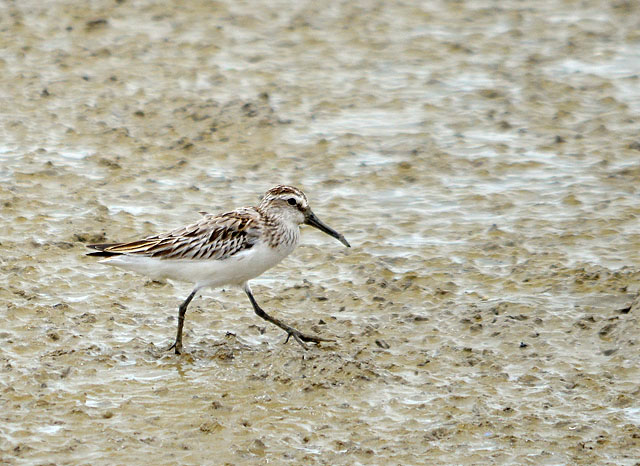
Asian Dowitchers have been showing well so far this season and today was no exception. A reasonably big flock was foraging along the tide line together with Black-tailed and Bar-tailed Godwits. This presented a good opportunity to compare the differences between the dowitcher and the godwits – especially when the former is relatively foreign to my guests.


A trio of Black-tailed Godwits sweep the coastal waters for nutritious morsels at their winter sanctuary…


The arrival of a few Brown-headed Gulls to the roost diverted our attention from the waders momentarily. I cannot help it but I do not forget bad experiences easily. The bitter memory of dipping out on the Black-tailed Gull here a few weeks earlier resurfaced to torment my thoughts.


The distinctive call of the Coppersmith Barbet started to resonate nearby our position. A quick search at the nearby trees revealed this adorable little bird. In an avian-scape of browns and greys, the vivid colours of this barbet was a welcomed sight.


The paddy fields in Permatang Pauh holds a few would-be lifers for my guests and finally, they were not to be denied. To be able to enjoy three lifers at a single location will turn any ordinary trip to an exceptional one. One good turn deserves another and in return for the lifers I found for them, my guests spotted Penang’s second Glossy Ibis which was discovered here yesterday by Hor Kee. This peculiar water bird was foraging at a distance and the lighting was harsh. However, I would not be able to forgive myself if I did not even attempt to obtain some images from this encounter because the last this species showed up in my home state, it stayed for only one day and I missed it on the second day. And this rare migrant is a fine way to conclude this half day excursion despite the slow start.

Wednesday, 12 October 2016

Old school birding

I get a fair share of guests who are old school birders and Barry, my latest guest who hails from Canada, is certainly one of them. I was a birder long before I took up bird photography. So, I can relate to the fact that all the gear Barry needs for a birding trip is his faithful binoculars. Today also happened to be the final day of the Nine Emperor Gods Festival and that usually spells rain in the daytime. Chinese believe the rain is meant to cleanse the roads in preparation for the chariot procession at night. We were almost drenched to the bone when we wondered out of our vehicle at the mangroves of Kuala Gula in search of Milky Storks that is a part of Barry’s bucket list. The trip was off to a bad start. The location did not live up to its name as a bird sanctuary and the only ‘Milkies’ we saw were in a cage within the compound of the Wildlife Department.

The Mangrove Blue Flycatcher also happened to be in his list and I know exactly where to take him after the disappointing visit to Kuala Gula. As we making our into the flycatchers’ swampy domain at Air Hitam Dalam, a spectacle of nature that I have not witness for a long time stopped us at our tracks. A flock of about 200 Asian Openbills were riding the hot air thermals in the sky above. I was getting a little worried that these storks have abandoned their intentions to settle down here in Peninsular Malaysia. The sight of this massive flock was a relief to say the least.


The male Mangrove Blue Flycatcher did not disappoint as usual. His friendly nature and striking colours made quite an impact on my guest. Barry travels a lot in his line of work and he has seen a considerable number of bird species. It would take something less ordinary to impress him and the Mangrove Blue Flycatchers here are anything but ordinary.


Barry enjoying his second lifer of the trip – a female Streak-breasted Woodpecker. This is probably the most reliable locality for this northern speciality in Malaysia. The differences between this species and the commoner Laced Woodpecker are so subtle, I had to work a little extra to convince my guest. The woodpecker, being a female, was playing hard to get - naturally.


The last leg of today’s tour brought us to the muddy shorelines of Penang’s only Important Bird Area (IBA) – Teluk Ayer Tawar. The tide has started to rise upon our arrival and I could make out waders moving about on the huge expanse of mud and sand.


However, it was not the birds that had my immediate attention but this building that was still under construction. It looks modern and posh and totally out of place here. You are surrounded by scrub and all creepy-crawlies of all kinds. The air is stench with overwhelming mud odour and for half the time, a bleak coastline greets your view. The noise pollution caused by the thousands of migratory waders that winter here each year will drive you insane. This is no place for such an innovative and classy building. Please leave this modest location to the local residents and the birders. You deserve so much better – really…


Now that I have gotten that out of my system, back to the birds again. The mere sight of the number of waders present was breath taking. Although the tide was a little far, we could still scrutinized the flocks for any rarities. As time passed, the tide pushed the waders closer. The adorable Broad-billed Sandpipers were the first to come close enough for some decent shots. Oblivious to all the looming threats their wintering ground is facing, they went about having a good time in this tropical paradise.


Small waders are usually more confiding and this Terek Sandpiper foraged quite close to our stationery vehicle that is now our mobile hide. I am not sure how to describe it but Terek Sandpipers are very soothing to look at – upturned bill and all.


The Common Redshanks due to their big numbers and moderate size is quite conspicuous. Having a tendency to shout your lungs out every chance you get is bound to attract attention to yourself also. I find that they tend to get used to your presence faster than any of the other moderate-sized waders and forage quite close at times.


Whimbrels are usually wary birds. This individual flew close to shore to avoid the rising surf and soon realized its mistakes when it could make out two human forms within this lug of steel that sits on four wheels. I managed to take a few shots before it made things right again and foraged further away from the shoreline.


The main reason for our visit here is the endangered Nordmann’s Greenshank. After a careful sweep, we failed to locate one. It is probably too early in the season but one has to be optimistic at times. The next best thing was probably the small flock of Asian Dowitchers foraging nearby. This species, unfortunately, is also on the endangered list. Like the greenshank, the area is one of the main wintering grounds for these endangered waders. Hence, the IBA status but I guess that does not mean much to most.


The dowitchers forage by probing their long bills into the mud quite frequently. It is delightful to watch but challenging to obtain sharp images. Especially now that the rain clouds have started to form again and threaten to block out all traces of the ever-essential natural light I rely so heavily on for photography. The absence of the usual scorching heat here at the mudflats is a nice change despite certain drawbacks. The cool breeze that day also made our wader watching session this time a lot more comfortable than usual. Go deep or go home...


It is a dog-eat-dog world out there on the mudflats. Once you obtained your prey, you better consume it with haste or run away to consume it in leisure because there is always another wader lurking nearby and ever ready to snatch away your hard earned meal. When we were satisfied of our visit to the beach, I took Barry for one last detour and that was to Kulim Hi-Tech Park for his third and final lifer of the day – a well hidden roosting Barred Eagle-owl. And that, I would say is a great way to end a day’s birding despite not having that many photographs to show for it at the end.

Tuesday, 27 January 2015

Giving back...(24/01/2015)

The Asian Waterbird Census (AWC) is an annual event coordinated by Wetlands International. Each year in January, volunteers from across Asia and Australasia will conduct the AWC in their respective countries. I am no scientist but I derive endless fascination from birds. That is why whenever I can, I do my part and help out in some conservation work. The AWC and My Garden Birdwatch (MYGB) are just some of the citizen scientist projects that I commit myself to. For the AWC this year, we did counts at two sites. Together with Dave and Hor Kee, we started off the first count at the sandy shores of Kuala Muda in mainland Penang.


Once we got ourselves comfortable, it was down to business. Here, on the exposed sandbars, a high concentration of terns rest in between feedings and tides. Egrets and a small number of waders will also use these resting stations. The count was conducted from the shore and it was a fair distance from the birds. There is no point to risk spooking the birds when doing a count. Stationery birds are much easier to count than flying ones - believe me. By mid morning, we concluded the count here. It was a good session as there were about 3,000 terns present consisting mostly of Common Terns and as well as a few Brown-headed Gulls.


The resident dark-morphed Pacific Reef Egret provided the photographic highlight for me after the count. This coastal species is the rarest egret after the globally endangered Chinese Egret in Peninsula Malaysia. The coastline here is one of the few spots in Penang where it is regularly encountered.


The elevated rocky outcrops next to the coastline where the egret had landed to forage provided the ideal cover for me to sneak up on my subject and successfully obtained my best images of this species to date. Being the only the egret in Malaysia with two colour morphs makes it unique and it is a species that I have always wanted to obtain good images. Looks like I got my wish today...


We had a few hours to kill before the next session of our AWC. The nearby paddy field was a very inviting option to pass the time. Upon our arrival, a flock of about 60 Asian Openbills were seen riding the thermals further confirming the fact that these enigmatic storks are still present in my home state. The paddy fields had quite a number of egrets about. Here is an image depicting the differences between the Great Egret and the Intermediate Egret.


I had a frustrating time trying to obtain decent shots of the Red-throated Pipit during my last birding trip that is at the grasslands of Chuping in Perlis. We came across a handful of these uncommon migrants again today but unfortunately, they are not any better than their northern comrades. I will get you guys one day...


Our second AWC session was by boat as we counted roosting waders along the Bagan Belat Important Bird Area (IBA) coastline which was not too far from the first count site. We were joined by Choo Eng and a few others including representatives from the local council. It is part of the Malaysian Nature Society's effort to get this site protected and turned it into some kind of an ecological reserve for tourists and future generations to enjoy - with the help of the local council.


Our 'guests' were in for a treat as we came across a few high tide roosts that had thousands of waterbirds. As we were doing the count on a boat, good images of individual species were difficult to obtain due to the distance and the constant rocking of the boat.


No matter what the distance, the Eurasian Curlew is almost impossible to miss because it is one of the largest waders in Malaysia and with a bill that is almost as long as its body.


A flock of Bar-tailed Godwits was looking very comfortable roosting at the water's edge. This is another species that spots an impressive looking bill.


Flocks of Common Redshanks are another species that were easy to pick out because of their vocal nature and distinct colouration.


This distant shot is of a flock of Common Greenshanks and Marsh Sandpipers. There were no Nordmann's Greenshanks here as initially thought (Thanks, Dave for the correction).


The Asian Dowitcher is another scarce winter migrant to Malaysia and deserves just as much attention.


Larger waterbirds were easier subjects for our guests to observe and appreciate. The resident Grey Herons were certainly one of them.


The Great Egrets also did their part to help keep the boat trip interesting...


We, on the other hand, required no such motivation to earn our undivided attention. The presence of 10,000 waders was more than what we could ever ask for. This was certainly a much better session of our AWC - as expected. Another exciting discovery was the 300 Brown-headed Gulls resting at one of the high tide roosts. This is probably the highest concentration of gulls in Malaysia.


A few of the gulls were quite near to our boat and they provided some great photographic opportunities.


This is a juvenile as it lacks the characteristic wing 'mirrors' of the adult bird.


Some were also swimming in the vicinity like this juvenile that has just caught quite a sizable meal. Beginner's luck, perhaps?


And if that was not enough, there were at least three of the much rarer Black-headed Gulls present as well. This adult bird was flying not too far from our boat and provided the only image I could obtain of them.


Initially, only the commoner terns were counted like this Common Tern...


That was until our boat passed some mussel farms out at sea. Consisting of cement poles jutting out from the water, they provided the perfect perches for the sea-loving terns to rest on.


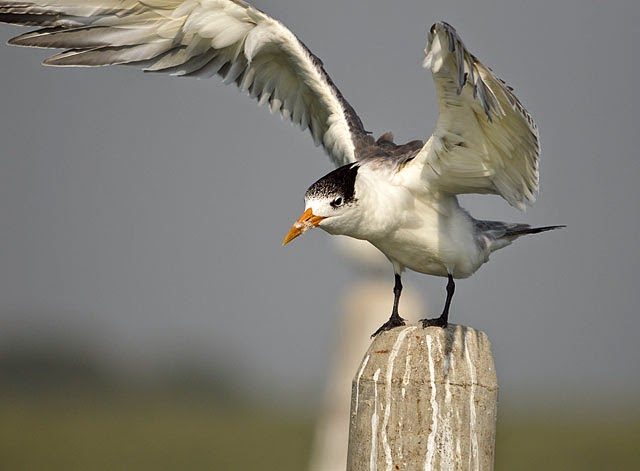
The majority of the terns recorded here were the Great Crested Terns - much to our delight.


Beautiful and majestic even in non-breeding plumage, this uncommon species provided the photographic highlights for the afternoon session.


The poles were quite crowded as there were about 55 Great Crested Terns present in the vicinity. Squabbles for space were inevitable…


Among the Great Crested Terns, there was a lone Lesser Crested Tern which is the rarer of the two species. It was almost too good to be true as I have had very little photographic opportunities with both species in the past. And now, here they are together at the same spot and so obliging. Truly a magical moment…


The Common Terns that were also making full use of the poles and are dwarfed by the larger Crested Terns. The former are outnumbered here because they prefer roosting on the sandbanks of Kuala Muda where we conducted the first session of the count.


A lone Whiskered Terns was present as well and I took a few shots of this widespread marsh tern just as we were about to head back to the jetty. This year's AWC was probably the most memorable and rewarding one that I have ever had. It just goes to show that it does pay to give back to Mother Nature once in a while.