Pages

Showing posts with label Kampung Pertama. Show all posts

Thursday, 10 November 2016

A sky full of storks

I found myself back at the base of the Treeswift Tree in Sungai Sedim Recreational Forest again. Nick, my British guest, wanted both species of Treeswifts found here in Malaysia and I thought to myself that this was going to be an easy one. However, I should have known better. There is no sure thing when it comes to birding. The Grey-rumped Treeswifts that usually outnumbers the Whiskered Treeswifts were nowhere to be found. I could feel a sense of embarrassment developing from within as only a handful of the latter were present. Just as I was about to give up hope, an all too familiar silhouette cut through the sky above followed by another and another. Soon the tree was filled with both Whiskered and Grey-rumped Treeswifts. I was back in business. The vicinity was exceptionally “birdy” morning. Species after species popped up as though to greet my foreign guest. The Chestnut-breasted Malkoha is an impressive bird. Brightly coloured and massive, this cuckoo garners affection wherever it goes. Unfortunately, it is shy and good views are hard to come by. On this rare occasion, it alighted momentarily on quite an exposed perch. But even at this far distance, it gave us the eye before disappearing back into the foliage of the forest. Now that is attitude for you...


There was a small fruiting near the base of the Treeswift Tree and the bulbuls were in a very good mood indeed. Any fruiting tree that is attracting birds is a phenomenal occurrence and the size of the tree certainly does not matter here. No less than six different species were recorded and the Finsch’s Bulbul is one of the more confiding ones.


The Cream-vented Bulbul made a few brief visits and this was the only image I managed to obtain.


It would not be complete if the fruiting tree did not have a few Buff-vented Bulbuls gorging on the fruits. This particular individual was taking a breather from the fiesta and the roadside cable was as good as any perch.


The birds were not the only ones performing well today. We also had the privilege to observe a Cream-coloured Giant Squirrel foraging on one of the tall trees nearby. It may lack the colours of some of the other squirrels but it is still an attractive creature and one that you do not come across all that often.


When the noon hour was upon us, it was time for my guest to get acquainted with some of the wintering freshwater waders at the paddy fields in mainland Penang. As we making our way out of Sungai Sedim, a soaring raptor delayed our departure in a good sense that is. It turned out to be a pale morph Changeable Hawk-eagle and as common as it may be, this formidable raptor still evokes excitement for me.


At the paddy fields, Grey-headed Lapwings, Little Ringed Plovers and Long-toed Stints soon found their way into our birding excursion despite the blistering heat. Wintering waders were not the only ones taking advantage of the accommodating conditions found in this muddy terrain. Eastern Yellow Wagtails can be seen in significant numbers here as well. Their numbers are increasing with each passing week thus providing more photographic opportunities.


Baya Weavers are regular patrons to the paddy fields but their penchant for paddy seeds do not make them very popular with the farmers. A lone individual that was resting next to the fields tried to appear as innocent as possible before the next feeding.


Unlike the last trip, the weather held up till the end but the swamp forest of Air Hitam Dalam was exceptionally quiet today. Come to think of it, the birding has not been the same since the uprooting of one the trees last month. They say time heals all wounds and I hope that will be the case here as well.


Anyway, this male Mangrove Blue Flycatcher seemed hardly affected by the tree and continue to excite and fascinate.


The female Tickell’s Blue Flycatcher was not recorded during my last visit but the old girl put my worries to rest today...


Normally, I would be worry when the natural light disappears all of the sudden but not this time. An enormous flock of Asian Openbills darkened the sky with their sheer number. It was a true spectacle. I have encountered big flocks of this stork here in the past but today, their numbers swept me off my feet as a 1000 strong of them rode the thermals above the adjacent paddy fields.


The Asian Koel, like most cuckoos, is more often heard than seen. This male was foraging unobtrusively on a fruiting tree when we spotted him. As the breeding season is still a few months away, his signature territorial call did not echo through the vicinity this time.


The final destination of the day was the mudflats at Bagan Belat. At the high tide roost there were a number of waders but not as many as my precious visits. I guess our timing was slightly off and most of the waders have retreated elsewhere. The direction of the setting sun also made observation difficult. After a careful sweep, only the usual species were present. A couple of Marsh Sandpipers were foraging at a spot where I could still obtain reasonable images and this graceful wader is always a delight to observe.


The waders at this Important Bird Area provided the perfect way to wind down after a rewarding day of birding. Although there were no lifers to be found at the mudflats here for my guest, a number of the waders were relatively rare where he comes from and that is good enough reason to spend about an hour admiring them before calling it a day.

Tuesday, 25 October 2016

Counting raptors?

October is always an exciting time of the year as the migratory season comes into full swing. It is also time to catch raptors on autumn migration. Bedong is small town in Kedah state where migrating raptors passed through each year. There is a particular hillock in the middle of a palm oil estate where these migrating raptors can be observed and counted. It is definitely not in the same league as some of the other renowned raptor count sites in this region but it is the nearest one to home and that accounts for a lot. However for a rewarding raptor count, hot and sunny weather is an absolute requirement. The Bedong site has changed considerably since my last visit and the ever-growing palm trees now threaten to block our view of the migrating raptors. But the trees were the least of Hor Kee and my worries. The looming thunder clouds were…


It was almost mid morning and yet, no sign of the life-giving rays of the sun. Our raptor count on this overcast Saturday morning was turning be a lost cause. Then the characteristic calls of the Blue -tailed Bee-eater echoed through the vicinity and that is always a good sign. Both of us immediately stare into the heavens above. Migrating bee-eaters are good indicators of approaching raptors and true enough, a lone dark morph Oriental Honey Buzzard leisurely glided into view. And it was surprisingly low.


Oriental Honey Buzzards usually form part of the majority seen during raptor counts here but today, we counted only two. I hope that they are a little late this year or have taken another route south. Got be positive in life sometimes...


Small groups of Japanese and Chinese Sparrowhawks periodically passed through but they were way too far for any photographic attempts. The biggest flock of raptors recorded today was a flock of 30 Black Bazas. My pathetic attempt to capture these striking raptors does them no justice. The poor lighting and distance was just too much for my gear to cope.


By lunch time, things came to a complete stop. Raindrops started to trickle down. It was fortunate that we heeded Mother Nature’s warning and made out way out there and then. Not long after we got into our vehicle, the heavens opened up. The torrential rain washed my SUV clean as we needed to go off-road to get to the count site. But it could not wash away my disappointment as my first raptor count of the season ended with less than 100 raptors. After lunch, we head towards the paddy fields of mainland Penang hoping for some waders to lift our spirits. It has stopped raining by then and the gloomy sky could work to our advantage as we need not deal with the harsh lighting of midday.


The newly ploughed patches were ideal for waders and it did not take long for us to find one teeming with waders. The Long-toed Stint is a small bird and its intricate upperwing patterns blend in well with the environment. A stationery bird can sometimes be overlooked and I am sure we did today. Those that we did managed to pick out numbered up to a staggering 150 birds.


A small number of Little Ringed Plovers were also present and these little guys usually try to be as inconspicuous as possible.


Talking about being inconspicuous, snipes are also back at their wintering ground here. Being masters of camouflage, they are often overlooked. And when that fails, they will fly off to the next cover when threatened. However, this individual did neither although its cover was blown. Another thing that struck us was its plumage. Snipes are a nightmare to identify and we pretty much agreed that this one was a Common Snipe but there is just something about its plumage that did not appear quite right. I suspect the reason it was so confiding was to allow us to obtain good images and torment us later when it came to confirming its identity.


Egrets were aplenty at the paddy fields today. Among all the freshwater egrets, the Intermediate Egret is the one that usually gets the most attention especially from my foreign guests. Although I was not hosting any guests today, it does not mean I do not give the egret any attention at all.


Other than the egrets, there was a big number of Purple Herons present as well. I cannot recall the last time I recorded this many here. Two adult birds standing next to each in the open is certainly not something you see often.


Flocks of Daurian Starlings will usually receive my undivided attention as I do not want to overlook the almost similar but much rarer Chestnut-cheeked Starling which has a tendency to hang out with its commoner cousins. But the only other starling species in this flock are a few Asian Glossy Starlings.


To wrap things up for the day was this flock of Grey-headed Lapwings exhibiting its usual suspicion of approaching humans – birders in particular. 

Thursday, 3 March 2016

No such thing as a sure thing in birding (27/02/2016)

Whenever I take guests out birding there will always be a sense of anxiety at the back of my mind. The birds that we so passionately seek are wild and free. How could anyone accurately predict the outcome of any birding trip? However if there is an active fruiting tree, you have got it made – most of the time anyway. My latest guest is from Australia and like me, is also an ad man by profession. After showing Tony the Treeswift Tree of Sungai Sedim, I took him straight to the fruiting tree that was a centre of attention the last time it came into season. I have to admit I was excited too because word has reached my ears that the Scarlet-breasted Flowerpecker was back to feed on the fruits. This little but rare forest denizen rocked the birding community back then when at least 2 pairs patronized the fruiting tree on daily basis till the fruits were depleted. Judging from the number of birders present here this morning, I was not the only one that received the news.


Unfortunately, the star bird did not make an appearance but the other species that did come for the fruits helped ease the disappointment. To my guest, the male Crimson-breasted Flowerpecker is just as stunning a bird and status does not mean much to an overseas birder. Appearance and character does. And the Crimson-breasted Flowerpecker certainly have those.


The Yellow-vented Flowerpecker, despite its lack of colours can brightened up any birding day. After all it is not that commonly encountered here when there is no fruiting tree about.


When the Yellow-breasted Flowerpecker joined in the feast, I knew that it was going to be a great day. There was a fourth species present but the Orange-bellied Flowerpecker did not stay long enough for me to capture its images.


Both the Greater Green and Lesser Green Leafbirds were also present at the fruiting tree. It is not common to see both these species feeding on the same tree and I felt truly privileged. Even the absence of the splendid adult males or my unsuccessful attempts at photographing the Greater Green Leafbird could not change that fact.


Bulbuls are expected patrons at any fruiting tree and the Grey-bellied Bulbuls led the way this time with their contrasting colours. It was the only colourful bulbul present and naturally had our attention whenever it appeared on the tree.


The distribution of the Finsch’s Bulbul throughout Peninsular Malaysia is somewhat erratic but in the forests of the north western region like Sungai Sedim, it is regularly encountered.


If not for the thin yellow eye ring, the Spectacled Bulbul would be a truly nondescript species. But a confiding forest bird, no matter how plainly coloured, deserves some attention. Forest birds can exceptionally difficult to photograph at times and I for one certainly do not take them for granted.


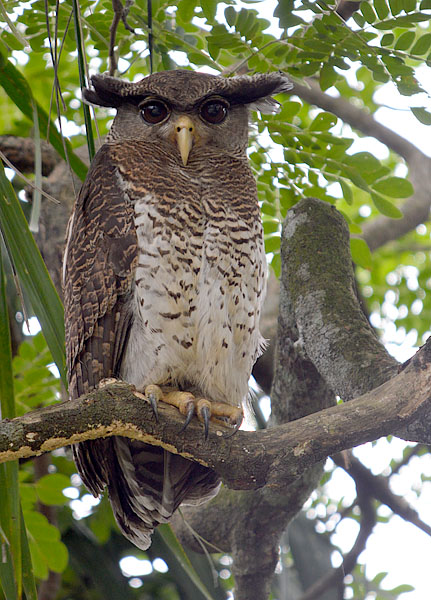
Apart from the fruiting tree, Sungai Sedim was surprisingly quiet. My usual Gunung Bintang trail provided very little opportunity to stop and utilize our birding gear. Not wanting to fight a losing battle, we decided it was time for a change of scenery. As we were making our way out of the Kulim district, a little detour to check on the roosting Barred Eagle-owls proved to be a most rewarding decision. I may be slightly used to the confiding nature of this incredible nocturnal hunter but for a first timer, difficulties in breathing and uncontrollable quivering are the usual reactions. Then only do awe and admiration kick in.


Since luck seemed to on our side, I decided to venture onto a nearby empty industrial plot to look for another creature of the night. A nightjar is not as impressive as an owl but it still has a lot of compelling qualities that make it simply quite amazing. Having said that, I was elated when we found a Savanna Nightjar roosting at one of its regular roosting spots.


Its cryptic plumage blends in perfectly to the concrete embankment and could have been easily overlooked if it was not known to roost there. It has eluded me during my past few visits and this surprisingly confiding individual certainly made up for all the misses. It seemed totally at ease in our presence and continued its afternoon siesta without a care in the world.


A visit to the paddy fields of mainland Penang yielded nothing much except for a huge flock of roosting Asian Openbills at the same spot where I last saw them. Instead of resting at the flooded patch, the storks perched on a nearby tree. With no way of reducing the distance, we left the flock after obtaining some environment shots.


In order to end my trips on a high note, a visit to the swamp forest of Air Hitam Dalam is usually what it takes. However, the Mangrove Blue Flycatchers that usually welcome my arrival were no where to be seen. In fact, I did not manage to even see one throughout the visit. Life, as I know it, almost came to a halt. My ‘guaranteed ’showstoppers have left me high and dry this time and I was utterly devastated. In fact my guest said I appeared to be more disappointed than him. It was relatively quiet at Air Hitam Dalam and the only photo I took was of an Indian Cuckoo lurking around the edge of the access road as we were making our way out of the locality.


An attempt to seek out some kingfishers eventually led us to the mangroves of Juru. However, things did not pick up at all and it was another disappointing visit. We did stop to observe a troop of Silver Leaf Monkeys and judging from their confiding nature, are quite accustomed to human presence.


A mother and her adorable baby was quite a delightful sight. Unlike the other members of her troop, she was a little reserved towards our presence and the reason was very obvious. And we did not push any further to obtain better images. The trip started extremely well but last bit was a little disappointing. But this is birding. You can never be sure of what you are going to encounter or miss. 

Saturday, 20 February 2016

The grass is not always greener on the other side (12/02/2016)

My plans were set for the third day of my festive birding spree – or so I thought. I intended to spend as much time as the volatile jeep shuttle schedule of Bukit Larut in the state of Perak would allow. As I walked towards the ticketing booth at first light, there was a notice stating that the shuttle service will not be operating today. I just stood there stunned. This turn of events really took me by surprise. After the initial shock, came the anger and the swearing. So much for some montane birding during this festive season. The reason, which I found out later, was because there will be a little ceremony here today to commemorate the handling over of the management of the hill to the local council. Whatever and so long as they do not kill off the hill, it does not matter who is in charge. I planned to visit the mangroves of Kuala Gula after my montane excursion but now, it will no longer be a side trip. I arrived at the locality slightly later than my usual birding time and proceeded to search for an enigmatic and unique bird that has been recorded here last month – the Common Hoopoe. It has been more than a decade since my last sighting of this scarce migrant and much to my dismay; it was nowhere to be found. Today is certainly not off to a good start and nothing has gone my way yet. Not even the weather as dark rain clouds started to form overhead.


Flocks of mynas and starlings will come out of their roosts in throngs at this locality after the break of dawn. I did my best to look out for any rare or unusual species and for my effort; I did come across one species I do not see that often up north. It is also a species I am not too fond to see making its way up north because it is not native and is highly invasion – the Javan Myna.


Then among the dead mangroves, I caught a glimpse of something moving up one of the dead trunks. It was a Sunda Woodpecker looking for breakfast. I stalked my way closer until the trunk was in front of me and patiently waited for the minute woodpecker to move round to this side of the trunk in which it did – eventually. Things are finally starting to look up...


A male Ashy Tailorbird came extremely close to my stationery vehicle while foraging among the branches of a fallen mangrove tree. Although the angle of the shot was a little steep but I am happy with the clarity of the image as the bird was quite active and the lighting was less than desirable
.


A small number of Pond-herons were foraging near the river and upon further scrutiny, one of them turned out to be a Javan Pond-heron. It was still in the early stages of its breeding plumage and that explained why it was so confiding and cooperative. If it were in its striking breeding, it would have been long gone before I could even get half as close as this.


The larger herons like the Grey Heron and Purple Heron were exceptionally skittish this time and I could not even muster one single reasonable shot. The Striated Herons that find refuge in this bird sanctuary have shown exceptionally bold behaviour in the presence of humans time and time again. And a nice portrait will not require much effort.


The waterways that cut through this bird sanctuary are favoured hunting grounds for kingfishers. Five species were recorded this trip. The Black-capped Kingfishers were being their usual difficult and skittish selves. Although my luck was improving, there was no point hoping for one of these beautiful birds to allow me to obtain one reasonable shot. The Collared Kingfishers, on the other hand, could not be bothered even if you reach out your hand and pat it on the head.


At least two Common Kingfishers were seen zipping up and down their respective territories and I did not have much photographic opportunities until the moment one alighted near where I have stopped my vehicle. It turned out be a female and remain on that perched for quite a period of time. And I felt so privileged to have the companionship of such radiant beauty - even if it lasted only for a few minutes.


When it comes to Red Junglefowls, you have but one shot to get it right as they are very shy and wary birds. This morning, I managed a couple of shots before it disappeared into the long grass of the adjacent palm oil estate. The male’s resplendent colours are something you do get to enjoy for a prolonged period and every shot that I get which is slightly acceptable will be keepers in my book.


The male Pied Triller is a striking bird that occurs in a wide variety of habitats including mangroves. Its nasal notes are not foreign in built-up areas as well but like most beautiful birds that occur alongside man in Malaysia, I do not have many images that I can be proud of. This slightly distant shot of a male bird proclaiming his territory from the canopy level of the mangroves is certainly one of my better efforts.


I started feeling restless around mid morning. This tends to happen when things are slow – like today. As I was making my way out of Kuala Gula, the distinctive silhouette of a White-breasted Woodswallow delayed my journey to my next destination. This species is commoner down south and I have yet to see one in my home state of Penang. It also has a preference to use man made objects to rest and this time, a rusty goal post in the middle of a school field. Not the kind of setting or the lighting condition one would ask for but it will do.


I headed up north to another vast area of mangroves. Pulau Burung is at the southern tip of mainland Penang and this whole area used to be one of my favourite birding haunts. I have lamented many times how this little birding haven was destroyed by the local authorities but I guess what is done is done. No point dwelling in the past because it will not bring back the glory days of yesteryear. The weather has turned full cycle by then and it was sunny with clear blue skies. The scenery is breath taking despite the landfill in the background. 


However, I am not here to soak in the view. It is always the birds that really do it for me and the Lesser Whistling Ducks are one of the few that still call this place home.


This used to be the best place in the whole of Malaysia to observe and photograph Blue-tailed Bee-eaters. This confiding individual brought back good memories of that era and I, slightly moved by this nostalgic moment, kept my composure well enough to continue shooting.


It has been a long time since I did a birding circuit and seeing that I still have half a day left, I might as well do one today. After a quick lunch, I set off towards Sungai Sedim. The active fruiting tree is not just a bird magnet. It pulls in birders just as well. On the way there, I made a little detour to check on an old friend who has been absent from his favourite roosting during my last first visits. Even from a distance, I could make out its silhouette and today, the Barred Eagle-owl was roosting much lower than usual. I would have been happy just to know that the owl was still well and kicking but to be able to get so close to this amazing animal was a real bonus. So long as I remained in my vehicle, this individual will be almost as tame as a house cat. And today’s excursion just when up a notch.


The slight drizzle as I made my through the narrow rural roads leading to Sungai Sedim could not dampened my spirit especially after such an exhilarating encounter with the owl. The rain trickled down to a stop when I arrive at the fruiting tree and I took that as another good omen. I barely had time to get down from my vehicle when the birds started to come in to the fruiting tree. Most of the species present at the tree were the same species as my last trip a few days back. As I was observing the patrons of the fruiting, the male Green-backed Flycatcher alighted barely a few feet from where I was standing. Unbelievably, it chose a clean perch with a clean background and almost at eye level. I was left dumbfounded. It is just one of life’s mysteries and one that I enjoyed it for almost half a minute. All the activity from the fruiting tree above momentarily ceased. It was just me and this handsome migrant.


Once the flycatcher disappeared into the vegetation, I was back on Earth again. The commotion above caught my senses again. The distinct calls of the Finsch’s Bulbul filled the vicinity and it did not take long to locate one gorging on the fruits.


A flock of Hairy-backed Bulbul made a pit stop at the fruiting. I only managed to take one shot before the flock moved on. And I had a sudden urge to visit the paddy fields of mainland Penang. Call it a birder’s intuition and I decided to adhere to my inner voice, packed up and head to one last locality for the day. 


Most parts of the paddy fields were either dry or waiting to be harvested and that is bad news for a birder. I was beginning to doubt my decision to leave the fruiting tree at Sungai Sedim when I spotted a flock of large birds soaring above and it was one massive flock. Even at this far distance there is no mistaking the Asian Openbills for anything else. This is another species that I have not seen for months and I decided to drive closer to this spectacle of nature.


As I got closer, the flock descended on probably the only spot that has open water in this entire area. I drove closer cautiously as these birds usually do not have much tolerance for intruding birders. However, they were exceptionally confiding today and I guess they were just very reluctant to part from this watery refuge.


Using my vehicle as a mobile hide, I got to as close as I possibly could and enjoyed the view. The storks appeared relax in the presence of this lone birder and I too got comfortable before focusing on obtaining some good images. The setting sun provided a certain glow to both the storks and the environment in my images and I am truly loving the moment.


Large shadows cast over the water marked the arrival of even more Asian Openbills. My initial guess was right. An open flooded patch is certainly a prized commodity here and I have positioned myself the best that I could to welcome this second wave of storks. Sometimes when I am birding, I will have encounters that are so captivating that everything else drowns out and I just lose myself completely. I had two earlier on – the Barred Eagle-owl and the Green-backed Flycatcher. And this is my third – being surrounded by Asian Openbills. All these took place in my usual birding spots and it made me wonder why I needed to drive all way into Perak state in the first place.


When the storks finally settled down, there were at least 500 birds in this pool of water alone and this is the closest I have ever been to this unique waterbird. Now, this is what birding is all about. Moments when everything just falls into place perfectly and the birds give a show that will last a lifetime.


When I was finally able to break free from the spell the storks have put me under, I discovered that the day was not quite done yet. A flock of Ruffs were foraging at different section of the flooded patch alongside the much commoner Black-winged Stilts. The Ruff is an extraordinary wader and what makes it so is the remarkable breeding plumage. Unfortunately, we will never get to see a male Ruff in full breeding here as they do not breed here in the tropics. But it is still a scarce winter migrant and seven birds together is something to shout about for sure.


Just as I was stalking towards the Ruffs, the entire flock of Asian Openbills suddenly took flight and it was a fury of wings and feathers. Continuous wingbeats of 500 pairs of wings at such close proximity can be a rush. Initially, I was puzzled by the unexpected departure of my feathered friends until I saw a local villager casting a net for fish. I guess I should not complain because at least he had the courtesy to wait until I was done with the storks and started to photograph something else. This wrap things up for a long and tiring day of birding circuit that started off on the wrong foot but concluded so much better than I could have hoped for.