Pages

Showing posts with label AWC. Show all posts

Tuesday, 22 January 2019

Counting waterbirds...


The emergence of the Chinese Egrets in Penang Island revived my passion for tidal habitats and the birds that find sanctuary there. I used to spend hours on end at the mudflats of Bagan Belat back in the day. Back when hundreds or even thousands of waders were present at this coastline. Sadly in recent years, the objects of my obsession have shifted to rather inaccessible areas. This and the destruction of most of the good wader sites in my home state has kept me away from indulging in wader watching. Each January, the Asian Waterbird Count (AWC) takes place throughout the continent and on this beautiful Saturday morning, I decided to do my part.


The tide was about right and the weather was good. But as expected, not much variety of waders were present at the extensive mudflats of Bagan Belat. Common Redshanks were the most numerous species present and it has been that way for quite some time.


A huge flock of white birds with black wings started to fly out from the mangroves and alighted beyond the edge of the mudflats. The birds were too far for me too positively identify them. Habitat may be ideal but they sure the hell were not Milky Storks – not in this kind of number anyway. Asian Openbills are a better bet and this is the first time I am encountering them in a marine habitat.


Eventually some of them flew over to my end of the mudflats and their identity were no longer in doubt.


One can always hope of something rare when gazing at flocks of waders out in the mudflats. Imagination can only take you so far but when seen well, it is not easy to misidentify a Common Greenshank for a Nordmann’s Greenshank.


All the egrets present were scrutinized to make sure I do not overlook a would-be rarity. I have recorded the globally vulnerable Chinese Egret here once before but today, only the Great Egret provided any form of excitement from this family of birds.


The resident pair of Brahminy Kites were up to their usual routine of scavenging and the occasional piracy of egrets’ fresh caught preys. However, what goes round comes round and the kites have to put up with the constant mobbing of the House Crows.


A fair number of Whiskered Terns were also present and the river mouth seemed to have their undivided attention today. A short walk along the rocky wave breaker got me into a better position to photograph these angelic and graceful birds. It is not easy but the good lighting helped tremendously.


Poetry in motion – the bird and not the photography…


After the AWC, I swung by the swamp forest of Air Hitam Dalam only to find a group of schoolchildren making their presence felt along the canopy walk. This location holds the status of an educational forest but judging from the level of noise and disturbance this group was making, I doubt there will be much education to be learned from this trip. The wintering Square-tailed Drongo-Cuckoo has been quite tolerant to human presence so far this season but nothing could have prepared it for the commotion that was now taking place. Inevitably, it was nervous and skittish and a record shot was all I could muster.


The male Scarlet-backed Flowerpecker is an exquisite creature despite his common status. Naturally he had my attention and from the look of things, I had his too (in a bad way). Not today, huh bud?


By the later half of the morning, the temperature started to soar and so did some of the birds. More Asian Openbills were seen again and this time at much closer proximity.


Poetry in motion – again the birds and not the photography…


Ever wondered how this stork got its name? Apparently only mature birds will sport this distinct gap between mandibles.


When a striking adult Brahminy Kite leisurely glided into view it was deja vu again. First the Openbills and now this common raptor.


I was just thinking to myself that there is another species that often patrols the sky above the swamp forest here this time of year and just like a staged performance, in came a trio of Black Kites from the adjacent paddy fields.


The kites were probably back to rest after the morning’s hunt and their favourite site is the row of big trees across the river. Enjoying the sight of a tree full of Black Kites is something you rarely get to say especially here in Malaysia.


This male Common Flameback signalled his arrival by uttering a series of his loud territorial call. Although this species is a regular here, I have always adored his vivid colouration. Today, he was particularly obliging and I think I took some of my best images of the species to date.


After the exciting encounter with the Common Flameback, I was ready to call it a day. The heat of the midday sun was starting to wear me out. But, this birding hotspot was not quite done. A male Banded Woodpecker alighted so close that it gave me a startle. This species can be exceedingly tame here at times and this was certainly one of those occasions. He was somehow attracted to a clump of Nipah Palms and most probably is about food. A dried palm frown coincidentally provide an interesting backdrop for the photo.


By that time, lighting was getting harsh. Despite the confiding nature of the woodpecker, some of my images somehow do not quite hit the mark. Nevertheless, like the woodpecker, I took my time to gradually move out of the vicinity. My last visit here was rather mundane but today was a whole different story. And it did not even involved one single uncommon species.


I would have missed the last bird of the day had I not seen it fly onto the perch. Indian Cuckoos are common migrants and there are at least two individuals wintering here this season. It is no award-winning photograph but sometimes, experiences matter more. And observing this handsome male Indian Cuckoo resting among the shadows of the canopy foliage is an intriguing experience indeed.


Tuesday, 27 January 2015

Giving back...(24/01/2015)

The Asian Waterbird Census (AWC) is an annual event coordinated by Wetlands International. Each year in January, volunteers from across Asia and Australasia will conduct the AWC in their respective countries. I am no scientist but I derive endless fascination from birds. That is why whenever I can, I do my part and help out in some conservation work. The AWC and My Garden Birdwatch (MYGB) are just some of the citizen scientist projects that I commit myself to. For the AWC this year, we did counts at two sites. Together with Dave and Hor Kee, we started off the first count at the sandy shores of Kuala Muda in mainland Penang.


Once we got ourselves comfortable, it was down to business. Here, on the exposed sandbars, a high concentration of terns rest in between feedings and tides. Egrets and a small number of waders will also use these resting stations. The count was conducted from the shore and it was a fair distance from the birds. There is no point to risk spooking the birds when doing a count. Stationery birds are much easier to count than flying ones - believe me. By mid morning, we concluded the count here. It was a good session as there were about 3,000 terns present consisting mostly of Common Terns and as well as a few Brown-headed Gulls.


The resident dark-morphed Pacific Reef Egret provided the photographic highlight for me after the count. This coastal species is the rarest egret after the globally endangered Chinese Egret in Peninsula Malaysia. The coastline here is one of the few spots in Penang where it is regularly encountered.


The elevated rocky outcrops next to the coastline where the egret had landed to forage provided the ideal cover for me to sneak up on my subject and successfully obtained my best images of this species to date. Being the only the egret in Malaysia with two colour morphs makes it unique and it is a species that I have always wanted to obtain good images. Looks like I got my wish today...


We had a few hours to kill before the next session of our AWC. The nearby paddy field was a very inviting option to pass the time. Upon our arrival, a flock of about 60 Asian Openbills were seen riding the thermals further confirming the fact that these enigmatic storks are still present in my home state. The paddy fields had quite a number of egrets about. Here is an image depicting the differences between the Great Egret and the Intermediate Egret.


I had a frustrating time trying to obtain decent shots of the Red-throated Pipit during my last birding trip that is at the grasslands of Chuping in Perlis. We came across a handful of these uncommon migrants again today but unfortunately, they are not any better than their northern comrades. I will get you guys one day...


Our second AWC session was by boat as we counted roosting waders along the Bagan Belat Important Bird Area (IBA) coastline which was not too far from the first count site. We were joined by Choo Eng and a few others including representatives from the local council. It is part of the Malaysian Nature Society's effort to get this site protected and turned it into some kind of an ecological reserve for tourists and future generations to enjoy - with the help of the local council.


Our 'guests' were in for a treat as we came across a few high tide roosts that had thousands of waterbirds. As we were doing the count on a boat, good images of individual species were difficult to obtain due to the distance and the constant rocking of the boat.


No matter what the distance, the Eurasian Curlew is almost impossible to miss because it is one of the largest waders in Malaysia and with a bill that is almost as long as its body.


A flock of Bar-tailed Godwits was looking very comfortable roosting at the water's edge. This is another species that spots an impressive looking bill.


Flocks of Common Redshanks are another species that were easy to pick out because of their vocal nature and distinct colouration.


This distant shot is of a flock of Common Greenshanks and Marsh Sandpipers. There were no Nordmann's Greenshanks here as initially thought (Thanks, Dave for the correction).


The Asian Dowitcher is another scarce winter migrant to Malaysia and deserves just as much attention.


Larger waterbirds were easier subjects for our guests to observe and appreciate. The resident Grey Herons were certainly one of them.


The Great Egrets also did their part to help keep the boat trip interesting...


We, on the other hand, required no such motivation to earn our undivided attention. The presence of 10,000 waders was more than what we could ever ask for. This was certainly a much better session of our AWC - as expected. Another exciting discovery was the 300 Brown-headed Gulls resting at one of the high tide roosts. This is probably the highest concentration of gulls in Malaysia.


A few of the gulls were quite near to our boat and they provided some great photographic opportunities.


This is a juvenile as it lacks the characteristic wing 'mirrors' of the adult bird.


Some were also swimming in the vicinity like this juvenile that has just caught quite a sizable meal. Beginner's luck, perhaps?


And if that was not enough, there were at least three of the much rarer Black-headed Gulls present as well. This adult bird was flying not too far from our boat and provided the only image I could obtain of them.


Initially, only the commoner terns were counted like this Common Tern...


That was until our boat passed some mussel farms out at sea. Consisting of cement poles jutting out from the water, they provided the perfect perches for the sea-loving terns to rest on.


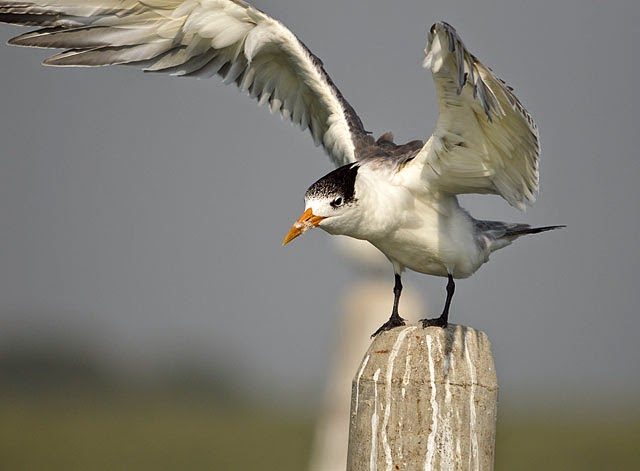
The majority of the terns recorded here were the Great Crested Terns - much to our delight.


Beautiful and majestic even in non-breeding plumage, this uncommon species provided the photographic highlights for the afternoon session.


The poles were quite crowded as there were about 55 Great Crested Terns present in the vicinity. Squabbles for space were inevitable…


Among the Great Crested Terns, there was a lone Lesser Crested Tern which is the rarer of the two species. It was almost too good to be true as I have had very little photographic opportunities with both species in the past. And now, here they are together at the same spot and so obliging. Truly a magical moment…


The Common Terns that were also making full use of the poles and are dwarfed by the larger Crested Terns. The former are outnumbered here because they prefer roosting on the sandbanks of Kuala Muda where we conducted the first session of the count.


A lone Whiskered Terns was present as well and I took a few shots of this widespread marsh tern just as we were about to head back to the jetty. This year's AWC was probably the most memorable and rewarding one that I have ever had. It just goes to show that it does pay to give back to Mother Nature once in a while.