Pages

Showing posts with label Malim Nawar. Show all posts

Tuesday, 15 September 2020

Getting twitchie over a sharpie


The former mining pools of Malim Nawar is probably the location for most, if not all of my pure twitching trips. And this time, it is for a Sharp-tailed Sandpiper – a rare migrant to our shores. It was a cold and gloomy morning. To make matters worse, it started to drizzle just as Hor Kee, Michael and I were about to complete our two hour drive from Penang. When we finally reached the spot, we found ourselves staring at a huge semi-dry fish pond. Our target is a relatively small peeps. This is certainly a muddied version of the needle in a haystack saying. And no matter how stunning the view may be, I do feel my spirit lifted. Only a particular little wader that breeds in the northern tundra will be able to do that.


There were other waders present like Wood Sandpipers and Long-toed Stints. As most waders in winter plumage look quite similar especially in a distance, their presence were distracting. A huge number of Black-winged Stilts were out foraging throughout the pond and the possibility of a Pied Stilt (a recent addition to the Malaysian checklist) did cross my mind but a quick scan at the stilts revealed nothing out of the ordinary.


Anxiety soared as our target remained elusive. Sharp-tailed Sandpipers usually do not linger long at a stopover during passage. This twitch was beginning to put our skills (and patience) to the test. Ever since a camera joined my birding arsenal, I do not carry a scope anymore. Luckily, Michael still does and it took some good old fashion birding to save the day. As soon as he had his scope up, he found the ‘Sharpie’ foraging leisurely at the edge of the exposed mud. And Malim Nawar once again provided a successful twitch for me.


Here is the Sharp-tailed Sandpiper in comparison to the smaller Long-toed Stint. When seen together, the differences are obvious. However when seen alone and taking into consideration the possibility of hallucinating some some non-existing field marks, it is a different story altogether.


The lighting was less than desirable and the privileged guest was quite a distance from the access road. There was undoubtedly room for improvement with the images that I obtained. But I was elated. In light of all the hindrance caused by the Coronavirus pandemic, I was not even sure there could be any lifers for me any time soon. The Sharp-tailed Sandpiper was confiding enough I suppose and the prolonged observation made the experience a memorable one nevertheless.


With the lifer safely in the bag, I started to focus on the other waders present. One other certainly had my attention because it is usually shy by nature. The Greater Painted-Snipe is somewhat crepuscular and it is one of the few bird species in the world where the gender roles and even appearance is reversed. Anyway, this male was foraging quite comfortably right out in the open and that is something I do not see very often. I guess it would be pushing it to hope for the more striking female to make an appearance.


The Asian Openbills which have settled in well in the north are also finding this locality ideal. I managed to photograph one that was doing what it does best and that is to extract a meal out of a snail using its highly-specialized bill.


Another recent colonizer to Malaysia that is thriving here is the Little Cormorant. Although we did not get many photographic opportunities, this flying bird provided a sufficient souvenir for our trip.


One would think that after my trip to Cambodia I would not be so easily excited by the presence of an Oriental Darter. However, this sleek waterbird is rare here in Malaysia and one perched at a far distance still had my undivided attention.


No visit to this area would be complete without coming across the Grey Herons. Although, these majestic waterbirds are also found in my home state, I still find them intriguing. Birding, after all, is not always about rarities.


Grey-headed Swamphens (yes, another split) were given their due attention because we recorded the first Black-backed Swamphen in Malaysia quite recently. As with the stilt, there was no cause for celebrations. Only wishful thinking.


A feral Water Buffalo looking undeniably intimidating and it is not all bark and no bite for this occasionally ill-tempered animal. Thus, it has my respect which is rarely given to any semi-domestic animal.


It is alarming to find Javan Mynas outnumbering every other myna species here in Malim Nawar because the same thing could well take place back home in Penang. Not only are they displacing the locals but they are also attempting to ‘breed’ them out as several hybrids were seen. If this is not considered an invasion, I do not know what is.


As for the Zebra Doves, they went about their daily routine peacefully oblivious to the threat that the Javan Mynas now pose to a few of their fellow residents here.


I do not think I will ever get bored of the Stork-billed Kingfisher especially one as confiding as this individual. Just look at that bill...


Unbelievable as it may seem, the kingfisher was outdone by an unlikely species – a Crested Goshawk. In northern Peninsular Malaysia, this stunning raptor does not come by often enough for me and even when it does, it is exceedingly shy. This is the closest I have ever approached a Crested Goshawk and it was a moment worth savouring.


The only drawback was the awful lighting condition and there was not another single angle from which I could truly capture the beauty of the goshawk.


As our group was feeling luckier than usual, we decided to test our fortune at a slightly similar habitat closer to home for an equally rare peeps. The Pulau Burung landfill has been visited by the Pectoral Sandpiper before but luck can only take you so far. It would take nothing short of a miracle to bag these two rarities on the same day. A confiding Little Cormorant was the only consolation from our efforts of scanning the shallow ponds surrounding the landfill.
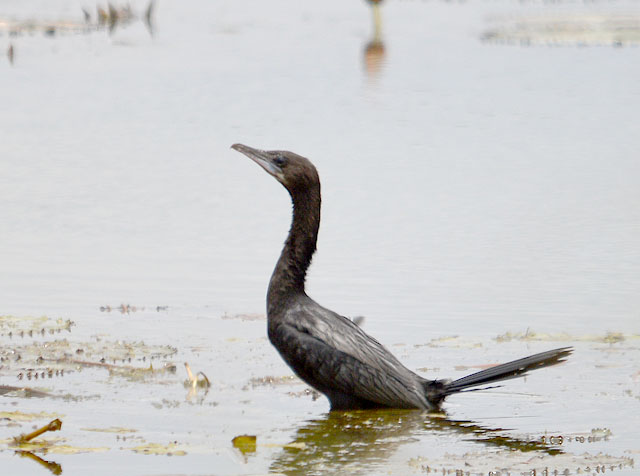


A tree full of Little Cormorants in the state of Penang is a sight that will still take some getting used to for me. The population has certainly flourished here and gone are the days when any cormorant is a rare occurrence.


Just like the Grey Heron, the Purple Heron still had what it takes to tickle my fancy. I guess being a big and beautiful water bird will make it easier to garner my affections.


It was a picture of serenity with this flock of Lesser Whistling-Ducks resting at the marshlands of this landfill. Their numbers are climbing again at this major stronghold and that is a good sign. The Lesser Whistling-Duck may be dull when compared to other ducks but it is still the only duck that can be regularly encountered in my neck of the woods.


Birds are not the only wildlife thriving in this environment. Reptiles like the Water Monitor Lizard has found sanctuary here as well. Some have grown to impressive lengths like this individual slithering about the river bank. This giant of a lizard wrapped things up for a great day out in the field as a successful twitch is one of the most exhilarating aspects of birding.


Friday, 10 February 2017

Duck Central

The former mining pools at Malim Nawar in Perak state proved once again to be the place for rare migratory ducks when a Northern Pintail decided to winter here this season. However, I was only made aware of its presence a few days before the Lunar New Year and whatever plans to twitch for this duck just had to wait. And the wait became almost unbearable when Dave came back on the first day of the New Year not only with images of the Northern Pintail but also Malaysia’s second Blyth’s Pipit. I found myself embarking on the 4-hour round trip to the site the first chance I had and with Hor Kee as my companion. Ducks rarely winter here in Malaysia and even when they do, the males will usually be in their drab eclipse plumage. This male Northern Pintail, on the other hand, was almost in full breeding plumage. For a waterbird enthusiast like me, that is almost like striking the lottery. Upon arrival, I immediately went for the Northern Pintail. My companion, having ticked off both birds on his last visit, tagged along to seek improvements shots of the Blyth’s Pipit and as it turned out, to provide moral support as the duck was no where to seen at his usual spot. And all the excitement built up in me during the journey here died off completely.


A careful sweep of the adjacent ponds was the next and only course of action. There is a God after all and among the reeds of one of the other ponds, the Northern Pintail was paddling leisurely whilst looking for breakfast. Life, is beautiful once again. Of the three rare ducks that this little piece of birding paradise hosted through the years, this male Northern Pintail is the most stunning in my book. The only thing lacking from his splendid plumage is the elongated tail feathers. That would have made it perfect.


The duck was reasonably confiding but the lighting was against me. The thorny scrub vegetation and the presence of temperamental Water Buffaloes prevented me from improving my position. Taking into account my miserable state of mind minutes earlier, I was not too disappointed with the natural elements that were not in my favour. I finally connected with a male Northern Pintail and it was truly an uplifting experience.


While I was being uplifted by a duck, a group of Selangor birders that arrived later came across the Blyth’s Pipit near where we have parked our car. As we were making our way out to search for the pipit, the Selangor birders were making their way in for the duck. Information was exchanged and my pace quickened as there was now a chance for a double mega lifer today. And the moment of truth came not too long into our search…


But it was not meant to be. Every single pipit that we managed to dig up the whole morning turned out to be Paddyfield Pipits including this one. I was not expecting much to begin with as the celebrity pipit was not seen for the past few days. I am glad that today someone saw it. Even if it was not me who was in the vicinity at that time - honest. I bet if I had look really hard from where I was crouched down observing the Northern Pintail, I would probably had the Blyth’s Pipit in my binoculars. But seriously, if I have to choose between the duck and the pipit it would undoubtedly be the former.


Anything that even slightly resembled a pipit received our undivided attention including Eastern Yellow Wagtails…


In between our stops for pipits and wagtails, a few other species did manage to garner our attention. Malim Nawar is the best locality in Malaysia for Bank Swallows – a scarce winter visitor. Although there is much debate and confusion as how to differentiate the Bank Swallow from the Pale Martin, I like to keep things simple and consider all 30 birds that were present today as Bank Swallows. That number itself would have brightened up any ordinary birding excursion. But today is no ordinary excursion.


Not much waders were present today and a lone “Swintail” Snipe (again, I like to keep things simple) momentarily distracted us from our search for the pipit.


A large raptor circling overhead turned out to be a Crested Serpent-Eagle…


Just before we called it a day, we returned back to the pond area for the Northern Pintail. He was no longer alone and was enjoying the companionship of 4 Garganeys. Although the Garganey is the commonest of our rare migratory ducks, 4 of them at a single locality is certainly a noteworthy record and a fine way to end yet another successful twitch for a rare duck at this locality.

Tuesday, 16 February 2016

No rarities, no problem (11/02/2016)

I have been quite consistent with my visits to the former mining pools of Malim Nawar in Perak during this time of the year. This locality does have a good record for producing mega lifers and I thought I will try my luck here on day 2 of my festive birding spree. The 200km drive was slightly taxing than usual due to my level of intoxication from last night’s festive drinking session. There have been records of the scarce White-shouldered Starling a few months back and I decided to start off today’s excursion from the spot where a pair of these migratory starlings were last seen. Luck was not on my side and despite a thorough sweep of the area; there were no signs of the starlings. So, I turned my attention to the next best thing – the uncommon Sand Martin. There is still some confusion about the true identity these martins and Malim Nawar is one of their regular wintering grounds. I am a simple man. Until, they find a way to differentiate the Sand Martin the Pale Martin (which is near impossible); they will all be Sand Martins to me.


At least 5 birds were present in the vicinity and they have a habit of resting along the wires, in the company of Barn Swallows, above the fish ponds. When compared to the latter, they are smaller and duller-looking but sometimes status supersedes everything else. With no way of getting any closer to the martins, I soon left them to their sunbathing and searched for other interesting species to document.


You are bound to see a few Cattle Egrets when birding in open country habitats like this. In winter, they are small and don their boring non-breeding plumage. Come spring and you will see an astonishing change for the Cattle Egret sports the most vibrant breeding plumage of all the egrets found here.


That remarkable breeding plumage is further enhanced when in full breeding plumage with the purplish hue to the lores and reddish glow to the legs. Exquisite is the word...


The Long-tailed Shrike is a beautiful bird and certainly beats the rest of the shrikes hands down. Unfortunately, it is also the shyest. I have come to a stage where I will not even attempt to try and reduce the distance for a better shot whenever I come across one in the field. Sometimes, God works in mysterious ways. I was not even trying today and the bird just happened to be along the route I was taking. To my astonishment, this Long-tailed Shrike did not budge. It still remained put when I raised my camera to focus on it. That’s more like it.


But the sound of the shutter must have struck a nerve because it flew across the trail after a few clicks. Luckily by then, I had already obtained my best images of this species to date. The lighting from this angle was better and the rays of the morning sun brought out the true splendour of the bird.


A colony of nesting Baya Weavers is not something you can easily miss. First of all, there is the presence of all those architectural work of art these birds call home. So amazing are these nests that are collected to be used as interior decorations. Unfortunately, these unscrupulous nest collectors lack conscience and humanity. Nests with fledglings still inside will not be spared and that just makes my blood boil. Secondly, the birds at a nesting colony tend to make a racket that can be heard from far away. There were at least 3 colonies within the area and I am glad this species is still doing well despite all the senseless prosecution.


As there was nothing much about, I took my time to observe a relatively new colony told by the big number of bachelor pads. Most of these pads are newly-constructed as they are still green. From these bachelor pads, all the hot-blooded males will sway, sing, shout and do whatever it takes to entice a female to join him. Not so much different from human beings, I guess.


This is the reason for all the activity at a colony – the dull female.


Once a male manages to find a mate, he will finish up the nest – turning his bachelor pad into a family suite. Again, this sounds very familiar. Anyway, this is what a completed nest looks like.


The Little Cormorants have settled in quite well to this locality. A handful were seen during this trip but they were extremely skittish and nearly impossible to approach even by car. These skilled fishers of birds were the only relatively uncommon waterbird that crossed my path today.


The commoner waterbirds, however, were very gracious and did a fine job hosting me during my visit. I absolutely adore Black-winged Stilts. There is always an aura of grace and poise about them. This male was so confiding that I could not help but to stop and photograph this common but striking wader.


It felt like there is a slight drop in the number of Grey Herons. In the past, I used to be overwhelmed by their sheer number. In fact, these large herons are one of the reasons I love this birding hotspot.


The same applies to the Purple Herons. It will be real shame if these two giants can no longer find sanctuary here in Malim Nawar. I could be a little paranoid but I have seen how these herons are losing grip of their home at the marshlands of Batu Kawan in my home state of Penang.


On the other hand, egrets like the Great and Little Egrets are finding life to be sunny and blissful here...


It is not that often a Greater Coucal allows itself to be photograph in the open. This cuckoo is shy despite its large size and common status. The deep booming call is frequently heard in a variety of habitats and is the best indication of its presence. Having said that, I guess having a few twigs in the way of my attempts to capture images of this skulker is not a big deal after all.


While taking a breather from intense searching for possible rarities under the blistering sun along the rows of former mining pools, a lone Eastern Yellow Wagtail wandered very close to my stationery vehicle. I certainly do not need any invites to start shooting this confiding individual. Now this is probably one of commonest passerines that spend their winter here in Malaysia. In suitable open country habitats, their numbers can be impressive. But a close encounter like this does help ease the disappointment of the lack of rarities for this trip.