Pages

Showing posts with label Snipe. Show all posts

Friday, 22 December 2023

A Manchurian for Christmas


It is common knowledge that our forests are under threat but the devastation does not end there. Wetland habitats suffer a similar fate. In my home state of Penang, I am running out of wetlands to visit. And for someone with a soft spot for water birds, it is utterly depressing. The marshlands at Batu Kawan would have been my saviour if it has not been slated for development in the near future. At the break dawn, my companions and I plodded along the soft laterite access road cutting through a construction site. It may not sound much like a birding trip but that is what one has to endure in order to reach the said wetlands. Sad but true...


I may not speak for everyone but the sight of a congregation of large water birds never ceases to amaze. Flock by flock of water birds arrive at this feeding ground from their roosts in the surrounding vicinity. For the record, this location probably has the highest density of Purple Herons and Grey Herons in Penang and the numbers are incredible. I opted to observe rather than photograph because that is where the true value lies and this image of a lone Grey Heron may not be able to fully convey the moment.


The advancement in digital cameras of late is undeniable but they do not come cheap. So, for the time being I still rely on pressing the shutter and pray for at least one frame to turn out decent. However, there is a limit to how much one can achieve through prayers especially for a flight shot in dim lighting like this taunting Cinnamon Bittern making its way to breakfast.


One has to be observant to pick out the small but adorable Long-toed Stint from all the blobs of mud, debris and vegetation present in the wetlands. The distance may have robbed me of some of the joy but the Long-toed Stints have their way to gain my affections.


A trio of drabber looking stints dashed across our field of view haphazardly and alighted on a distant sandbank. Our initial guess was spot on when they turned out to be Temminck’s Stints in the end. This species is an uncommon winter visitor to our land and more than capable to excite even the most seasoned birder.


My encounter with the rare Common Ringed Plover here last season left much to be desired. Naturally, all Little Ringed Plovers were scrutinized for a possible re-occurrence of the former but I could not attain the closure I seek.


The Black-winged Stilts graced the location in good numbers with their elegant presence. The new generation of birders and bird photographers may not be aware that this bird was once a rarity in Malaysia but I certainly do. Decades may have passed. Exhilaration may have been reduced. One of my all-time favourites, the bird remains.


They are conspicuous not only because of their contrasting colouration but vocal nature as well. More often than not, they drown out most other species that share their watery domain. This temporary sanctuary will host the Black-winged Stilts and the rest for at least one more season. I am no soothsayer but unless a miracle takes place, the demise of this locality is just a matter of time.


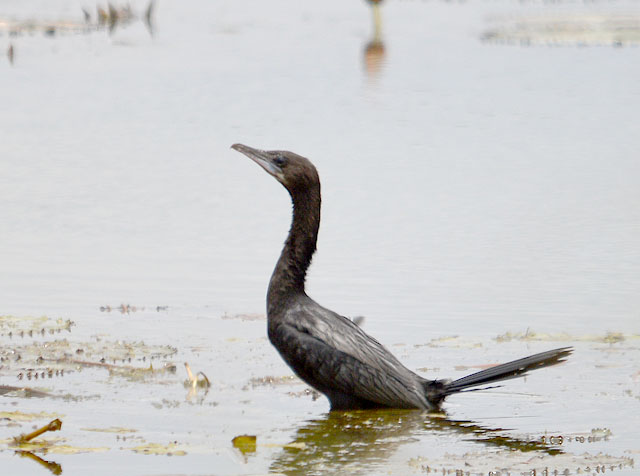
It is safe to say it is no longer unusual to record Little Cormorants in the northern half of the peninsular. A big flock resting together after a morning’s hunt is an impressive sight. One that I am still trying to get used to.


Garganeys, on the other hand, are unusual with sporadic winter records throughout the years. And to have four individuals together at a single spot close to home should be my early Christmas judging on how slow things have been for this year.


Apparently, the Lesser Whistling Ducks have had enough of the overwhelming stench and toxic at the marshland next to the Pulau Burung landfill and are now taking refuge here. I wish there was a way I could warn them not to get too comfortable because the good life they are now enjoying is not going to last.


There is a good reason behind the name of the Greater Painted-Snipe. The female bird (yes, female bird) is vibrantly coloured and stunning. There is also a reason why she seldom reveals her true beauty for evolution has made her particularly elusive.


Wetland habitats are not without their dangers. Raptors are always on the lookout for prey and today, a male Eastern Marsh Harrier was on the hunt. Harriers are generally uncommon at this location but this individual seemed to have decided on his wintering ground this season. His malicious presence will not be welcomed by other wildlife but it certainly added value to our excursion.


Executing a mid-flight scratch to get rid of an annoying itch…


The Zebra Dove is about bite-size for the Eastern Marsh Harrier and its tendency to perch in the open can be hazardous to its health.


The Long-tailed Shrike is predatory as well but on a smaller scale. This is one of the few places in Penang where this beautiful species resides and has been recorded regularly.


It is normally a shy bird despite occurring in scrub and open country habitats. Today, a pair was being more confiding than usual perhaps due to the approaching breeding season. Whatever the reason may be, I do not come across the Long-tailed Shrike often enough not be thrilled by their performance.


There was a significant change to the taxonomy of birds recently. More splits and renaming – as usual. Inevitably, I try my best to keep myself updated for Malaysian species. Among the changes, the Intermediate Egret is now called the Medium Egret which I cannot help but to chuckle when I first found out. I do not know how to put it but it just sounds odd. Will the Little Egret and Great Egret be renamed as to go with the flow?  Anyway here is the bird, with no regards that it is now probably the most joked-about bird wherever it occurs, looking all so poised at our second location of the day which is the Permatang Pauh paddy fields.


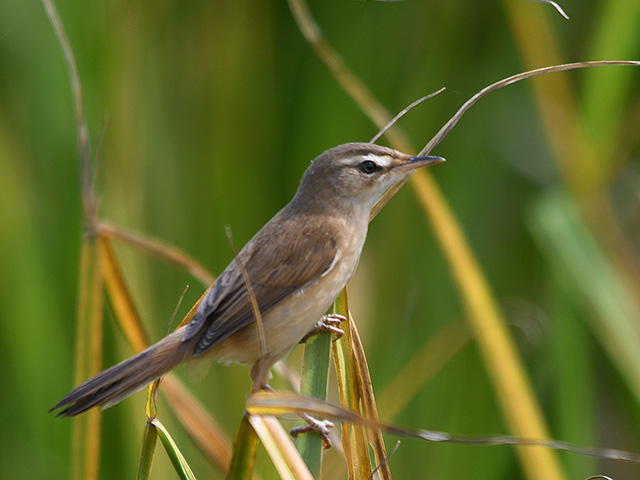
Searching for a little brown job in dense vegetation is not every one’s cup of tea. I will usually give it a pass but my companions convinced me otherwise. A lot of thought and strategy was put into the approach this time and we managed to persuade two Manchurian Reed-warblers to settle into a small clump of reeds. In fact, the smallest clump in the vicinity and just next to the access road. I could almost taste success when these globally vulnerable migrants put the human observers in their place and reminded them just how difficult reed-warblers can be if they choose to be.


When the vegetation finally gave way to a less obstructed view, it was the lighting’s turn to dampened our photographic efforts. Murphy's Law at work again.


However, birders can be exceedingly stubborn and determine especially with failure looming. An unexpected turn of luck eventually had the Manchurian Reed-warbler alighting on a relatively open perch with decent lighting. If this is not proof of the existence of a higher being, I do not know what is. As we were enjoying our moment of triumph, the reed-loving warblers gradually made their way out of sight but not out of memory. A fitting end to a rewarding outing and I am relieve there is no negative conclusion to this posting for a change. Perhaps, it is the magic of Christmas at work.

Speaking of which, MERRY CHRISTMAS & HAPPY NEW YEAR to everyone!

Wednesday, 24 March 2021

Birding blues...


At first light, I found myself soaking in a spectacular sunrise and the overwhelming aroma of the biggest landfill in the state. With the restriction of interstate travel still very much in place, there are limited choices as to where Hor Kee and I could venture to and I guess Pulau Burung is as good a site as any here in Penang. Anyway, the Asian Koels dominated the dawn chorus this time as it is still breeding season for these parasitic cuckoos. Despite being for than a foot long, they have a remarkable ability to stay out of sight. Hence, an image of the sunrise...


We scanned the larvae-infested lakes hoping for any uncommon migrants but there were none to be found. As usual, the flocks of Lesser Whistling-Ducks filled the locality with their presence and whistling calls. Of late the weather has been sweltering but at this hour, the sun’s penetrating rays have yet to reach their full potency and provide the much desired golden hues for photography.


The Little Grebes were also in good numbers today. Beautiful and adorable, they will always have my attention whenever they wander within the comfort zone of my gear. The lakes surrounding the landfill here is probably the only remaining wetlands in the state that is still rich in bird life. And that is something I am most grateful.


For a species so elegant, the call of the Black-winged Stilt leaves much to be desired. Judging from the vocalizations today throughout the vicinity, the Stilts have found sanctuary here again and are thriving. After all these years, I still find it hard to resist their charm.


Crakes are usually difficult to see well – usually. This morning, we had at least 3 White-browed Crakes that frequently abandoned their skulking nature and provided good views. Despite fortune being in our favour, the Crakes are small and active birds. Following their movement was not easy and only a handful of the images turned out reasonable.


The Javan Pond-Heron is a regular migrant and every season (around this time of the year when it is identifiable), a number will be recorded especially from the northern states of the peninsular. This individual, stalking at the edge of the lake, was only in partial breeding plumage but with enough traces of its true identity.


A foraging male Olive-backed Sunbird momentarily diverted my attention from the water birds. A few of the trees next to the lake was in bloom and the nectar addict was having his sugar fix. The lighting was harsh and the hyperactive Sunbird hardly provided any photographic opportunities.


Red-wattled Lapwings are a regular feature here. These striking waders prefer the grassy river bank to forage and rest. As long as you stay in your vehicle, your presence is usually tolerated and all hell will not break loose.


A relatively confiding snipe shared the foraging ground of the Lapwings today. Although good views were obtained, it remained to be just another “Swintail” Snipe at the end due to the lack of evidence to proof otherwise.


The Greater Painted-Snipe is an intriguing species that I sorely lack field experiences. Its somewhat crepuscular and shy nature is the reason why. Today, however, we came across 3 individuals and 2 were in the open. Naturally, all were the duller males. To have a spectacular female in full view would have been phenomenal but things like that do not often take place in the real world. Anyway, one of males appeared to be absolutely relax in this untypical behaviour and the lighting condition was the only let down of this memorable encounter.


We left the Painted-Snipe to his morning siesta and heads towards the nearby state park of Bukit Panchor. Spring will see the Blue-throated Bee-eaters replacing the Blue-tailed Bee-eater here in Peninsular Malaysia. The former being a breeding visitor and the latter, a winter visitor. A few of these striking birds were seen hunting near the park entrance.


I cannot really recall my last visit to this locality and that would make it years. One thing about this location is that the habitat may be pristine enough but there are less birds here than you would normally expect. But it was not like this always. Once upon a time, the forest here was home to some truly incredible birds like the near-mythical Giant Pitta and you could also hear the far-carrying call of the amazing Great Argus on a regular basis. Once upon a time...


I do have to admit that the vegetation here is dense and it is not the easiest of sites to bird. We did come across some birds and a few bird waves but almost everything eluded my camera. A pair of Checker-throated Woodpeckers were foraging quite close to the access trail and provided a rare opportunity for me to actually put my camera to use. You know that I am scraping the bottom of the barrel when an image of this quality is included in my blog post.


A flock of White-bellied Erpornis exhibited little fear of our presence which is quite typical of the species. Being inquisitive and charming, it normally brightens up any forest excursion. And one even stayed still long enough for its image to be taken.


One of main highlights our visit here shares the sky with the birds but it is not a bird. A hut that was initially built to provide shelter for weary trekkers has been taken up by group of fruit bats (if any reader happens to know the exact species, please enlighten me). These winged mammals have a bad reputation which is totally uncalled for. I find these nocturnal creatures intriguing and like all other wildlife, deserves our respect and admiration.


On the way out of the park, a Stripe-throated Bulbul was exceptional vocal along the forest edge. By that time, it was blistering hot but it did not deter us from taking some time to appreciate this lovely bird before calling a day. The birding today may not have been exceptional but it is always good to be able to just get out into the field.


Tuesday, 15 September 2020

Getting twitchie over a sharpie


The former mining pools of Malim Nawar is probably the location for most, if not all of my pure twitching trips. And this time, it is for a Sharp-tailed Sandpiper – a rare migrant to our shores. It was a cold and gloomy morning. To make matters worse, it started to drizzle just as Hor Kee, Michael and I were about to complete our two hour drive from Penang. When we finally reached the spot, we found ourselves staring at a huge semi-dry fish pond. Our target is a relatively small peeps. This is certainly a muddied version of the needle in a haystack saying. And no matter how stunning the view may be, I do feel my spirit lifted. Only a particular little wader that breeds in the northern tundra will be able to do that.


There were other waders present like Wood Sandpipers and Long-toed Stints. As most waders in winter plumage look quite similar especially in a distance, their presence were distracting. A huge number of Black-winged Stilts were out foraging throughout the pond and the possibility of a Pied Stilt (a recent addition to the Malaysian checklist) did cross my mind but a quick scan at the stilts revealed nothing out of the ordinary.


Anxiety soared as our target remained elusive. Sharp-tailed Sandpipers usually do not linger long at a stopover during passage. This twitch was beginning to put our skills (and patience) to the test. Ever since a camera joined my birding arsenal, I do not carry a scope anymore. Luckily, Michael still does and it took some good old fashion birding to save the day. As soon as he had his scope up, he found the ‘Sharpie’ foraging leisurely at the edge of the exposed mud. And Malim Nawar once again provided a successful twitch for me.


Here is the Sharp-tailed Sandpiper in comparison to the smaller Long-toed Stint. When seen together, the differences are obvious. However when seen alone and taking into consideration the possibility of hallucinating some some non-existing field marks, it is a different story altogether.


The lighting was less than desirable and the privileged guest was quite a distance from the access road. There was undoubtedly room for improvement with the images that I obtained. But I was elated. In light of all the hindrance caused by the Coronavirus pandemic, I was not even sure there could be any lifers for me any time soon. The Sharp-tailed Sandpiper was confiding enough I suppose and the prolonged observation made the experience a memorable one nevertheless.


With the lifer safely in the bag, I started to focus on the other waders present. One other certainly had my attention because it is usually shy by nature. The Greater Painted-Snipe is somewhat crepuscular and it is one of the few bird species in the world where the gender roles and even appearance is reversed. Anyway, this male was foraging quite comfortably right out in the open and that is something I do not see very often. I guess it would be pushing it to hope for the more striking female to make an appearance.


The Asian Openbills which have settled in well in the north are also finding this locality ideal. I managed to photograph one that was doing what it does best and that is to extract a meal out of a snail using its highly-specialized bill.


Another recent colonizer to Malaysia that is thriving here is the Little Cormorant. Although we did not get many photographic opportunities, this flying bird provided a sufficient souvenir for our trip.


One would think that after my trip to Cambodia I would not be so easily excited by the presence of an Oriental Darter. However, this sleek waterbird is rare here in Malaysia and one perched at a far distance still had my undivided attention.


No visit to this area would be complete without coming across the Grey Herons. Although, these majestic waterbirds are also found in my home state, I still find them intriguing. Birding, after all, is not always about rarities.


Grey-headed Swamphens (yes, another split) were given their due attention because we recorded the first Black-backed Swamphen in Malaysia quite recently. As with the stilt, there was no cause for celebrations. Only wishful thinking.


A feral Water Buffalo looking undeniably intimidating and it is not all bark and no bite for this occasionally ill-tempered animal. Thus, it has my respect which is rarely given to any semi-domestic animal.


It is alarming to find Javan Mynas outnumbering every other myna species here in Malim Nawar because the same thing could well take place back home in Penang. Not only are they displacing the locals but they are also attempting to ‘breed’ them out as several hybrids were seen. If this is not considered an invasion, I do not know what is.


As for the Zebra Doves, they went about their daily routine peacefully oblivious to the threat that the Javan Mynas now pose to a few of their fellow residents here.


I do not think I will ever get bored of the Stork-billed Kingfisher especially one as confiding as this individual. Just look at that bill...


Unbelievable as it may seem, the kingfisher was outdone by an unlikely species – a Crested Goshawk. In northern Peninsular Malaysia, this stunning raptor does not come by often enough for me and even when it does, it is exceedingly shy. This is the closest I have ever approached a Crested Goshawk and it was a moment worth savouring.


The only drawback was the awful lighting condition and there was not another single angle from which I could truly capture the beauty of the goshawk.


As our group was feeling luckier than usual, we decided to test our fortune at a slightly similar habitat closer to home for an equally rare peeps. The Pulau Burung landfill has been visited by the Pectoral Sandpiper before but luck can only take you so far. It would take nothing short of a miracle to bag these two rarities on the same day. A confiding Little Cormorant was the only consolation from our efforts of scanning the shallow ponds surrounding the landfill.


A tree full of Little Cormorants in the state of Penang is a sight that will still take some getting used to for me. The population has certainly flourished here and gone are the days when any cormorant is a rare occurrence.


Just like the Grey Heron, the Purple Heron still had what it takes to tickle my fancy. I guess being a big and beautiful water bird will make it easier to garner my affections.


It was a picture of serenity with this flock of Lesser Whistling-Ducks resting at the marshlands of this landfill. Their numbers are climbing again at this major stronghold and that is a good sign. The Lesser Whistling-Duck may be dull when compared to other ducks but it is still the only duck that can be regularly encountered in my neck of the woods.


Birds are not the only wildlife thriving in this environment. Reptiles like the Water Monitor Lizard has found sanctuary here as well. Some have grown to impressive lengths like this individual slithering about the river bank. This giant of a lizard wrapped things up for a great day out in the field as a successful twitch is one of the most exhilarating aspects of birding.