Pages

Showing posts with label Roller. Show all posts

Monday, 16 March 2026

Thailand Part 1: A feast fit for a King


Six long years has passed since my last birding trip abroad. It was an amazing adventure to Cambodia taking place just before the dreadful Covid-19 pandemic. The same companions for that trip sent me an invite to join them for another one and this time, to the jungles of central Thailand. It was going to be an eight-day exploration of a variety of habitats from the coast to the hilly interiors. A couple of months later, I found myself touching down at Suvarnabhumi Airport to meet up with Nigel, Kok Siong and our guide Arjin before heading to our first destination of the trip – the river banks of the mighty Chao Phraya in Bang Ban district.


A few days before we embarked on this journey, our guide promised us two things in our Whatsapp group. Pied Kingfishers to kick off the tour and Giant Freshwater Prawns for lunch to celebrate this striking lifer. And he delivered both as promised. Although the lighting was harsh, the aerial agilities of the Pied Kingfishers were still a breath-taking sight.


Unlike any other Kingfisher I have encountered before; this species hunts by hovering high above the waters before plunging down to capture prey close to the surface.


I am no stranger to heat as I lived all my life in this region but it was really hot here in central Thailand. With the scorching heat along this river bank, shade is a prized commodity. However, in the days to come, I have learned to welcome the heat as it played a significant role in the productivity of our birding endeavours.


Brahminy Kites were also present in the area but I doubt they are any threat to the kingfishers. This common but beautiful raptor scavenges as much as it hunts and a river like this would be able to provide a living for it.


Although the succulent river prawns were calling our names from a nearby restaurant, we spent a considerable amount of time at the river bank. One of the main reasons was because we were waiting for decent opportunities to capture the Pied Kingfishers perched. And a male bird, told by the full band across his chest, finally let down his guard and provided the memories we were seeking.


You would think this paragraph would now be about the much-anticipated local cuisine but we were held back again. However, it was not by a bird. But a Golden Tree Snake with a freshly caught Tokay Gecko. In fact, this rare sight almost overshadowed the performance of the Pied Kingfishers – almost.


Shortly after, we left the snake to savour the meal to come in peace and proceeded to have our own little feast. The prawns did not disappoint as well and it was a good start indeed for the three of us.


Since we are on the subject of food, we got to taste any array of local dishes throughout the tour. Our bird guide apparently is also a knowledgeable food guide – much to our delight. Well fed birders are happy birders and happy people are more easily pleased than hungry, cranky ones. Yes, our guide had certainly put much thought into this strategy.


Now back to the birds. We were taken to an urban park within Bangkok city next. In fact, Chatuchak which is a popular tourist destination, is not the kind of place one would expect to visit during a birding tour. But you always got to have faith in your guide especially one as accomplished as Arjin. Soon we were surrounded by a Black-capped Kingfisher and Indochinese Rollers providing ample flight shots for all the photographers present. Unfortunately, this endeavour was a little beyond the capabilities of my modest setup. The Indochinese Rollers did linger around the vicinity and resting birds are just as beautiful in my book.


Eventually I was lured away from the others by a pair of foraging Black-collared Starlings. It may be a common species to the locals here but it does not occur naturally in Peninsular Malaysia. It was a delight to observe and capture them going about their daily routine and rather vocally if I might add.


The Siamese Pied Starling is more familiar to me because it is not uncommon in the northern Malaysian states like Perlis. Like its larger cousin, this species also possesses a personality and aesthetics that is hard to resist.


Great Mynas here are the equivalent of Common Mynas back in Peninsular Malaysia. It is probably amusing to my guide and other local birders that I show so much interest in Great Mynas. Status aside, I find this species to be visually appealing.  


Elvis is in the house...


House Crows are rare or absent from this part of the country and to take their place are the bigger Large-billed Crows. The latter is no longer a common sight in Penang and a confiding individual like this one deserves a mention in this post.


Little Herons are just as common here as in Malaysia and can be found foraging along the edge of the ponds of this park.  


As always, birds are top priority for me wherever I go especially in a foreign land. But this Finlayson’s Squirrel had enough appeal to momentarily distract my attention. This species also goes by the name Variable Squirrel due to their highly variable plumage colouration and a pale variance like this individual is exquisite.


A sizable Water Monitor Lizard had its afternoon siesta interrupted unintentionally be a foreign birder exploring its territory.  


One bird that truly tugged my heart strings here in Chatuchak Park was the adorable Spotted Owlet. And any diurnal sighting of an owl is usually a mesmerizing affair.


We have encountered this species before during our trip to Cambodia and observing it again after all these years certainly brought back memories of our Cambodian adventure. And now, this little fellow has become an integral part our Thai adventure as well.


At nightfall, we reached the coastal salt farming district in the outskirts of the city. Tomorrow is a big day as we will be hunting down one of the main targets of the trip and that will be covered in my next post.


The checklists of birds recorded:

1. Bang Ban riverside

2. Chatuchak Park


Wednesday, 22 November 2017

Great things sometimes come in small packages

This weekend’s birding plans were far from ordinary. It was not because of the locations but more because of the company. James, Hor Kee and I will be hosting a couple of distinguished birders from this region. Ding Li, a friend who hails from Singapore happens to be the co-author of 100 Best Bird Watching Sites in Southeast Asia (a book that I will be contributing the Penang chapter for the next revision) and writer of several papers on birds. He brought along Abdel who is an avid birder currently residing in Hong Kong. Anyway, the duo was keen to visit the grasslands of Chuping and the recent the Manchurian Reed-Warbler was their main target. The trip up to the tiny state of Perlis did not start off well. A 5-vehicle pile up along the North-South Highway held us back for at least half an hour and we arrived at the location much later than we had planned. After a tedious search, the Reed-Warbler offered us only a glimpse but Ding Li who is into call recordings, managed some relatively good recordings of this difficult skulker.


The number of raptors present were still less than desirable. Hopefully, it is not an indication of things to come. A dark morph Booted Eagle did not seem to think so and its presence was one of the highlights of our visit here.


Blue-tailed Bee-eaters are common winter visitors to Malaysia. It can be exceptionally bold at times and this individual showed no fear to our presence and continued with its routine while we obtain images of this aerial feeder. And the beautiful blue sky, typical of the Chuping landscape, provided the perfect backdrop.


The Indian Roller may not have the aerial agility of the bee-eater but it just as stunning a bird. On the west coast of Peninsular Malaysia, Chuping is the best place to observe and enjoy the Indian Roller. Naturally, this scarce bird had our attention for quite while.


During our last trip here, the Siberian Stonechats were just amazing. This time, they were in good numbers but photography required a lot more effort. It was a scorching day and when the sun was its zenith, it became almost unbearable.


After lunch, we decided to try for the Dusky Crag-Martin at the adjacent limestone hill of Bukit Keteri. We brought two more accomplished birders to prove that we were not mass hallucinating during our last visit. With more eyes, we managed to confirm not one but two martins present in the vicinity. Hor Kee even obtained a record shot to put all doubts away. This is his gallant effort of my latest lifer.


We headed towards Air Hitam Dalam next and it was to be our third and final destination of the day. The recent flood that devastated my home state of Penang made the site inaccessible for a few days after. We were not sure what to expect. The consequences of the flooding could have been dire. But in the end, our worries were uncalled for. There was enough magic left here in Air Hitam Dalam to get a few experienced local birders all excited. The Taiga Flycatcher is a rare migrant to our shores. I am fortunate to have seen this species in two other sites prior to this. Dusk was approaching and there was nothing I could do about the horrid lighting. But this little brown job that can be mistaken for the ever-abundant Asian Brown-Flycatcher, was the bird of the day for me.


It has been months since the last time I connected with the resident Spotted Wood-Owls of this swamp forest. With the fading light, one of the owls started to stir and caught our attention. The foliage that provided sanctuary for the owl was a major hindrance to my photographic attempts. There was not much time for us to rekindle either. A group of visitors was simply too vocal for the owl’s liking and the night bird retreated further into the forest. However it was a welcomed encounter and a fine way to wrap things up for our guests’ first day of birding in this part of Peninsular Malaysia.


The next day we found ourselves combing the forest surrounding Pedu Lake for more feathered denizens of northern Peninsular Malaysia. Due to illegal bird trades, leafbirds are declining throughout the country. I guess we can consider ourselves lucky that their stunning beauty and melodious song is not completely absent from here. This foraging Blue-winged Leafbird was unperturbed by our presence and carried on within close proximity to our position. It was a female and although it lacks some of the vibrancy of the male bird, she was still a sight to cherish.


A row of fruiting trees was a centre of bird activities – naturally. Bulbuls were the predominant species this time. The presence of two of the most attractive bulbuls made our time at the fruiting trees most rewarding. The Grey-bellied Bulbul is always a pleasure to observe and despite the harsh lighting, it was only right to spend some time appreciating its striking colouration.


That was until a small flock of Scaly-breasted Bulbuls decided to join in the feast. Then all eyes were on these sultry beauties. The foliage was dense and the lighting, less than desirable but we still tried our best to capture some images of this bulbul. Apparently, the Scaly-breasted Bulbul is not so common down south and that made the encounter rather exciting for our guests. As for me, no matter how many times I have seen this species, it will always have my undivided attention.


Everything was just swell as we enjoyed sunbirds, white-eyes, flycatchers and other avian splendours that were patronizing the fruiting trees. The thing about birding is that it has the capabilities to turn ordinary into extraordinary in a blink of eye. The Grey-and-buff Woodpecker is one of the smallest woodpeckers in Malaysia. What it lacks in size is made up with character, adorability and beauty. Due to its penchant for the top most part of the canopy and its minute size, good photographic opportunities are rare. To come across one in the mid-level of the forest is already a blessing in my book. To have one perched in the open for a prolonged period time is nothing short of a miracle. That was exactly what this male Grey-and-buff Woodpecker with his flaming red crest and all did.


The Grey-and-buff Woodpecker is not a rare bird but to be able to bask in its radiance is a privilege. This is the closest I have ever been to one and it is by far my best encounter with this species. This is something that only forest birding can offer. Unexpected moments that will have a lasting impression. This will definitely be part of my reflections of wings and inspiration in years to come.


Pedu Lake is rich in fish life and that in turn will attract predators that have an appetite for fish. The Lesser Fish-Eagle can occasionally be seen in this locality and as the name implies, fish is its staple diet. A distant individual taking advantage of the rising thermals did not go unnoticed.


Hours of birding in the humid rainforest will usually have you sweating buckets. This diminutive Tailless Lineblue seemed adamant of extracting all the dried sodium from my skin. Certainly beats having your blood extracted by mosquitoes.


After a hearty lunch, we swung by the mangroves of Sungai Batu. It took a little longer than usual but we did managed to capture the star bird of the locality – the Mangrove Pitta. A second bird was heard calling but as usual, the dominant bird would have none of it and the latter remained among the shadows of the swamp forest.


The Forest Wagtail was the final bird of the day and it was quite a fitting sent off for our guests. The past 2 days of birding had its downs but a few remarkable birds and the companionship I had certainly evened things out.

Saturday, 12 December 2015

Harrier Central Part 1 (05/12/2015)

I picked up Ben, one of my regular guests from Singapore, from the hotel much earlier than usual. It is because we were heading to the forest of Pedu before proceeding to the open grasslands of Chuping. This 2-day tour spanning over the two northern states promises a memorable trip for us. The slightly more than 2 hours’ drive to our first locality did not seem to take as long due to the feeling of anticipation and excitement that was building up inside me. Pedu is home to numerous forest denizens but most of the rarer species, including the Giant Pitta, were exceptional elusive this trip. The commoner species, on the other hand, kept us busy for the entire morning.


A canopy dweller by nature, the beautiful Raffles's Malkoha usually stays clear of terrestrial dangers and birders alike as they forage along the upper levels of the forest. Like all malkohas, they are quite active and fast, moving about like squirrels rather than birds. This female was enjoying a little sunbathing from the top of a tree. She was still far but by being stationery, she gave us a chance to try and capture her true beauty.


Ever since the discovery of wintering Rosy and Swinhoe's Minivets to Peninsular Malaysia, I have been paying extra attention to flocks of the much commoner Ashy Minivets. Flitting about the canopy, these graceful and extremely active birds are hard to observe and photograph. After much scrutiny, this flock turned out to be nothing more than Ashy Minivets. The males with their distinct colouration did not pose much hassle in terms of identification.


It is the paler females that I had to pay more attention to…


There is no shortage of striking birds that seek refuge in the forest here. The male Ruby-cheeked Sunbird is certainly one of them. Sunbirds are small and active birds. A good amount of perseverance (and strong neck muscles) is required in order to obtain good views. He did take a breather at one time but unfortunately, it was in the shade. In this dim lighting, the resplendent colour of the male bird was never fully revealed.


The Grey-bellied Bulbul is one of nature's finest creations and deserves all the admiration and attention it usually receives from birders - even when the lighting does not complement his vivid colours well.


The strong sunlight and dense foliage hindered our efforts to capture this Black-crested Bulbul while it foraged in the lower level of the forest canopy. I always find myself drawn to this common species and I bet the wicked crest has got a lot to do with it.


An Oriental Honey-Buzzard circling low above the forest canopy was one of the highlights of the visit here. It may be one of the commonest of the wintering raptors but it is also the most varied in plumage and the source of most raptor misidentifications.


A second look is inevitable just to make sure it is not something else…


As we were making our way out of Pedu, we came across two more Oriental Honey-Buzzards separately. Our primary target for this trip was the raptors at Chuping. This multiple Honey-Buzzard sightings were a sign of things to come. I just did not know it at that time.


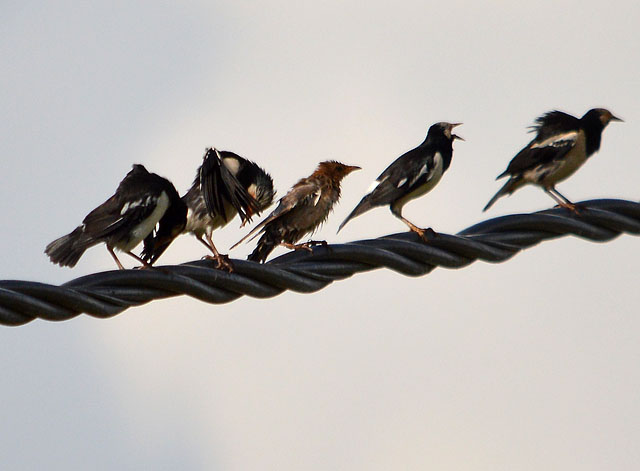
It was blazing hot when we finally got round to venturing out on the open grassland of Chuping. Flocks of mynas and starlings were taking advantage of whatever pools of water to cool down. A thorough scan along the electrical lines where these birds have gathered to bathe produced something that I was really wishing from among a flock of Asian Pied Starlings. However, I have to make a mental note that whenever I wish for something from the Big Guy upstairs, I should be more specific. So, instead of just wishing to see the juvenile Brahminy Starling that was recorded by my buddies earlier this month, I should also mention that preferably in mint condition and not like it has just been dragged through a washer. However, after putting up this post, Dave corrected the identification of the starling and it is a subadult Rosy Starling instead. 


As I was still contemplating if this was indeed the juvenile Brahminy Starling (drenched birds are a little tricky to identify), an Indian Roller swooped down from one of the electrical poles and alighted on a low stake right next to our stationery vehicle. We are used to seeing the Indian Roller at this locality but to see one on a natural perch is somewhat of a privilege due to this beautiful bird's fetish for steel and cable perches.


We came here for the raptors and it did not take too long for us to record the first one of the trip and it was a dark morphed Booted Eagle. A rare winter visitor to our shores, Chuping is the only place where it regularly recorded. It is unfortunate that all my encounters with this species so far are distant observations and once again, I only managed record shots.


The harriers were also up and about but the only one that came relatively close was this juvenile Pied Harrier. By then, the weather had unexpectedly turned for the worse and rain clouds started to form just beyond the limestone hills. With the availability of light now being restricted, shooting raptors in flight was no longer a walk in the park.


Regardless of the weather condition, the ever-abundant Eastern Yellow Wagtails went about their business as usual. This is a typical winter plumage bird...


And this is the pimped up version. At least two leucistic individuals have been recorded here this season and this is my first encounter with one. The odd colouration does give it an exquisite appearance but it also makes it stand out like a sore thumb and that makes it vulnerable to predators. The first raindrops brought our excursion to an early end but from the look of things, tomorrow looks set to a great day and that will be covered in my next post.