Pages

Showing posts with label Taiping. Show all posts

Saturday, 13 June 2026

Not so ordinary garden birds...


My birding endeavours take me to all kinds of locations ranging from spectacular mountain tops and lush tropical rainforests to bleak coastal mudflats. However, there is one type of habitat that I will try to avoid and that is habitats with humans. Wherever there are humans, there will usually be situations. Situations that I can do without when I am enjoying my birding. I guess there is some truth when some consider me to be somewhat anti-social but I will not be losing any sleep over that. Before I carried away with this, I better get back to the birds. That is what this blog is all about after all. A quiet neighbourhood in the outskirts of Taiping became the centre of attention when the presence of Common Hoopoes was discovered. This enigmatic species is still considered rare here in Peninsular Malaysia with irregular records throughout the years. I have personally recorded this species as far back as 2003 and it is not new to me. But at this particular location, it appears to be thriving and that is good enough a reason for a visit.


With my companions Hor Kee and Rodney, we arrived at our destination just after dawn. The first bird that caught my attention was a Crested Goshawk surveying its domain from a lofty perch. This stunning raptor was a great way to start off the day and I began to develop a good feeling about this modest location.


A pair of Oriental Pied Hornbills compounded the feeling as they wandered about the housing area. No matter how many times I have recorded this species living alongside humans, it still evokes the same amount of excitement.


I guess the same can be said about Lineated Barbets but on a lesser scale. Well, very few things in life can rival the awe of hornbills and that is the brutal truth. From the look of things, the barbets have also found sanctuary here and the population is set to increase.


A lone Asian Openbill casually foraging within a house compound certainly took me by surprise. There is no doubt this species has come a long way since when they first started to colonize Peninsular Malaysia back in 2010. But this cool fellow is taking it to a whole new level.


Pink-necked Pigeons occur even in my own home compound and I would find it odd if I do not come across them here. Here is a male feeling a little dismay that the lighting condition and my photographic effort did not do much justice to his true appeal.


Another common species of built-up areas is the Asian Glossy Starlings. Electrical cables are predominant in any housing area and birds have a tendency to use them as perches. For birders, this behaviour eases our main mission in life which is to find and observe.


For a bird photographer, these man-made perches hold little value for their photographic effort. This applies to even a striking species like the Blue-throated Bee-eater. In my eyes (and the bird’s), the cable is a strategic point for it to launch aerial assaults on flying insects. If it good enough for the bird, it is good enough for my camera.


The Red-whiskered Bulbul is a species you do not get to see in a lot of neighbourhoods. So, it was heartening to see one here. There is a possibility of escapees for the beautiful bird as it is a popular cage bird. Either way it will not cause any major scientific impact if I get the status wrong for this individual.


I stated earlier birds on cables are more conspicuous and to proof my point, that is how we got our first Common Hoopoe of the day. This may be normal sight in neighbouring countries like Thailand but in my own, it will take some getting used to.


Eventually, we managed to locate a flock of at least five birds consisting of adults and sub-adults as feeding still took place within the flock. During my documentation of the birds, I could not really tell any differences between the birds. All of them were striking and charismatic.


When I scrutinized my photographs back home, I noticed that all the birds I shot had slightly shorter bills. Only then did I realize that maybe both the adult birds managed to evade my photographic efforts.  


The discomfort of a “human-habitat” started to take its toll and we shifted to the second destination of the trip which is the foothills of Bukit Larut. Soon after our arrival, we were greeted by the diagnostic territorial call of the Banded Broadbill. It took a little effort but the result was rewarding. Often hidden by the cover of the forest canopy, a good view like this is a real godsend to me.


I could not believe it when another broadbill species decided to show well after the first encounter. The Black-and-yellow Broadbill can be confiding at times but the individual today has surpassed that point.


The full black collar indicated that it was a male bird and that feature is only the difference between the sexes. He is a truly exquisite creature of the forest.


A few fruiting trees in the vicinity were in season and they attracted the usual groups of bulbuls. Among them was a female Blue-winged Leafbird and she was the only that managed to find her way into my memory card.


The Verditer Flycatcher is a species that I have not seen for a long while now. When one decided to hawk for insects nearby, I was elated. It may be the duller female but the prolonged encounter was fair compensation.


I know I always lament how frustrating forest birding can be but apparently, not today. Another female bird provided a memorable encounter and she was a Raffles’s Malkoha. Initially she played hard to get, typical of most desirable ladies. On a more serious note, malkohas are usually difficult subject for photography and the Raffles’s Malkoha is no different. But the good girl performed unexpectedly well in the end and made every birder present fell head over heels for her.


Here is one final image of the alluring Raffles’s Malkoha to wrap things up this time. The foothills of a colonial hill station and a surprisingly birdy neighbourhood certainly rose up to the occasion and provided ample material for another entry to my birding blog.


Wednesday, 22 March 2023

Taboo of the birding world?


This would be my first birding excursion to the wettest part of Peninsular Malaysia since the pandemic. We have been experiencing excruciating hot weather in Penang and unfortunately, it is not much different here in Taiping as well. I decided to visit the stakeout at the foothill of Bukit Larut and a juvenile Siberian Blue Robin reminded me just how challenging photography can be at this particular spot.


The migratory Green-backed Flycatcher did not fare any better for my photography endeavour. My feeble attempts did no justice to the vibrant colouration of this adult male and in the end, this is the only image that I can barely justify to share in my post.


Any pitta encounter is a good encounter in my books. Despite the lighting condition, this Hooded Pitta provided a much-welcomed dose of exhilaration to my time here in this gloomy gulley. And the throng of hikers making their way up and down the steep access road finally had a reason to stop and look at my unreserved birding antics set off by this mesmerizing species.


I cannot help but to feel a little disappointed with the results at the stakeout so far. Years of birding may have made me a patient man but I have my limits. The absence of any resident species to the stakeout was another setback to my plans for the day. But life goes on and I then started to explore the vicinity by foot. This old school approach yielded a female Rhinoceros Hornbill flying above this lush landscape.


A pair of Banded Broadbills was nesting in the locality as well and as expected, a congregation of bird photographers marks the spot. Photography at nesting sites is a controversial matter – always has been and always will be. As long as one does not go overboard with his or her attempts for the perfect shot, there are worse threats to a nesting site as far as I am concerned. Anyway, the chicks successfully fledged at the time of writing and here are some images of the female bird carrying out her parental duties. As you can see, I do practice what I preach.


While waiting for the Banded Broadbill, some other forms of local wildlife helped to keep me occupied like this Gliding Lizard.


Slight movements near where I have planted my feet (when there is a crowd, good shooting positions is a prized commodity) turned out to be a Flat-backed Millipede. Invertebrates are not really my cup of tea but I made an exception for this creepy crawly.


Once I obtained the images I wanted of the Banded Broadbill, I continued with my search for more avian delights which have proved to be difficult throughout this warm and sunny morning. A female Large Woodshrike managed to convince me that the world is not such a bleak place after all with a commendable performance.


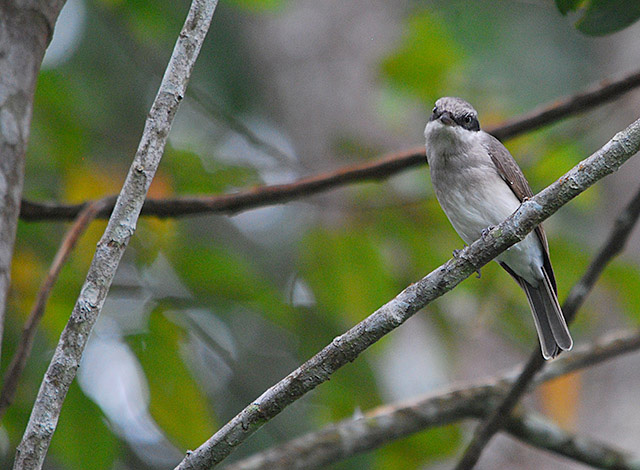
A foraging Grey-breasted Spiderhunter could not keep the momentum going and refused to give up the safety of the forest canopy. And a distant, harshly lighted image was all I have to show at the end of this rather brief encounter.


The Black-thighed Falconet is not uncommon here but its diminutive size can be easily overlooked. This tiny bird of prey does have a preference for exposed perches and this individual doing exactly that, wrapped things up for this time.


Tuesday, 2 October 2018

A sky full of raptors


Dipping out on the Oriental Plover last season at the grassland outside Taiping in Perak state left a devastating blow to my spiritual well being. It was a deep wound that may have healed as time passed. But the scar remained. An invitation by Hor Kee (who suffered the similar fate) to check the grassland again as this migratory season commenced, was accepted without much hesitation. The sight of 50 Pacific Golden-Plovers (a known associate of the distinguished Oriental Plover) upon our arrival at the locality sent a stream of adrenalin through my veins with such vigour that left me lightheaded. However, the exhilaration was short lived. Upon further scrutiny, there was no Oriental Plover among them.


We scouted around the remaining areas of grasslands but without success. It was relatively slow in terms of birding. A Long-tailed Shrike calling from a lofty perch provided some compensation. Although this species is not uncommon in this part of Peninsular Malaysia, it is a species that rarely occurs back in my home state of Penang. Of all the shrikes found here in Malaysia, I find the Long-tailed Shrike to be the most appealing. Its distribution may have an influence on this matter.


A Spotted Dove that alighted near our stationary vehicle received some unexpected attention as there was basically nothing else about.


From the flat grassland, we made our way to the vantage point atop Scott’s Hill to try to eradicate another disappointment from last season when we spent at least two excursions staring at empty blue skies during the peak of raptor migration.


Our faith in the locality was restored when we saw a flock of about 100 Chinese Sparrowhawks riding the thermal as they make their way south for the winter. This flock alone had more migrating raptors than the whole of last season at this site. During our 2-hour observation, this species formed the majority and several flocks were recorded.


Most of the migrating raptors were high up in the sky and photography was almost a lost case. Record shots like this of a lone Japanese Sparrowhawk were aplenty.


Even the larger Oriental Honey-Buzzard passed through at great heights...


Except for one but it was heading the other direction and in no particular hurry. It was, after all, the resident race of the Oriental Honey-buzzard and it provided the best raptor images of the day. Soaring gracefully just above the tree line, it had our undivided attention. Unlike its migratory counterparts, resident Oriental Honey-Buzzards are not exactly common raptors.


However, not all the resident raptors recorded today were as confiding. A pale morph Changeable Hawk-Eagle flew past about the same altitude as the migrants.


Another highlight from this brief raptor count came in the form of Rufous-bellied Eagles. An adult swooped down at a juvenile in mid-flight and although it was not a vicious attack, the display of aerial agility was spectacular. My modest gear could not capture the true essence of the bout but it was an exciting experience nonetheless.


Evolution has made the Brown-backed Needletail aerodynamically perfect and trying to photograph the world’s fastest bird is no walk in the park. However, today the lighting condition was ideal and this one was cruising a leisurely pace. I took the opportunity to capture a few images of which one turned out reasonable. This wonder of nature was the last bird we recorded before we made our way to the last destination of the trip.


Both residential and commercial developments have been sprouting up like wild mushrooms in Batu Kawan ever since the Second Penang Bridge was opened to public. Inevitably, a significant area has lost its charm as birding localities. A newly discovered wader roost near some major developments including a much-anticipated one by a Swedish-founded furniture company. This rose among the thorns was where we headed before calling a day.


I always have a soft spot for waterbirds and I just wanted to check out the site before it is too late. An expanse of mud and water may not appeal to normal folks but no one ever said birders are normal folks. This bleak landscape plays host to several species of birds and that to me makes it irresistible.


It is heartening to see big waterbirds like the Grey Heron still has a place to call home here in Penang state. The lighting was harsh at the time of our visit and not much hope was put into the outcome of the images taken there.


Overall, this new site certainly has potential and pushes all the right buttons for me. A return trip at a more ideal time will not be too far in the future. A foraging Long-toed Stint made sure of that.