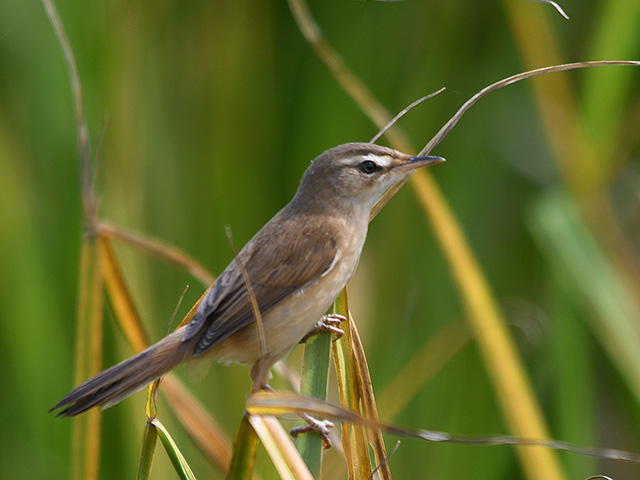
During
one of the afternoons at Khao Yai National Park, it rained and we decided to
try our luck at another birding location. After all, this whole area is Arjin’s
playground because he is lucky enough to have a permanent residence here. He
took us to an open country and scrubland type of habitat in Ban Ngoi with a
peculiar bird in mind to brighten up our day. The Yellow-eyed Babbler behaves
more like a Reed-Warbler more than anything else and thrives in an environment that
is preferred by the latter as well. The first of these birds that we encountered
actually fulfilled all the requirements for a lifer record – visual, call and
image. But I was secretly hoping for something more.

We
then drove to the next spot but not before obtaining a record shot of another lifer.
The male Asian Golden Weaver in breeding colours is a sight to behold but he just
would not oblige our photographic requests.

The
target at the next spot was the Small Pratincole and from the air of confidence
surrounding our guide, I would say this uncommon species is a regular here.
Initially, we did our photography from the vehicle. The human form will
probably put all forty of them to flight – yes, forty! And the look on this
individual is not a positive sign at all.

We
knew it was unlikely to come across this opportunity again and decided to put
our fate to the test. We carefully got out of our vehicle and inched towards
these unusual-looking waders. The three
of us went our separate ways. It is a big congregation after all. I found
myself drawn to a particular individual and I followed what could only be my
gut instinct.

To
my surprise, the chosen one started to approach me instead and I immediately stopped
moving and waited. I guess the unexplainable connection between me and this
adorable little fellow was real after all.

Eventually
it came closer than most wild birds would to a birder. You noticed that I used
the word birder and not human. It is an unspoken truth (and personal
observations) that birds of open country are extremely tolerant towards field
workers. Present yourself as a birder and the posterior of the bird as it flies
away is what you will get most of the time.


The
Small Pratincole is sort of a personal bogey bird for my life list especially
on home soil. And here, more than a thousand kilometers away, I can finally put
that ‘tick’ to rest. Fortune favours the bold and, in this case, my life has
certainly been enriched by the accommodating nature of this particular feathered
individual.

I
was so caught up in the moment that I lost track of my companions. When I came
to, they were on the opposite side of the pratincole patch photographing a
couple of Temmick’s Stint. Before leaving the vicinity, we encountered another
species that was uncommon to us but the Oriental Skylark was just too far
for any improvement shots.

We
made another attempt at the Yellow-eyed Babblers but at a different spot. And
this time, the birds were exceptional. My hope did come true and that does not
happen often enough when birding.


There
was a pair of them again and when I did some post-trip research, these birds
are known to develop life-long bonds and encountering solitary birds would be
rare. They also exhibited the inquisitive qualities typical of babblers. Thus, rebuking
my earlier thoughts of them having an identity crisis.

As
the sun gradually descended towards the horizon, the effects of the golden hour
were added value to our photography. This Yellow-eyed Babbler was so accommodating
that I found myself lost in those piercing eyes. And if eyes are indeed the
windows to our souls, then this fascinating species has certainly entered mine.


Sitting
in our vehicle parked next to some bushes overlooking a stream was not exactly
a picture one would envision of birding in a far-off land surrounded by the
wonders of nature. However, this unassuming location provided one of the most
memorable photo sessions of the trip for me.


By
the time we started our drive back to the hotel, it was already dark. And we
finally got an owl in a nocturnal environment. The Eastern Barn Owl is a widespread
species and its proficiency at keeping rats at bay makes it a welcomed member
to any community.

All
good things must come to an end and the final day of our Thai adventure came
faster than anticipated – naturally. With a few hours to spare before we all parted
ways, our guide presented us a parting gift by taking a detour across an
agricultural land in Pak Phli at the outskirts of Bangkok City. The Plain
Prinia is not new to us because we encountered this species a few times before
but today, we were able to capture good images of this relatively common
species.

Typical
of this family of birds, it is active by nature and we had to constantly deal with
its rapid movements. The bright lighting conditions was a double-edged sword. Although
it helped my modest photographic gear to keep up with the Plain Prinias, the
harshness effected the quality of the images. But I rather have sharp than
ideally exposed photos anytime.


Before
I embarked on this remarkable journey to Thailand, news broke out of
Bluethroats wintering at one of my local patches in mainland Penang. I have
recorded this species during my trip to Cambodia but it is a rare migrant to
Malaysia nevertheless. No doubt a significant tick in my Malaysian life list as
well. But a greater calling beckoned and I told myself I will gradually get
round to this rare visitor after my big trip. Fast forward a week or so and
here I am, in central Thailand, enjoying a striking male Bluethroat performing
admirably in front of us. And I could not help but to feel the irony. It is not
uncommon here in central Thailand but I guess a confiding individual like this
one probably is.


There
is no denying the beauty of a male Bluethroat though. The vivid blue throat and
breast band complimented by the surrounding tinge of orange gave the impression
that the bird ornamented himself with precious stones. I bet my fellow
birders back home are just as enthralled.


After
the exhilarating encounter with the Bluethroat, I was finally ready to go home.
But the alluring bird life of central Thailand was not quite done yet.


The
Striated Grassbird is another species very foreign to me. When we came across
one perched right out in the open, I guessed this is not a common behaviour
judging from the excitement in our guide’s voice. Either that or like yours
truly, thinks it is an absolute stunner of the bird. And I am not saying this
because it is a lifer. Just look at the wickedly long tail and bold markings on
its upperparts. If this cannot get you excited, I do not know what will.

A
Little Cormorant sunning itself would have received more attention from me if
this species had not colonized and multiplied in my country in recent years.

The
Bronze-winged Jacana has also amended its rare status in Peninsular Malaysia
but not as significantly as the Little Cormorant. This attractive water bird is
doing much better here in Thailand and this locality was no different. The
presence of drab juvenile birds indicated another successful breeding season.

A
striking adult bird that was a little more tolerant to our presence than the
rest allowed a photo to be included in this post.

I
could not help but to notice several soaring raptors in the vicinity. A habitat
like this could produce notable species but the only one recorded was the Black
Kite. It was not the only migrant that was conspicuous in this vast open
landscape. Black Drongos were also present in big numbers which is not unusual as
it should be as common here as in Peninsular Malaysia. One confiding individual
provided a decent capture due to its close proximity. Photographing a black
bird at a distance under harsh lighting can be a challenge.
.jpg)
The
company that you have during birding trips also plays a vital role in determining the success of
the outcome. Nigel and Kok Siong are both great companions and I have also known
Nigel for a long time. This paragraph is my way of thanking them for having me
on this trip and being a part in this fantastic chapter of my birding life. And
that concludes our birding adventures in central Thailand. The Penang birder signing
out for now.