In
a time when checklists are being reduced, the Bronze-winged Jacana added itself
to Penang’s when it started breeding in the marshlands of Batu Kawan earlier
this year. For now, this locality is a wildlife haven especially for water
birds. Earmarked for development, there is no is telling when this site will
join the rest of the birding hotspots that has diminished in my lifetime. The
COVID-19 restrictions for the past six months prevented me from giving these
new residents the welcome they truly deserve. Finding myself with some time to
kill last Saturday morning, I set out on this long overdue quest.
I
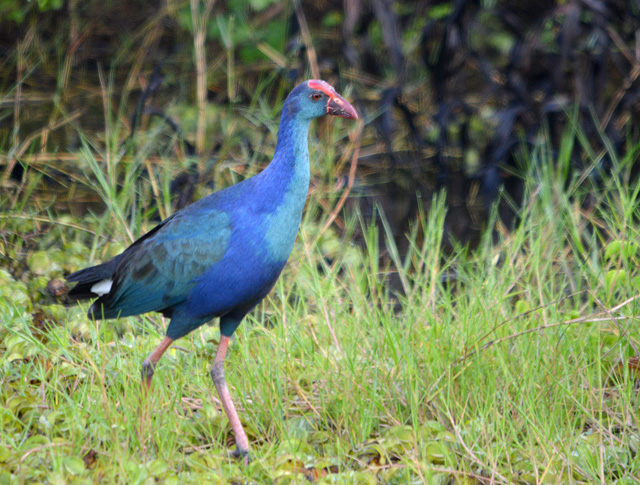
was surprised to find a number of Grey-backed Swamphens foraging out in the
open. Although I drove as slowly as I could, my approach made them retreat back
to the edge of the reed beds. Luckily, they were still in close proximity and
their stunning appearance momentarily distracted me from my search for the
distinguished lily trotters.
I
made myself comfortable in my stationary vehicle and observe these sizeable birds
go about their routine. I cannot recall the Grey-headed Swamphen to be so
confiding. But then human presence is undeniable here. May it be construction
workers, anglers or birders. I guess the birds have grown accustomed to all the
commotion. Anyway they are undeniably beautiful and as the morning sun
gradually rose above the horizon, the colours of the Grey-headed Swamphen start
radiate with utter brilliance.
A
pair of White-breasted Waterhen were sneaking about quietly near the vicinity
of my car hoping not to get detected. But it will be difficult to overlook the
contrasting plumage coloration of this common rail even with the distracting
Grey-headed Swamphens in the near distance.
When
I regained my composure, emotion of another nature began to set in. Anxiety has
now pushed aside my feelings of exhilaration because there was no sign of the
Bronze-winged Jacanas. It was then that I noticed another stationary vehicle close
by. I casually drove over as I could tell it belonged to another birder and was
immediately pointed to a foraging Bronze-winged Jacana. And the rest, as they
say, is history...
The
jacanas tend to move about the locality and I think there are two adults
present as they were seen together at one time. They seemed to be constantly
foraging as well. Photography was a little more challenging than I had
anticipated. Images with motion blur or subject’s head stuck between the marsh vegetation
are not exactly appealing images. But the lighting was beautiful today and this
photographic woe is thankfully not something a little perseverance cannot overcome.


The
first time I saw the Bronze-winged Jacanas on Malaysian soil was along the
banks of Timah Tasoh Lake in Perlis. Back then, they were miles away. In the more
recent past, small numbers of this scarce resident were discovered at Chuping which
is also located in this tiny state. Though the observation distance was a major
improvement, much was still left to be desired. And now, here in one of my
local patches, I am ogling at Bronze-winged Jacanas in all their splendour at close
range. Surreal is definitely the word that comes to mind. Birders usually associate
radiance and beauty with forest birds. If you have ever seen the Bronze-winged
Jacana in good light, you know that it is far from the truth. Come to think of
it, a few of the residents of this vast marshland are indeed no less
spectacular than their forest counterparts.


However
when it comes to vocal abilities, the marshland denizens are no match for the
songsters of the forest. Despite all its aesthetic appeal, the call of the
Bronze-winged Jacana is nothing more than nasal notes.
Bright
sunlight will supposedly bring out the best of the plumage colouration and it
does, to a certain degree. But for me, the Bronze-winged Jacanas are dazzling
birds regardless of what lighting condition they may be dancing under.
In
the duration of my visit to the Batu Kawan marshlands, a rather determined
female Yellow Bittern hunted for breakfast and did not budge from one particular
spot. I could not be sure if she has been very successful there or the
opposite.
It
has been a long time since I last enjoyed a memorable encounter with a Common
Greenshank. One was wading along a shallow canal and provided a commendable performance.
Although it is a stark contrast from the colourful Bronze-winged Jacana, this
common but elegant wader provided one of the main highlights of the trip.
I
cannot blame the Common Greenshank for a being a bit narcissistic as it admired
the reflection of its own sleek form.
Unlike
the Common Greenshank, the Wood Sandpiper is a pure freshwater species. You are
unlikely to find one plodding along a coastal mudflat somewhere but you can definitely
find one in a marsh like this.
Although
water birds held the limelight for this trip, a few other species of birds did
manage to momentarily have my attention. The Blue-tailed Bee-eater is always a
treat to come across in the field. The striking colouration and graceful
sallies are near impossible to ignore.
I
almost tripped over this overly confiding Zebra Dove that was resting along the
pavement next to the vast reed beds. There may be a little exaggeration in my
statement but this adorable little bird was barely an arm’s length away and showed
very little intention of taking flight from my approach.
For
my next destination, I decided to swing by the paddy fields of Permatang Pauh
and what greeted upon arrival took my breath away. Surprisingly, it was not an
extraordinary bird. It was not even an animal. But a surprisingly beautiful
scenery.
Unfortunately,
the birding could not provide the same sense of astonishment. It was not to say
a poor excursion but I was hoping to catch up with something uncommon rather
than just the regular species. Large birds are usually the first ones to be
sighted for obvious reasons. And the Asian Openbill is a big and common bird.
Flocks
of these peculiar storks was encountered throughout the paddy fields and the
confiding ones reminded me just how much I miss birding during the government’s
partial lockdown to curb the pandemic.
The
angelic egrets are a regular feature here and like the storks, they are rather
conspicuous in this open landscape. The Cattle Egret is the smallest but commonest
one of them all.
On
the other hand, the Intermediate Egret will usually occur in smaller numbers. Furthermore,
it is often mistaken for the commoner Great Egret as both species bear some
resemblance to each other.
And
talk about the Great Egret, here is one providing a ‘reflections of wings and
inspiration’ moment as the stately water fowl stalks a flooded patch for prey.
As
I wandered further into the paddy fields, I came across even more impressive and
large water birds. This Purple Heron looked uncomfortably out of place standing
in the middle of this recently planted field.
The
Grey Heron is not quite a regular occurrence here and the big fellow’s presence
did not go unappreciated despite the harsh lighting.
Although
not quite in the same league, Pond-Herons have their own appeal nevertheless. However,
one has to wait for the right time of the year when these migrants don their
respective breeding plumages to appreciate their true beauty and ascertain
their identity.
Flocks
of migratory Black-winged Stilts were also back here as expected for the winter.
They are not large birds but their sheer numbers, vocal nature and distinctive appearance
make them rather conspicuous. Set against the natural backdrop of paddy fields,
it is always a delight to observe these graceful waders.
A
Stilt with blackish nape is a just cause for getting excited. Pied Stilts,
after all, have made their way into the Peninsular Malaysian checklist. But
this individual is not going to increase my dormant life list.
Where
there are Black-winged Stilts there will usually be Grey-headed Lapwings and
they took no effort to hide their disapproval of my intrusion. A lone individual
was a little more tolerable and for that I am most grateful.
A
careful scan along the muddy stretches did not yield much except for this
Little Ringed Plover in non-breeding plumage.
There
was one particular patch that was bustling with bird activities and naturally,
I decided to have a better look. It turned out to be a flock of Eurasian Tree
Sparrows having a feast at the expense of the farmers. Recently germinated
paddy seeds were easy pickings and as these raiders continued with their
onslaught, the heat of midday started to take its toll on me. I am not sure if
the days are getting warmer or my heat tolerance level has dropped due to
spending too much time indoors of late. As I made way home, my thoughts
inevitably wandered back to the mesmerizing encounter with the Bronze-winged
Jacanas and their shimmering plumage.