Pages

Showing posts with label Tern. Show all posts

Tuesday, 19 April 2022

Better late than never


There was only one reason I found myself at the swamp forest of Air Hitam Dalam in mainland Penang for the second consecutive time and it was to attempt for the rare migratory Slaty-legged Crake again. In fact, it could well be my final try as spring migration will draw to a close soon. This species would be a significant addition to my life list and naturally, anxiety was high despite my calm appearance. After all birding is about luck and lady luck has been unkind to me so far.


As I patiently waited for the distinguished visitor to reveal itself, I tried my best not to be distracted by other species present in the vicinity. But a little brown job flitting about the foliage of the forest could not be taken lightly especially at this time of the year. During passage, one has no idea what might decide to make a stopover at one of the few remaining forests in mainland Penang. Upon further scrutiny, it turned out to be an Asian Brown Flycatcher. It may be a common migrant to this part of the world but a confiding individual like this deserves some attention.


The resident pair of Mangrove Blue Flycatchers serenaded the locality with their pleasant territorial calls. The striking colouration possessed by these birds also helped to pass the time during my tedious wait for the Slaty-legged Crake.


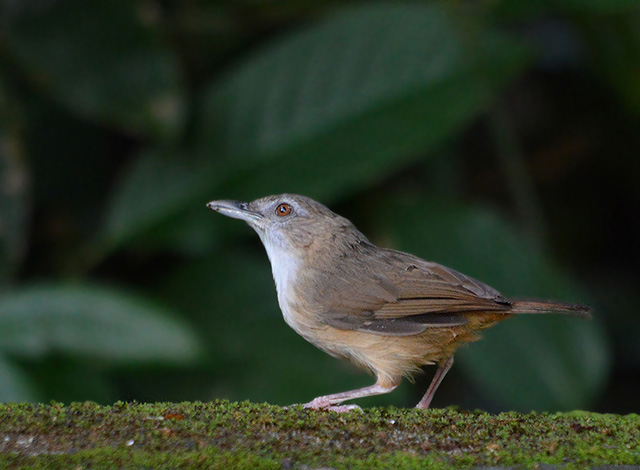
There is not much aesthetic appeal to be found on the Abbott’s Babbler but an adult bird with a recently fledged juvenile in tow indicated yet another successful breeding season for this robust undergrowth dweller.


A Blue-winged Pitta in full view would have normally made my day because pittas are such amazing creatures. However, I was a man on a mission today and the stunning beauty of the Blue-winged Pitta did not have the usual influence over my emotions.


I sighed in relief when the Slaty-legged Crake finally strolled into view. It was a young bird as it lacks the colour intensity of the adult birds. Not that it mattered. I was transfixed on the rhythmic gait of the crake. The exhilaration was intense and I struggled to keep my hands steady as I accumulated digital memories of the encounter.


Almost as soon as it appeared, the rare migrant disappeared back into the swampy undergrowth and the performance was over. I managed to obtain the images I wanted but most importantly, acquired a lifer which is a rare thing for me nowadays.


My companion and I decided the explore the surrounding areas but by then, the temperature had started to soar. A lone Dollarbird seemed unperturbed by the scorching heat and took no effort to seek some shade. Inevitably, the harsh lighting made photography of this attractive bird difficult.


April is the best time to catch the Pond-Herons in their breeding plumages before they undergo the journey back north to breed. We recorded all three species on this trip but unfortunately, none were confiding enough for any memorable photographs. This mediocre image of an Indian Pond-Heron foraging in a sea of paddy stalks still managed to wriggle its way into this blog post. Being the rarest of them all has got absolutely nothing whatsoever to do with it.


The scrubland habitat was ideal for Red-wattled Lapwings and we found several individuals in the vicinity. The absence of any other notable species cut short our exploration here and we turned our attention to the coast.


The timing of our arrival at Kota Kuala Muda was ideal with the rising tide pushing the waders and other water fowl to the high tide roost. However, it was a case of so close and yet so far. There was no safe walking access to the roost and inevitably, we made our way as far as the sandy beach was willing to take us.


We had some consolation in the form of Common Terns. A few of these graceful coastal terns decided to roost on the beach and they provided the best photographic opportunities here.


One of them has a deformed lower mandible but judging from its overall appearance, life goes on as normal for this determined individual.


Some waders were also found roosting close to shore but the heat wave was too overwhelming for any decent photographs. Nevertheless, the sight and sounds of thousands of roosting water birds is always a breath-taking affair. As Hor Kee did a final sweep of the roosting flocks for any surprises with his scope, I took the time to enjoy the spectacle before we wrapped things up for the day.


Thursday, 18 March 2021

A morning with five kings


The breaking of dawn saw flocks of Asian Openbills emerging from their roosts to forage within nearby vicinities and beyond. A few decided to try their luck along the river skirting the Air Hitam Dalam Educational Forest. The Malaysian government has loosened the movement control order allowing me travel within my home state and I found myself back at this locality for a few hours of much-needed birding. Of late, I am feeling somewhat like a caged bird with all the restrictions in placed.


When I turned around to let the Openbills carry on with their daily routine, I found that the storks were not the only ones being watched. A village cat has taken a keen interest in my presence. A friendly gesture of clicking my tongue was all it took to have the feline rushing over and showering with me affection.


The morning, as expected, was sunny and beautiful. I decided to try my luck along the river trail with my new companion in toll. The walk, however refreshing it may be, failed to produce any unexpected species.


I cannot recall ever seeing the migratory Whiskered Tern hunt above the murky water here before but one was certainly at it today.


A dead tree on the river bank must be to its liking as the elegant water fowl frequently returned to rest and preen in between forays.


Two pairs of Collared Kingfishers were proclaiming territories along this short stretch of riverside forest and between them, particularly drowned out all other sounds with their raucous vocalizations. Unfortunately, good views were hard to come by. The birds were restless probably due to the presence of rival birds.


I could also hear a pair of Stork-billed Kingfishers calling persistently nearby. For a change it was not too hard to trace the call back to the source this time and the massive Stork-billed Kingfisher, is always a sight to behold. By the end of the trip, I managed to rack up 3 more species of Kingfishers (Black-capped, White-throated and Common Kingfisher) making these striking birds one of the main highlights.


A Crested Serpent-Eagle surveyed its domain from a lofty perch. Looking quite majestic against the clear blue sky, I naturally took the time to enjoy the view. At this hour, food was probably on its mind. Reptiles mainly form its diet but I suppose anything it can overpower will be in the menu as well.


With the migratory season coming to an end, the Black Kites that grace this locality with their presence will soon undergo the long journey back to their breeding grounds. A flock of 7 birds flew towards my direction before dispersing to the nearby paddy fields to hunt. I suppose this would be my last sighting for this season.


The commercial fish ponds next to the reserve attract water birds like egrets and herons for obvious reasons. It is a private property but the owner do not usually mind my intrusion. Of all the species present today, the smallest one outshined the others with its lovely breeding plumage. In fact, the Cattle Egret is the only one found here in Malaysia that develops some plumage colouration when it is time to breed.


The Cattle Egret shared the limelight with a few Chinese Pond-Herons that were also looking their best in breeding colours. The Herons were more suspicious of my presence and it took effort to gain enough of their trust in order to obtain some images.


A banana leaf was somehow able to provide this non-breeding plumaged Pond-Heron with a sense of security. The partial concealment and angle of the Heron did not make it an appealing capture despite my close proximity.


Waders do not occur in good numbers at this location and even this Wood Sandpiper, one of the commonest species, might actually be a new site record for me.


The tendency to burst out alarm calls of the Red-wattled Lapwing will often reveal its presence. But not this one. It stood briefly on the embankment and just coolly strolled away upon my approach. When the Lapwing was finally out of sight, I decided to take my leave before I outstay my welcome here at the ponds.


In the freshwater swamp forest proper, there was not many opportunities for photography. A Mangrove Blue Flycatcher was singing from the darkest part of the undergrowth and when I eventually obtained full view of the bird, a handsome male, he had my undivided attention.


And he was not alone. The sole Indochinese Blue Flycatcher was also in the vicinity and it is always heartening to see her still doing well after all these years.


As I made my way to the car park area, I was surprise to see a pair of Greater Coucals confidingly loitering about the rubbish dump area. They were in search of food and I do not think this species scavenges. They were probably after scavengers there.


I do not come across this beautiful bird so close and in the open like this often enough and this opportunity was much welcomed. I made myself as unintimidating to the pair as possible nearby and savoured the moment. On this occasion, both the birder and photographer in me were utterly satisfied.


The Greater Coucals provided glimpses of this site’s former glory days and just about enough to keep me hopeful that one day the Air Hitam Dalam Educational Forest that I love so deeply at one point in time will rise up once again.


Tuesday, 22 January 2019

Counting waterbirds...


The emergence of the Chinese Egrets in Penang Island revived my passion for tidal habitats and the birds that find sanctuary there. I used to spend hours on end at the mudflats of Bagan Belat back in the day. Back when hundreds or even thousands of waders were present at this coastline. Sadly in recent years, the objects of my obsession have shifted to rather inaccessible areas. This and the destruction of most of the good wader sites in my home state has kept me away from indulging in wader watching. Each January, the Asian Waterbird Count (AWC) takes place throughout the continent and on this beautiful Saturday morning, I decided to do my part.


The tide was about right and the weather was good. But as expected, not much variety of waders were present at the extensive mudflats of Bagan Belat. Common Redshanks were the most numerous species present and it has been that way for quite some time.


A huge flock of white birds with black wings started to fly out from the mangroves and alighted beyond the edge of the mudflats. The birds were too far for me too positively identify them. Habitat may be ideal but they sure the hell were not Milky Storks – not in this kind of number anyway. Asian Openbills are a better bet and this is the first time I am encountering them in a marine habitat.


Eventually some of them flew over to my end of the mudflats and their identity were no longer in doubt.


One can always hope of something rare when gazing at flocks of waders out in the mudflats. Imagination can only take you so far but when seen well, it is not easy to misidentify a Common Greenshank for a Nordmann’s Greenshank.


All the egrets present were scrutinized to make sure I do not overlook a would-be rarity. I have recorded the globally vulnerable Chinese Egret here once before but today, only the Great Egret provided any form of excitement from this family of birds.


The resident pair of Brahminy Kites were up to their usual routine of scavenging and the occasional piracy of egrets’ fresh caught preys. However, what goes round comes round and the kites have to put up with the constant mobbing of the House Crows.


A fair number of Whiskered Terns were also present and the river mouth seemed to have their undivided attention today. A short walk along the rocky wave breaker got me into a better position to photograph these angelic and graceful birds. It is not easy but the good lighting helped tremendously.


Poetry in motion – the bird and not the photography…


After the AWC, I swung by the swamp forest of Air Hitam Dalam only to find a group of schoolchildren making their presence felt along the canopy walk. This location holds the status of an educational forest but judging from the level of noise and disturbance this group was making, I doubt there will be much education to be learned from this trip. The wintering Square-tailed Drongo-Cuckoo has been quite tolerant to human presence so far this season but nothing could have prepared it for the commotion that was now taking place. Inevitably, it was nervous and skittish and a record shot was all I could muster.


The male Scarlet-backed Flowerpecker is an exquisite creature despite his common status. Naturally he had my attention and from the look of things, I had his too (in a bad way). Not today, huh bud?


By the later half of the morning, the temperature started to soar and so did some of the birds. More Asian Openbills were seen again and this time at much closer proximity.


Poetry in motion – again the birds and not the photography…


Ever wondered how this stork got its name? Apparently only mature birds will sport this distinct gap between mandibles.


When a striking adult Brahminy Kite leisurely glided into view it was deja vu again. First the Openbills and now this common raptor.


I was just thinking to myself that there is another species that often patrols the sky above the swamp forest here this time of year and just like a staged performance, in came a trio of Black Kites from the adjacent paddy fields.


The kites were probably back to rest after the morning’s hunt and their favourite site is the row of big trees across the river. Enjoying the sight of a tree full of Black Kites is something you rarely get to say especially here in Malaysia.


This male Common Flameback signalled his arrival by uttering a series of his loud territorial call. Although this species is a regular here, I have always adored his vivid colouration. Today, he was particularly obliging and I think I took some of my best images of the species to date.


After the exciting encounter with the Common Flameback, I was ready to call it a day. The heat of the midday sun was starting to wear me out. But, this birding hotspot was not quite done. A male Banded Woodpecker alighted so close that it gave me a startle. This species can be exceedingly tame here at times and this was certainly one of those occasions. He was somehow attracted to a clump of Nipah Palms and most probably is about food. A dried palm frown coincidentally provide an interesting backdrop for the photo.


By that time, lighting was getting harsh. Despite the confiding nature of the woodpecker, some of my images somehow do not quite hit the mark. Nevertheless, like the woodpecker, I took my time to gradually move out of the vicinity. My last visit here was rather mundane but today was a whole different story. And it did not even involved one single uncommon species.


I would have missed the last bird of the day had I not seen it fly onto the perch. Indian Cuckoos are common migrants and there are at least two individuals wintering here this season. It is no award-winning photograph but sometimes, experiences matter more. And observing this handsome male Indian Cuckoo resting among the shadows of the canopy foliage is an intriguing experience indeed.