Yesterday’s
failure with the Giant Ibis only fuelled our determination to observe and
photograph this rare water bird in its natural habitat. We arrived at the ‘ibis
pond’ and settled into the makeshift hide well before dawn. Both ibises have
been seen here at first light quite regularly nowadays and we are not taking
any chances. Should we arrive after the birds and spooked them, we can
literally kiss our chances goodbye. Like clockwork, a flock of large dark
coloured birds descended upon the dead tree overlooking the pond like a group
of gargoyles at the break of dawn. They were a flock of 8 White-shouldered Ibis
– one of the secondary targets of the trip. The tree was the same one used by
the Olive-backed Pipit yesterday and according to our guide, most of the water
birds will perch on that tree to make sure that the coast is clear before
coming down to the pond to feed. Hence, the significance of this tree to me.

Lighting
was horrendous at the time but we cannot help taking a few shots of these captivating
birds. Odd but captivating birds. The clean shaven head is typical of ibises
and storks. I sometimes wonder if having the same look somehow influence my
love for these birds...
It
took the flock nearly 30 minutes before they had the confidence to come down to
the pond to feed. Even then, only one descended while the rest remained. I am
not sure if the first bird was a sentry but it did not take long for it to
sense something was amiss. We barely managed a few shots before it swiftly
moved to the far end of the feeding area and almost beyond our field of view
from the hide. Either by telepath or body language, the rest of the flock
joined the sentry. It is most unfortunate that my gut instinct from our first
encounter with the White-shouldered Ibis was right and they are indeed unbelievably
shy.
The
arrival of a Lesser Adjutant momentarily eased our disappointment with the ibis.
Just like them, it alighted on the tall tree first before gliding down to the
pond.
Unexpectedly,
the presence of the Lesser Adjutant gave one of the White-shouldered Ibis a renewed
sense of security. One strong enough for it to foraged into full view of the
hide again. They say God works in mysterious ways and I for one would have never
expected a Lesser Adjutant to turn things around and save the day. The two
water birds got along well and the atmosphere in the hide improved
tremendously.
Unfortunately,
our joy was short lived. Perhaps, the Lesser Adjutant felt it was being used or
the hide could not contain our excitement completely. The big guy took off in a
flurry of feathers and we were left looking at an empty pond – again. The ibis
joined the rest of the flock at the far end and there they remained for the
next 2 hours.
There was nothing we could do but wait. It was truly a blessing
that a few other species of birds that gradually came to forage at the pond
unknowingly helped us pass this testing time even if they were not lifers like
this stunning Banded Bay Cuckoo.
With
the hide as our cover, we actually enjoyed some great moments. Not only with
the cuckoo but a handful of other species as well. One thing is for sure. These
are by far my best effort of the Banded Bay Cuckoo.
I
have been longing for an opportunity to truly admire the beauty of the
Red-billed Blue Magpie even since I had a glimpse of the wicked long tail during
yesterday’s exploration of the ibis pond. And today, the opportunity presented
itself on more than one occasion.
I
rarely question the processes of evolution but judging from the magpie’s
preference to forage near and on the ground, the long tail that makes it so
alluring seemed to hinder the movements of the bird. Well whatever the reason
may be, it is thrilling to see such a stunning bird in the wild and I am grateful
for the experiences received today.
The
striking and loud Black-collared Starling occurs only as escapees or introduced
birds in Malaysia. I know it is all in the mind but these wild birds certainly
looked a lot better than the ones I sometimes see roaming about housing areas
in Penang.
There
is one significant difference between the forests here and back home in
Malaysia and it is the reduced number of bulbuls. Maybe I was not looking hard
enough for this family of birds. Anyway, the commonest species here in this wildlife
sanctuary happens to the Sooty-headed Bulbul – another lifer for a southerner like
me.
In
fact, a pair was all over the hide throughout our time there and we could not
have asked for a better performance.
The
best thing about birding in a new country is every bird you encounter could
well be a lifer – even a little brown job scurrying about the undergrowth. The
Brown Prinia is aptly named and a confiding individual foraging just next to
the hide was given its due attention.
However,
there is a downside to this expectation of lifers. It can blind you and even a
modest Brown Shrike can leave you puzzled. To be fair (a self-preservation
moment here), it was an extremely worn bird and it took someone not under the
birding-in-a-new-country syndrome (thank you, Ayuwat) to set things right.
Decades
of birding has made me a patient man but my uncomfortable position, the rising
temperature and the disappointment with both ibises are putting that quality to
the test. Much to our delight, a few of the White-shouldered Ibis gradually
inched closer to the pond after a tediously long wait and life was beautiful
again.
While
observing the foraging ibises, I could not help but notice the Pond-Herons
somewhat escorting the former. The reason for this behaviour soon revealed
itself. Prey items flushed or missed by the ibises were easy pickings for the
Pond-Herons. However, I did not see nor do I think the Pond-Herons are bold
enough to glaringly snatch away prey caught by the ibises. And these polite
pirates earned some attention after being literally ignored throughout the
morning.
As
we were enjoying the companionship of the White-shouldered Ibis, a pair of
large dark birds descended upon the same dead tree. It was the moment of truth.
I held my breath and turn my attention (and my gear) towards the new arrivals. I
had to be sure. Looking somewhat prehistoric, the Giant Ibis is undeniably unique
and impressive. My journey of a thousand kilometres, the tribulations faced and
the built up anticipation have all led me to this moment. And it is a remarkable
one.
To
be honest, there is hardly anything aesthetically appealing about the Giant
Ibis. But the beady eyes and charisma of the ibis king has definitely won me
over. In between shooting, I admired the Giant Ibis through my bins. After all,
I know exactly where I am coming from and a still image or a moving video cannot
replace seeing a bird in the flesh. I know we live in the digital age. Call me old
fashion but I somehow feel the connection is lost when a digital medium bridges
me to the bird.
When
the excitement subsided, we waited for the pair to join their smaller cousins
by the pond. Much to our dismay, the wait ended in vain. Out of the blue, the
Giant Ibises took flight and the White-shouldered Ibis follow suit. I am not
sure of the reason for their retreat but it could have been a lot of things - a
distant human, a stray dog, our breathing or even just because they could. And for
the third time, we were left staring at an empty pond.
The
ibises are certainly one of the shyest water birds I have ever encountered.
Even with the hide, the ibises were still suspicious. When we first settled into
the hide, our guides were busy putting up additional twigs and vegetation to further
conceal this human structure. I felt the hide, covered with camouflaged netting
and the works, was sufficient to do the job even without the additional touches
but I did not speak my mind at the time. So, let this be a lesson. Never doubt
your local bird guide because he knows his shit.

Now
that we (or maybe just me) have achieved the main mission of the trip, the rest
of the bird species found in this dry forest were about to be given their due
attention. The Rufous-winged Buzzard possesses a certain poise and beauty that
makes this small raptor mesmerizing. Unfortunately, it is usually shy despite
its common status at this renowned birding site. There is a pair residing near
the ibis pond and they tolerated my intrusion on a few rare occasions.
As
expected most of my images of the Rufous-winged Buzzards were in flight...
We
encountered drongo species throughout our time in Cambodia but they are shy. My
best photo of a drongo has to be this Ashy Drongo hunting from a dead tree.
The
distinct colouration of the Pied Bushchat makes it relatively conspicuous even
when foraging among ground vegetation. One individual resting on a tree
provided what should be my best images of the species to date.
The
relatively drab colours of the Common Woodshrike ought to help blend the bird
into this landscape of browns and greys. But its active and confiding nature gives
away its presence most of the time. In a place where the human form is feared,
the Common Woodshrike’s behaviour was a welcomed trait.
It
is a blessing that the trees here are short or it would have been truly testing
to obtain records shots of the minute Yellow-crowned Woodpecker. Small but
striking, we inevitably followed its movement as it skipped from tree to tree. The
woodpecker may be seeking out sustenance but for the human birders, something
more than just record shots.
The
Small Minivet looked slightly out of place here in this type of forest. Maybe
it is all my years of birding in Malaysia that I associate reddish minivets
with dense and tall rainforests. The male Small Minivet may not have the colour
intensity of the minivets that I am used to but it was still a breath taking
species.


As
the blistering heat of midday started to take its toll of us, we retreated back
to the lodge for a lunch break. I had some time on my hands before food was
served and as always, I continued birding around the vicinity but at a
leisurely pace. I could not be sure if it was the heat or age finally catching
up with me but birding here in Cambodia was no walk in the park. Anyway, I approach
the nearby pond with caution just in case yesterday’s White-shouldered Ibis was
back. Even before I could see the pond, audible croaks filled the vicinity and
a mixed flock of large water birds took to the air in retreat including the
ibis. I was dumfounded. Before I step foot in Cambodia, I would never had guessed
that the ibises will be so unbelievably skittish. But they are and it can be
frustrating at times. However, I could take comfort that I managed to obtain my
best photo of the Woolly-necked Stork so far.

As
I dragged my feet back to the lodge, a huge raptor took off from a nearby tree
and rejuvenated my enthusiasm. Although it was a familiar sight to me, this
Crested Serpent-Eagle made me realized how good sometimes I have it back home
in Malaysia. This is one of the few encounters in Cambodia where the bird was
as tolerable to an approaching human as the bird normally is in Malaysia.
A
leafbird participating in a small birdwave within the grounds of the lodge turned
out to be a Golden-fronted Leafbird. Nothing to brag about in terms of
photography but it is was a lifer and naturally had my undivided attention.
A
little celebration to commemorate our success with the enigmatic Giant Ibis but
it was premature. We found out later that day, a British couple and their guide
enjoyed a foraging Giant Ibis at the ibis pond at around 3:30pm. We were contemplating
about another attempt tomorrow afternoon until the guide showed us a clip of
the foraging ibis and that made the decision up for us. We will go for the
elusive Giant Ibis again tomorrow before the long drive back to Siem Reap.
After
lunch there was no news from the local guides of the ibises returning to the
ibis pond and we proceeded to explore other parts of this wildlife sanctuary. I
have had not much luck with photographing owls so far here in Cambodia but that
was about to change. A pair of Spotted Owlets has been roosting regularly in an
area not far from the lodge and even with the sparse foliage, it took the
guides some time to finally locate these adorable night birds.
I
see absolutely nothing wrong with photographing a nocturnal bird with its eyes
closed during the day. I sometimes hear bird photographers stress on how mandatory
it is to shoot the bird on a natural perch. I guess it is to make the photo
look as natural as possible. Which brings me back to what is so unnatural about
a nocturnal species roosting with its eyes closed?
The
second owl we encountered today was a Brown Wood-Owl and it certainly found an
ideal spot in which to roost – well hidden and inaccessible.
Parakeets
are quite a common sight here but all the sightings so far were of birds in
flight. Even so, the parakeets were a spectacular sight with their longish tail
and striking colouration. This distant photograph of a Red-breasted Parakeet at
rest was the only one I could obtain of the species.
While
we were trekking along the access trail, a parakeet suddenly alighted on a
nearby tree. It offered only one shot before it realized its mistake and took
off. But it was classic Sod’s Law. Instead of the gorgeous male Blossom-headed
Parakeet, it was the drab female. And life goes on.
Another
small and striking woodpecker made its way into our life list and this time, it
was a Rufous-bellied Woodpecker. This tiny critter made us work hard to obtain its
image and out of the whole bunch that I took, this is probably my best effort.
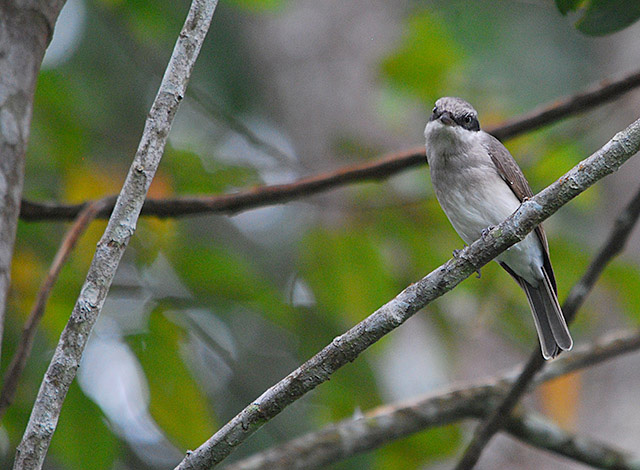
The
Burmese Shrike is did not provide any better photographic opportunities and
this photo of a bird at the canopy of a tree did not go unappreciated.
There
is only one species of treeswift here in Cambodia and it is the Crested
Treeswift. I did not have much opportunities to photograph this lifer as all
the sightings so far were birds in flight. Nearing the end of Day 4, a nesting
male provided a prolonged encounter and despite the bad lighting I took a
number of photos as we are unlikely to come this way again.
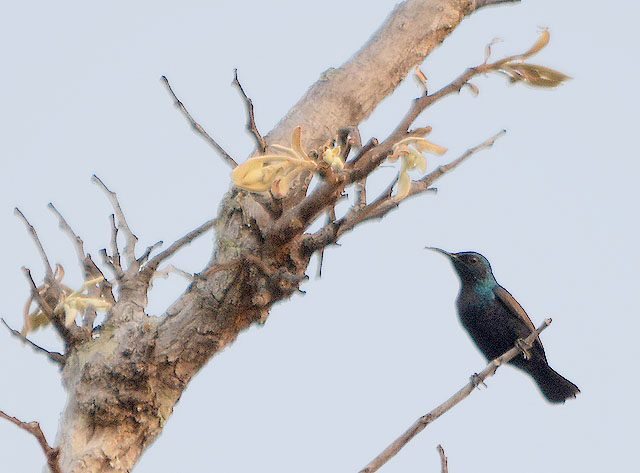
Dusk
is probably the worst time to photograph a male Purple Sunbird but beggars
can’t be choosers. So, the iridescent purple plumage from which the name is
derived was not in its full glory at this hour.
The
last night bird of the day was another familiar sight – a Changeable Hawk-eagle
and it was nesting at the edge of the forest. Just before we called it a day, we
found ourselves surrounded by the loud and distinct calls of the Chinese
Francolins. The setting sun seemed to trigger off some internal setting in
these gamebirds but they were too well hidden for anything other than an audio
record. The Giant Ibis certainly lived up to its reputation of being shy,
elusive and enigmatic and hopefully tomorrow, it will give us another reason to
remember this incredible birding adventure to Cambodia.