Pages

Friday, 27 July 2012

The cuddly couple


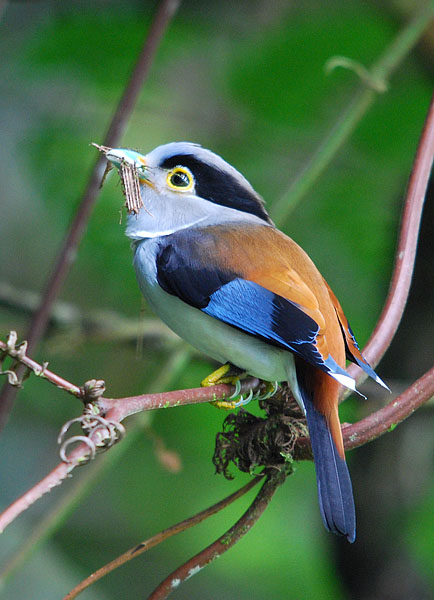
Earlier this year, I had the good fortune of being able to observe a pair of Silver-breasted Broadbill nesting. This species is one of the smallest found in Malaysia and without a doubt, is one of the cutest. Together with the brilliant colours of its plumage, Silver-breasted Broadbills are one of the most after targets for both birders and bird photographers alike. I have encountered this species on numerous occasions while I’m out in the field but I never get tired of them. But this time, the encounter was better and more memorable than usual because I managed to obtain far better shots than all my previous attempts. Broadbills build untidy dome-shaped nests that are usually suspended above rivers, ravines and rather unfortunately, access roads as well. This particular nest was indeed built above an access road but it was quite close to the forest edge and well away from the dangers posed by passing vehicles.


Both the male and the female shared the nest building duty and it was the fairer sex that provided the best photographic opportunities this time round.


The male looks almost like the female but lacks the silver necklace. Here, he was putting the finishing touches the top part of the nest and pretty soon, this pair will become proud parents to the next generation of adorable and stunning forest dwellers.

Friday, 15 June 2012

An evening by the swamp (14/06/2012)


I decided to do a short visit to the swamp forest at the Air Hitam Dalam Forest Reserve in Penang as I was quite curious as how the upgrading construction works are getting along. The rotting wooden boardwalks are now being replaced by concrete ones. Although it loses the “wild” look, I feel that it is the right way to do it as the wooden ones will not last long. I have been birding at this locality since it first opened its “doors” to the public and that was back in 1996. Through the years, this locality has provided me countless memorable experiences. It has also gone through and endured a lot – including having a road cut right across the center. Despite all that, the birds are still there and this area still remains as one of the main birding locations in the state and my heart.

The Spotted Wood-owl is one of the many alluring residents that draw me and my fellow birders back here time and time again. Although it is a relatively large bird, it can remain undetected at times because it prefers to roost well hidden among the tall densely crowned trees.


The Crested Serpent-eagle is another predatory bird that calls this forest home and their piercing cries are very much a part of the sights and sounds here. 


Although the Greater Racket-tailed Drongo is quite a common bird, it still does it for me. Not only because of the racket tail but its “charming” personality as well. However, this subadult bird is little scruffy or it would have been a really nice capture.


Just who do you think you are calling scruffy? It has been a really rough day. That’s all.

Tuesday, 5 June 2012

In search of the Barau (31/05/2012)


The Royal Belum State Park is part of the Belum-Temenggor forest landscape located at the northern-most corner of Perak state and is one of the largest forested areas in Malaysia. This was my third only visit to this particular area and every single one of them concluded quite satisfactory. 


Unlike Taman Negara, it has managed to maintain accessibility by boat only and this helps to keep the park relatively as wild as it should be. Anyway, the four of us chartered a small boat for the day to explore this pristine birding locality and most of the birding and photography from this trip were done from the boat. 


The Lesser Fish-eagle is rather scarce everywhere and the Temenggor Lake is probably one of its last strongholds where it can still be seen quite regularly. Unfortunately, it is rather shy and I was only able to obtain record shots despite crossing paths with this eagle a couple of times throughout the trip. And the constant movement of the boat did not help much in improving my photographs.


If you are a big fan of hornbills, and to be totally honest who isn’t, Royal Belum is one of the best places to observe these majestic and regal birds. It is the only place in Malaysia where all the 10 species of hornbills have been recorded. On this trip, we managed to record 3 species and obtained record shots of 2 of them – a flying male Wreathed Hornbill…


And a resting Black Hornbill.


We had our lunch at Sungai Kejar base camp. It is one of the few basic accommodations can be found within the park. There are no big resorts here and I sincerely hope it will stay that way. 


Anyway, the base camp was quite rich in bird life and a nearby fruiting tree was really luring in the forest birds – much to our delight. Unfortunately, the tree was quite tall and good photographic opportunities were rare. A rather confiding male Tickell’s Blue Flycatcher eventually prevented me from leaving the base camp empty handed.


The indigenous people of Belum-Temenggor are also one of the attractions for visitors to the park but not quite so for a quartet of birders from Penang. We are solely here for the feathered residents only.


The star performer of the trip is a species of bulbul that I have not seen in more than 17 years and one of the main targets for this trip – the Straw-headed Bulbul. By the way, the local name is Barau and hence, the title of this post. It may be the largest of all the bulbuls in Malaysia but sadly, it is also one of the rarest as well. Being a highly-prized songbird in the illegal bird trade is the main reason for its scarcity. And that is a real shame because not only does it sing beautifully but it is also visually stunning. This bulbul favours riverside vegetation and it is not particularly shy as we were able to approach it reasonably close by boat.


Despite all the threats that this bulbul is facing, we discovered that there is still hope…


Like all young birds, this fledgling had a ravenous appetite and the parents had to work hard to keep it happy.


A Praying Mantis is certainly not beyond their means. 


Before I end this post, I would to share this image of a family of Black-thighed Falconets taken along the Kupang-Gerik highway a few days before our trip to Royal Belum. The birds were having some quality time together as the day draws to a close but like all loving families, occasionally there may be one that is just not in the mood to cuddle up.


Friday, 13 April 2012

Dressed for success (11/04/2012)


It is coming to the end of the spring migration and this is the best time to catch some of the remaining migrants, especially the waterbirds, in their breeding plumages before they undertake the migration back north to breed. Today was declared a public holiday as it was the installation day of our new King and at first light, I was at the marshlands in Pulau Burung, Penang. Luckily, there were still quite a few of the migratory waterbirds present to keep me company – like this Intermediate Egret in partial breeding plumage.


Despite a careful sweep of the area, the only Pond-herons present in the vicinity (and everywhere else today) were the Chinese Pond-herons. This species may be the commonest of the three species that occur here in Malaysia but their plumage is certainly the prettiest. There is a high possibility that I may not get to photograph the Javan and Indian Pond-heron as I have had very little luck with them this season and time is now running out.


The bird that really got my adrenalin pumping for this visit was not a waterbird. It was a Tiger Shrike and a first record for me for this area. Much to my delight, it was a male and in breeding plumage. Inevitably, this handsome bird immediately gained my complete attention and admiration.


This Yellow-bellied Prinia was belting out his territorial song from an exposed perch when he was interrupted by my approaching car. My sincere apologies. Please carry on, Sir…


Some waders undergo amazing plumage transformations for the breeding season. The Pacific Golden Plover is one such wader. Unfortunately for me this rather confiding individual foraging along the mudflats of Batu Kawan, Penang has yet to attain its full breeding plumage. And that would have really made my day.


This Long-toed Stint is also in partial breeding plumage but was a lot more wary of my presence than the much bigger plover.


At the paddy fields of Kubang Semang, Penang I came across a rather big mix flock of egrets following a tractor that was working the field. This is a common practice among the waterbirds as the tractor will flush insects and other prey out and they will be easy pickings. The majority of the egrets present were Cattle Egrets and most of them were sporting their smart breeding plumage.  


Among the few Intermediate Egrets that were present at the locality, one individual was in partial breeding plumage. The thing that really caught my attention was the piercing red eyes. This is not the first time I have seen this species in breeding plumage but the red eyes were certainly new to me.


Among the other “normal-looking” Intermediate Egrets, this individual just appear a little evil to me – like an egret possessed. Egrets are just so angelic but one with bloodshot eyes looks more suitable representing the other “side”.


A quick detour to the Blue-throated Bee-eater nesting ground showed that it was likely to be another successful season.

Tuesday, 27 March 2012

Rail watching (24/03/2012)


The marshland at Pulau Burung, Penang is a haven for waterbirds and waterbird-loving birders as well. Here, the resident rails and crakes are more tolerant to human presence and it is certainly one of the best sites to observe them in their natural habitat. This morning, an exceptional tame Common Moorhen kept me company for a good hour or so.  Although the lighting was little harsh on this beautiful but sunny occasion, I did enjoy the encounter and happy with the images that I managed to obtain.


The White-browed Crakes were rather “visible” today and there was certainly plenty of scurrying movement along the long grasses caused by the crakes.


This parent bird was seen taking a lone fledgling out foraging. These must be a very exciting times for the little one as it explores the world a little more each day and learning the ways of life at the same time.


I came across another family of crakes but the youngster in this family is much older and will be able to obtain its adult plumage in the near future. Well, looks like it was another good breeding season for the crakes.


This Common Sandpiper may not be a rail but it gave me a pose that I found to be almost impossible to resist.

Wednesday, 7 March 2012

Feeding time (03/03/2012)


Mom? Dad? Where are you, guys? I’m starvin’ here.
How am I suppose to grow into a big and healthy Yellow-breasted Flowerpecker when you guys don’t come back with food often enough? Sungai Sedim Recreational Forest is still a prime habitat in Kedah state. I’m sure it’s not that difficult to find food.


Well, it’s about time. Finally…food! What? That's it? Aw, man...


Mom? Dad? Where are you, guys? I’m starvin’ here…

Tuesday, 28 February 2012

Good ol' Bukit Larut (25-26/02/2012)


Every trip to this birding hotspot in Taiping, Perak begins and ends with the “adventurous” half-hour jeep ride up and the down this hill resort. It is certainly not for the faint-hearted as there are numerous hairpin corners that the drivers’ have to masterfully maneuver past. Anyway, our group of six made it to our destination in one piece.


I am pretty excited about this trip because it will be my first overnight stay at the Methodist Bungalow (I prefer the old name which is The Nest) and it is located just above Speedy Resthouse – my regular accommodation at this locality. But the latter is nothing but an empty bungalow on most days now. That’s a real shame as it holds many fond and exciting birding memories for me. However, there are plans to convert it into some kind of a biological centre. I am not against such plans as long as it will be fully utilized and well maintained once it is completed.


Like most great birding spots, the accommodation at The Nest is rather basic but it serves its purpose well enough. 


Nevertheless, it does possess a certain charm and ambience of its own and you even have to trek through a short jungle trail to actually reach the bungalow.


The compound itself is frequently visited by birds and that pretty much kept us occupied during meal and supposedly, rest times.


And to top it all off, the caretaker Mr. Lee prepares glorious home-cooked food for all our meals and that is something we do not usually get to enjoy on birding trips.


Being the wettest part of Peninsula Malaysia, rain is a constant threat to birders here but the sky managed to hold back the rain for most parts of our stay. All we had to worry about was getting the perfect lifer or photograph as our group was made up of old-school birders and bird photographers. 


Although we saw very little rain, the engulfing mist occasionally made us lose sight of our targets.


And now, to the important stuff – the birds. This was one of the best trips I’ve had at this locality for a long time. Black-throated Sunbirds can be seen throughout the day as they indulge themselves on the flowering plants just next to the dining area of the bungalow. Really good photographic opportunities were hard to come by as the Sunbirds are hyperactive and usually, there will be branches or vegetation in the way. This is my best effort but the lighting condition was just good enough to bring out some of the resplendent of this common montane resident.


Just beyond the compound of the bungalow, the level of bird activity usually holds us back temporary before we wander further away. Mountain Bulbuls are another species that is very common around here. My best image of this species is still rather embarrassing taking into account the abundance of this species. Well, maybe I didn’t put enough effort into it. But you can’t really blame me because there were so many distractions around.


Distractions like this stunning male White-browed Shrike-babbler gorging on a succulent caterpillar…


A family of Hill Blue Flycatchers residing just outside the boundaries of the bungalow is rather tolerant of human presence. They performed admirably in front of both birders and photographers alike during our stay. Only thing was that the capabilities of my gear prevented me from obtaining sharper images as the Flycatchers tend to keep to dimmer parts of the forest.


Further away from The Nest, this lone Chestnut-backed Scimitar-babbler came agonizingly close to making my day when it alighted on a nearby bare branch. Unfortunately, I waited in vain for it to change position and provide me with a better pose because it just scurried further up the branch and into the dense canopy.


I paid more attention to flocks of Ashy Minivets nowadays in light of the recent discovery of the almost similar-looking Swinhoe’s Minivets wintering in Malaysia. After much scrutiny there was nothing out of the ordinary with this flock.


Birdwaves may be a birder’s dream come true but it can be a photographer’s nightmare. So many different species traveling together as a giant flock combing through the forest vegetation at a rapid pace overwhelms my decision-making ability on what to shoot at first. And when one is busy focusing on a single bird, there is always a risk of something rare slipping past one’s “radar”. I use my binoculars more often than my camera when it comes to birdwaves. Unless, an individual becomes exceptional bold in the feeding frenzy and comes exceptional close and low like this Ashy Bulbul.


Thanks to the keen sense of sight of Choo Eng and James, I managed to capture a few records shots of this foraging Silver-breasted Broadbill – undoubtedly one of the most adorable of all Malaysian birds.


Everyone is quite accustomed to the term fighting cocks but fighting Fulvettas, that is something new. Watching two Mountain Fulvettas having a rather aggressive dispute with beaks and feet locked in battle was something rather unexpected – to me anyway. And to make the encounter even more interesting was a couple of Golden Babblers that came very close to the jostling pair. Were they just being busybodies, trying to be peace-makers or adding fuel into the flame? Although this was a serious affair, we can’t help but to smile at the antics of the latter.


The Pygmy Wren-babbler looks like a small ball of feathers that forages along the montane forest undergrowth. With its distinct and piercing call, it is more often heard than seen. Well, this cute little fellow was the highlight of the trip. On the first day, it caught us all by surprise when it suddenly alighted on a rock next to where we were taking a breather. I managed to take a few hasty shots before it dived into the cover of the undergrowth. That, however, was only the appetizer.


The next day, I came across another Pygmy Wren-babbler doing a territorial display. It was a commendable performance indeed and one that I shall remember for a long time to come. The routine was quite simple but visually appealing. Turning from side to side while calling its heart out and every once in a while, it will flap its wings once. I was well aware at the time that my gear could not cope with all those fast action shots at such dim lighting. However, I was rather delighted when a few images did turn out better than expected. Bukit Larut delivers yet another outstanding moment in my birding life and all courtesy of a very tiny bird.


The biggest disappointment of the trip was failing to photograph a White-throated Rock Thrush – again. It was only back in December of last year that I managed to record this scarce winter visitor for the first time in my life at Sungai Sedim but she evaded my camera then. And this time it was a striking male bird and he simply did not keep still long enough for me to even press the shutter once. The funny thing about birding is that sometimes when you finally get a lifer that you have been trying for all these years, that species starts to cross your path more often. To add to my misery, I gave owling a pass on that night and my companions came back with a photo of most probably the same bird roosting on a boulder. I have a funny feeling I am destined to only see but not photograph this species. Anyway, Harvey was kind enough to share his image for my post.


Besides the birds, this tiny Reed Snake was just another one of the alluring wildlife that can still be found along the slopes of this hill that I managed to photograph and that wraps things up for my birding adventure this time.