Pages

Wednesday, 12 October 2016

Old school birding

I get a fair share of guests who are old school birders and Barry, my latest guest who hails from Canada, is certainly one of them. I was a birder long before I took up bird photography. So, I can relate to the fact that all the gear Barry needs for a birding trip is his faithful binoculars. Today also happened to be the final day of the Nine Emperor Gods Festival and that usually spells rain in the daytime. Chinese believe the rain is meant to cleanse the roads in preparation for the chariot procession at night. We were almost drenched to the bone when we wondered out of our vehicle at the mangroves of Kuala Gula in search of Milky Storks that is a part of Barry’s bucket list. The trip was off to a bad start. The location did not live up to its name as a bird sanctuary and the only ‘Milkies’ we saw were in a cage within the compound of the Wildlife Department.

The Mangrove Blue Flycatcher also happened to be in his list and I know exactly where to take him after the disappointing visit to Kuala Gula. As we making our into the flycatchers’ swampy domain at Air Hitam Dalam, a spectacle of nature that I have not witness for a long time stopped us at our tracks. A flock of about 200 Asian Openbills were riding the hot air thermals in the sky above. I was getting a little worried that these storks have abandoned their intentions to settle down here in Peninsular Malaysia. The sight of this massive flock was a relief to say the least.


The male Mangrove Blue Flycatcher did not disappoint as usual. His friendly nature and striking colours made quite an impact on my guest. Barry travels a lot in his line of work and he has seen a considerable number of bird species. It would take something less ordinary to impress him and the Mangrove Blue Flycatchers here are anything but ordinary.


Barry enjoying his second lifer of the trip – a female Streak-breasted Woodpecker. This is probably the most reliable locality for this northern speciality in Malaysia. The differences between this species and the commoner Laced Woodpecker are so subtle, I had to work a little extra to convince my guest. The woodpecker, being a female, was playing hard to get - naturally.


The last leg of today’s tour brought us to the muddy shorelines of Penang’s only Important Bird Area (IBA) – Teluk Ayer Tawar. The tide has started to rise upon our arrival and I could make out waders moving about on the huge expanse of mud and sand.


However, it was not the birds that had my immediate attention but this building that was still under construction. It looks modern and posh and totally out of place here. You are surrounded by scrub and all creepy-crawlies of all kinds. The air is stench with overwhelming mud odour and for half the time, a bleak coastline greets your view. The noise pollution caused by the thousands of migratory waders that winter here each year will drive you insane. This is no place for such an innovative and classy building. Please leave this modest location to the local residents and the birders. You deserve so much better – really…


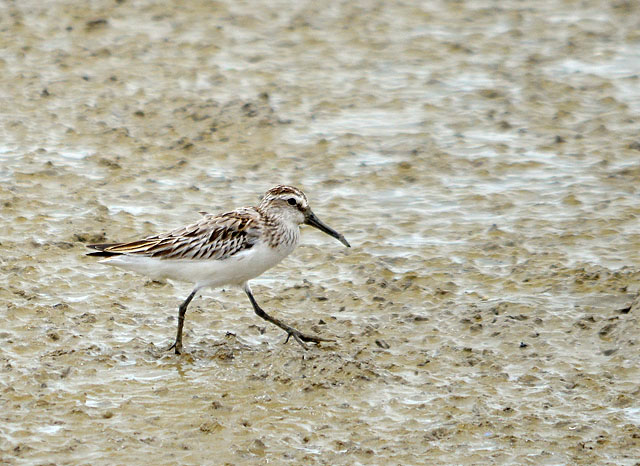
Now that I have gotten that out of my system, back to the birds again. The mere sight of the number of waders present was breath taking. Although the tide was a little far, we could still scrutinized the flocks for any rarities. As time passed, the tide pushed the waders closer. The adorable Broad-billed Sandpipers were the first to come close enough for some decent shots. Oblivious to all the looming threats their wintering ground is facing, they went about having a good time in this tropical paradise.


Small waders are usually more confiding and this Terek Sandpiper foraged quite close to our stationery vehicle that is now our mobile hide. I am not sure how to describe it but Terek Sandpipers are very soothing to look at – upturned bill and all.


The Common Redshanks due to their big numbers and moderate size is quite conspicuous. Having a tendency to shout your lungs out every chance you get is bound to attract attention to yourself also. I find that they tend to get used to your presence faster than any of the other moderate-sized waders and forage quite close at times.


Whimbrels are usually wary birds. This individual flew close to shore to avoid the rising surf and soon realized its mistakes when it could make out two human forms within this lug of steel that sits on four wheels. I managed to take a few shots before it made things right again and foraged further away from the shoreline.


The main reason for our visit here is the endangered Nordmann’s Greenshank. After a careful sweep, we failed to locate one. It is probably too early in the season but one has to be optimistic at times. The next best thing was probably the small flock of Asian Dowitchers foraging nearby. This species, unfortunately, is also on the endangered list. Like the greenshank, the area is one of the main wintering grounds for these endangered waders. Hence, the IBA status but I guess that does not mean much to most.


The dowitchers forage by probing their long bills into the mud quite frequently. It is delightful to watch but challenging to obtain sharp images. Especially now that the rain clouds have started to form again and threaten to block out all traces of the ever-essential natural light I rely so heavily on for photography. The absence of the usual scorching heat here at the mudflats is a nice change despite certain drawbacks. The cool breeze that day also made our wader watching session this time a lot more comfortable than usual. Go deep or go home...


It is a dog-eat-dog world out there on the mudflats. Once you obtained your prey, you better consume it with haste or run away to consume it in leisure because there is always another wader lurking nearby and ever ready to snatch away your hard earned meal. When we were satisfied of our visit to the beach, I took Barry for one last detour and that was to Kulim Hi-Tech Park for his third and final lifer of the day – a well hidden roosting Barred Eagle-owl. And that, I would say is a great way to end a day’s birding despite not having that many photographs to show for it at the end.

Friday, 7 October 2016

The Ferruginous Fever

I was up well before dawn despite it being a long day of birding yesterday. Sleep did not come easy. The glowing plumage of the Ferruginous Partridge filled my night with lucid dreams. There is no doubt I have caught the ‘Ferruginous Fever’ and the cure, is to get the birds in the flesh. I know that I will not be alone in this quest. It is a Sunday morning after all and the pandemic has swept through the entire length of the country all way to neighbouring Singapore. A crowd is inevitable. But I have traveled too far for this partridge to develop a sudden case of agoraphobia. Like a man on a mission, I was determined to get my main target of the trip. A hide is a requirement and together with a dozen other birders and photographers, we prepped our gear and ourselves for the morning to come and God willing, Ferruginous Partridges in all their glory.


The first couple of hours was quite uneventful with only the commoner species to keep us company. A sense of worry started to take a hold of me. To miss out on the partridges two mornings in a row would certainly have dire consequences on my state of mind and overall wellbeing. My uncomfortable seating position in the hide was taking its toll on me also. But persistency as well as patience is a virtue in the world of birding. Time passed a little easier whenever the Ochraceous Bulbul decides to show itself. Just like yesterday, it can be confiding at times.


The family of Oriental Magpie-robins are regulars to this locality and the chick was still banking on its parents’ maternal instincts for a quick meal.


Whenever I see a Treeshrew now, I am instantly reminded of Scrat (the character from the Ice Age movie franchise). I guess I have Scrat to thank for keeping me occupied with its antics as I waited for the Ferruginous Partridges.


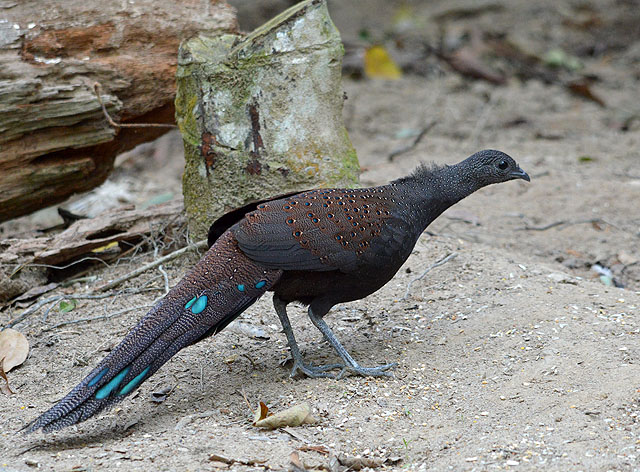
Another hour has passed and still no partridge. I was about to lose it when two male Mountain Peacock-pheasants decided to inject some life into this slow but beautiful morning. And I do not need any invites to start capturing this handsome endemic. It was probably the same two males from yesterday morning but I am not complaining. They still do it for me.


Not long after the males retreated back into the forest, a female pheasant show herself. For me, this is the first time I have seen a female here. And she was even more confiding than the males. That’s a good girl...


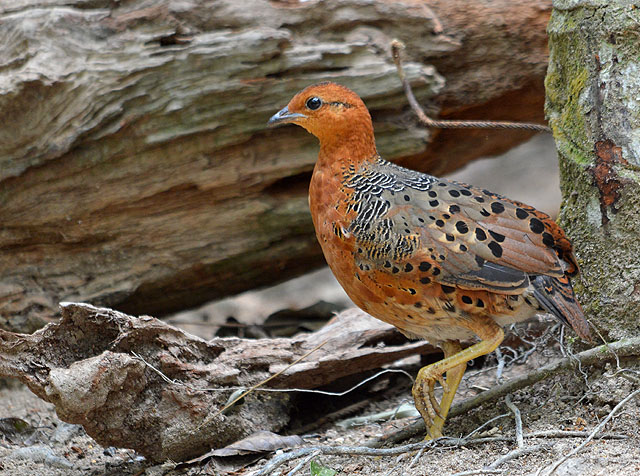
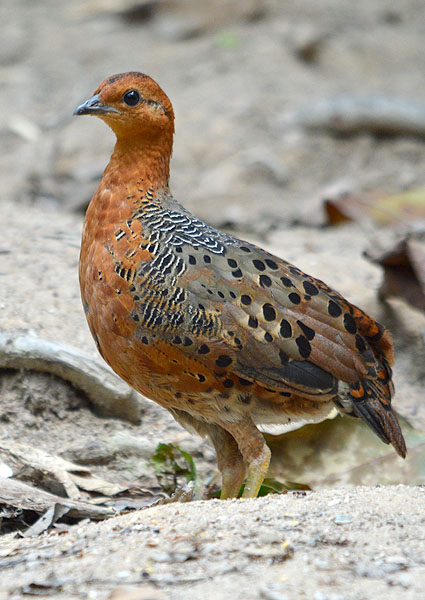
Right about then something orange moving about the undergrowth caught my eye. I held my breath. I knew what it was. And it was slowly edging closer. For the first in my life, I have a Ferruginous Partridge in full view and it was unimaginably striking. I will not attempt to describe the partridge. Just like illustrations and photos, it will not do the partridge any justice. Nothing beats seeing a species in the wild. The long drive, unsuccessful first attempt, crowded birding spaces, cramped sitting positions – all those do not matter anymore. All that mattered was here I am, enjoying one of the best looking partridges in Malaysia and loving every second it.


A second partridge revealed itself soon after. And then a third. Now, I was faced with a dilemma – which one to shoot first? The partridges were mostly on the move and that certainly did not help the situation. On this rare occasion, less could very well be more as I do not have to frantically capture as many shots as possible of all three birds.


At one time, I just put my camera down and soak in the view. Three beautiful Ferruginous Partridges were foraging in front of me and as far as I can tell, all of them were young adults. Naturally, I would have preferred adult birds with complete plumage but in life, we cannot always get what we want. I could have just as easily missed them like I did the day before. Nothing is a sure thing when it comes to observing and shooting wildlife. Come to think of it, nothing is a sure thing in life as well. So, be grateful what you have been given and cherish what you have.


And just like that, they vanished into the forest again. I thought the performance was over and so did everyone else. I could not have been more wrong. The partridges came back again and they appeared to be more confiding during the second session and came even closer to our hides. I guess my images also improved as I have gained back most of my composure and breath. My back and legs still ache but that is of no significant importance.


If a year ago someone would have told me that I will be able to capture these two remarkable birds in one frame and I would have asked that someone to have his head checked. Unbelievable as it may seem, it is happening now and many have been given the privilege to experience it.


This photo brought back memories of my one and only sighting this partridge prior to this encounter. I had to struggle and wait for years to be able to finally have a glimpse of the bird. I could not even muster a single shot then. I was elated just the same to be able see it and include it into my life list despite having to trek uphill for a few kilometers followed by strenuous stalking of my quarry along a forest trail.


Now, it is parading right out in the open and in good light. Life does not get any better than this. My birding adventure to central Peninsular Malaysia definitely ended on a high note. Pahang, with its vast expense of forest, still provides sanctuary to some truly fascinating birds. I still have dreams of the Ferruginous Partridge after the incredible encounter at Bukit Tinggi. Then I realized this fever is not something I recently contracted nor is it caused by the partridges. It is something that I have with me for the past two decades or so and it is the ‘birding bug’ for which there is, hopefully no cure.


Wednesday, 5 October 2016

Natural Born Models

I embarked on another birding adventure to central Peninsular Malaysia and it was back to the chilly montane air of Bukit Tinggi in Pahang. I was here back in March to experience the Mountain Peacock-pheasant phenomenon that has put this hill resort into the world birding map. This time, I was not after the endemic pheasant. This time, it was the resplendent Ferruginous Partridge. Gamebirds by nature are shy and elusive. And I thought my brief glimpse of the bird along the Gap Road in Fraser’s Hill will be as good as it will ever get for me. When news broke of a family of these partridges are showing well at the pheasants’ locality, it was only a matter of waiting for the right time for a revisit.

The Mountain Peacock-pheasants were the first to arrive and the two males put on a good performance. Although this is my second time with the pheasants here, my hands trembled with excitement as I followed their movement with my photographic gear. I guess it will take some getting used to.


How can anyone ever get used to being so close to these majestic creatures? Just look at him…


With my main target of the trip nowhere in sight, the other birds present were given their due attention. The Ochraceous Bulbul is not uncommon especially in montane forest. Its vocal nature tends to give it away quite easily whenever it is presence. However, it is not easy to photograph and a confiding individual should never be taken for granted.


In fact, the bulbul was a bit of a show off and it certainly received everyone’s attention. Yet again, I had to share the locality with other birders. It seemed like you can never be alone here – especially on weekends.


The Oriental Magpie-robin is certainly doing well in this hill resort. You can see this striking songster throughout the vicinity. A family was foraging at the pheasants’ locality and the fully fledged chick was just starting to find food on its own. Whenever the opportunity arises, it would still take full advantage of its parents’ maternal instincts and receive the handouts.


Making decisions is very much a part of life. Sometimes we make good decisions and sometimes, we make bad ones. And then there are times we make horrendous ones. With the disappointment of the partridges not showing clouding my judgement, I left Bukit Tinggi at mid-morning and headed towards Lanchang for my secondary targets of the trip only to find out later that the partridges came out an hour after my departure. All three of them. Well, you might as well kick me in the groin because that was how it felt like. Lanchang is also located in the state of Pahang too and it was about an hour’s drive from Bukit Tinggi. Unlike the later, it was hot and humid but none of that mattered when a Black-throated Babbler hopped into view at the stake out area. This babbler is not new to me but I have no opportunities to capture its images till now.


I spent a considerable amount of time observing, shooting and admiring the Ferruginous Babbler during my last visit to the forests of Taman Negara Sungai Relau but the bird has not lost its novelty with me. I still find it to be a delightful species with a large dose of character and beauty.


Another familiar species was the Yellow-bellied Bulbul. Like the Ferruginous Babbler, Taman Negara Sungai Relau provided plenty of quality time with this species as well. However, its presence did not evoke as much emotions. Maybe it is because it also occurs in good numbers in the forests of Kedah where I often find myself birding.


A screen has been put up to accommodate the high number of birders and photographers (individual hides would only take up more space) to the site. This location is probably the hottest birding spot in Peninsular Malaysia now.


The one species that stands out from the rest is the enigmatic Malaysian Rail-babbler and there are at least 2 individuals frequenting the area. The birds here have grown accustomed to human presence and that gives both birders and photographers a rare opportunity to enjoy them for prolonged periods of time.


The walking gait of the babbler reminiscences the catwalk of those slender-limbed female models as they showcase their beauty and sensuality through graceful and provocative movements of the body anatomy. This is Mother Nature’s version and unlike its human counterparts, no training is required. Well, you will not find me driving more than 400 kilometers just to ogle at female models in a fashion show. But as you can see, I would for this alluring species.


Before I could fully recover from the Malaysian Rail-babbler’s performance and regain my composure, a female Banded Pitta came into the picture. There are a small number of sexually dimorphic bird species here in Malaysia where the female is just as attractive. The Banded Pitta is certainly one of them and although she is not fully matured yet, she is absolutely gorgeous. What she lacks in colour is made up by the striking black and yellow stripes on her underside.


This is the second time this year that I have the privilege to spend time with this extraordinary species and for that I am most grateful. The light was slightly behind the Banded Pitta but it did not matter. I am satisfied with how the images turned out. The colours of the bird are so radiant that even the setting sun could not drown them out.


To wrap things up for my first day of birding in Pahang is a little rodent that I cannot be certain if I have it in my photographic database – the Low’s Squirrel. The disappointment with the Ferruginous Partridge was a bitter pill to show and I hope to make things right the next day. The outcome of day two will be covered in my next post.