Pages

Tuesday, 19 December 2017

It's starting to feel a lot like Christmas - Part I

I have been spending a considerable amount of time at the forest surrounding Pedu Lake in the interiors of Kedah state and the reason is quite simple – the birds have been showing really well of late. This time I was with brothers Nigel and Jimmy, one of my regular guests. It was a beautiful morning as we wandered into the lush landscape of this birders’ paradise and the local birdlife serenaded us with their divine vocals. However, one particular call stood out from the rest. It was definitely not for its musical capabilities and the croaking notes are far from pleasant to the layman’s ears. But to birders, it belongs to one of the most stunning birds found here – the Red-bearded Bee-eater. Since Christmas is just around the corner, the shaggy beard and plump body reminded me of a certain someone who resides in the North Pole. Anyway, the confiding nature of this handsome specimen provided me with one of my better images of this forest dweller.


In view of the number of rare brownish flycatchers popping up this migratory season, every brown flycatcher I come across nowadays are scrutinized. The plumage of this Asian Brown Flycatcher was so typical, I could not even try to imagine it being any other species. Anyway, the background was pleasant enough to have my attention.


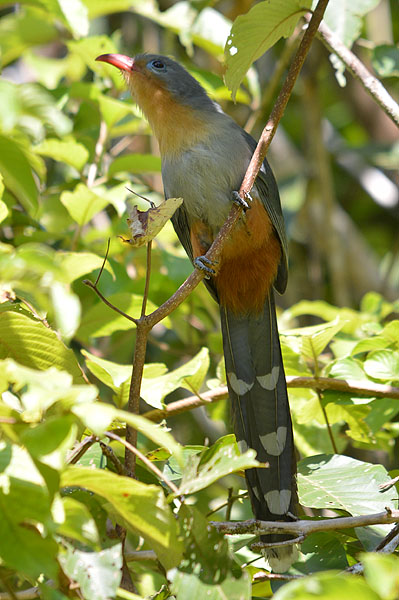
During my last visit here, the Red-billed Malkoha came tantalizingly close in providing images I could be proud of. I came across one yet again today. Initially, it appeared to be another frustrating encounter in the making as it scurried along the forest canopy at breakneck speeds. The dense foliage and harsh lighting were no help at all either.


Then, a spilt second of sheer luck and Yuletide magic produced my best image of this sultry species. Yes, it is starting to feel a lot like Christmas...

It is understandable when a small passerine is overlooked even after numerous excursion to a birding site. However, birds as big as a Greg-headed Eagle can sometimes remained hidden from view within Mother Nature’s embrace as well. Today is the first time I have ever seen a Grey-headed Fish-Eagle here in Pedu Lake. And to commemorate the moment, the uncommon raptor made sure I do not screw up its identity by providing prolonged views of both its upper and lower tail colouration (one of the more distinct field characteristics of this species). And nothing else - literally.


We made our way to the coast next as the alluring bird life of the mangroves of Sungai Batu beckons. True enough, a male Mangrove Blue-Flycatcher greeted me and my guests with much enthusiasm. As it was late afternoon by the time we arrived, lighting was a bit of a challenge at times.


The Mangrove Pitta had my guests grasping for air as usual with its electrifying presence. There are very few birds that can stir one’s emotions as vigorously as pittas. And to have one performing well is about as good as it gets in the world of birding.


Babblers are another group of birds that can elevate your senses. Despite their vocal nature, they are usually hard to observe due to their preference for dense undergrowth and constant movements. A pair of Abbott’s Babbler inquisitively foraging in front of us were given ample attention despite their dull colouration.


The Puff-throated Babbler, unbelievable as it may seem, provided the best encounter at this swampy domain. Its combination of aesthetic appeal, amazing vocals and charming character managed to pip past the pitta this time. Just in case you are wondering why it is called the Puff-throated Babbler...


This terrestrial babbler wrapped things up for day one of my clients’ birding adventure around Penang. I have to say it was another memorable and exciting day. But what does the future hold for the birding brothers on day two? That will be covered in my next post.


Saturday, 9 December 2017

What a Ruff day...

Compared to yesterday’s two-hour drive to the interiors of Kedah, the drive today to the mangrove belt of Merbok was a breeze. We were delighted to find this presumably female Japanese Sparrowhawk out hunting. This small but deadly raptor is usually shy - typical of all Accipiters. The only reason this girl was so confiding is because she knows fully well I will not be getting any great images of her due to the poor lighting at this hour.


Once we ventured onto the mangroves, it did not take long for Stuart to start ogling at the star bird of the locality, the ever-striking Mangrove Pitta. Looking splendid as usual, it thrilled us with its electrifying presence from among the undergrowth of the swamp.


The resident pair of Abbott’s Babblers were next in line to make an appearance and their character makes up for their lack of colours.


The sweet musical song of the Puff-throated Babblers echoed through the vicinity long before the birds were seen. I may have grown slightly accustomed to the accommodating nature of the birds found here but for a visiting birder like Stuart, it was overwhelming to say the least.


Our next destination was the Air Hitam Dalam Educational Forest. We had gloomy skies the day before but fortunately, that was not the case today. Good weather will often result in better yield and Stuart soon found himself surrounded by the sights and sounds that make this little patch of birding haven what it is.


The White-chested Babbler is a regular here but to obtain good views hard work and lots of luck are required. Scampering around the forest undergrowth, this species is habitually difficult to photograph even in close proximity. The angle from which I took the shot may be unflattering but it is still one of my best efforts to date.


Golden-bellied Gerygones have provided me with a number of close and intimate encounters here in the past and today, I got to share one with my foreign guest. Three inquisitive individuals wandered very close to our positions and together with their vocal abilities, resulted in an intriguing encounter.


We came across a Brown Shrike hunting unobtrusively along the access road. Although it is a common migrant throughout the country, the confiding nature of this individual did not go unappreciated.


Woodpeckers have been a rare sight so far for Stuart here in Peninsular Malaysia and that does not happen often in my tours. Thankfully, the resident pair of Common Flamebacks put on a relatively good performance for my British guest. And I, could finally breathe a sigh of relief.


The migratory Black Kites are back in full force at this wintering ground of theirs. A few were soaring aimlessly in the sky above most likely prompted by hot and sunny weather. Despite being a scavenger by nature, this raptor is graceful in flight and I could not pull myself away from their mesmerising aerial display.


For the scarce migratory Taiga Flycatcher, Air Hitam Dalam is very unfamiliar land. Unfortunately, it appeared just long enough for my guest to add another tick for his maiden trip to Peninsular Malaysia but yours truly, not even a single image. On the other hand, one of the resident pairs of Mangrove Blue Flycatchers was accommodating enough to provide ample views. This is the dominant pair that frequents the rear car park area and it is good to know that the recent floods did not effected them much.


Olive-winged Bulbuls are common residents here but one’s unbelievably confiding nature even took me by surprise as they kept to the cover of the vegetation throughout most of the morning.


Our final destination of the day was the paddy planting district of mainland Penang. As usual we searched for recently ploughed or planted areas that are like magnets for water birds. Both the Grey-headed Lapwing and Black-winged Stilt are regular winter visitors here and they were in their hundreds today. Distance can be an issue at times and the only reasonable image I took while admiring this congregation of water birds was of a foraging Lapwing.


There was a good number of small waders or peeps as they are so affectionately called, present today and scrutiny is required to confirm their identities. The most numerous of them all are the strikingly marked Long-toed Stints but they did not present any good photographic opportunities. I could tell Stuart has a soft spot for water birds like me as he took the effort to bring his spotting scope along for the trip and that certainly came in useful for enjoying peeps at a distance.


On one occasion, we came across two rather uniformly coloured peeps. I knew what they were immediately. The Temminck’s Stint is generally a scarce migrant to Malaysia but at this site, it is an annual visitor in small numbers. Using our vehicle as a mobile hide we managed some outstanding views. I was utterly delighted with the images obtained this time. I just cannot explain how I could get so excited over a dull-looking bird like this but I can and will. Come to think of it, a lot things are beyond explanation when it comes to birding.


There is no mistaking the distinct shape of the Ruff and there was a small flock foraging at a flooded patch. The Ruff is a unique wader because the male Ruff is bigger than the female Reeve. Judging from the sizes there was one Ruff in the company of three Reeves.


With the aid of our vehicle again, we managed to sneak closer to our subjects. The lighting was good and when the birds got accustomed to our presence, the encounter turned out to be one of the best I have ever had with this species. The Reeves were the ones to let down their guards first and continued with their daily routine.


The male took slightly longer to reveal himself completely from the cover of the paddy stalks. The Ruff is one of the most exceptional birds on the planet because of his unbelievable striking breeding plumage. The change from its dull non-breeding plumage is so remarkable it borders the line of fantasy. I have to accept the fact that we will never have a chance to see one in breeding plumage here in the tropics. A good thing God make humans with the ability to imagine because that is the only consolation I have.


This shot depicts the sexual dimorphism for this scarce winter migrant. We spent a considerable time with both the Temminck’s Stint and the Ruff. Although these birds are neither new nor rare to Stuart, he was just as enthusiastic during the encounters. I guess as a water bird lover, he understands the significance of coming across rare ones that are performing well in the field. And these two species certainly fit the bill here in Malaysia.


A flock of Pacific Golden Plovers was the last bird to be photographed for the trip. There are three species of Golden Plovers in the world of which two are not known to occur here in this region. But they all do look similar. Stuart reminded me of that fact and since we were on a roll, there was no harm scrutinizing the flock for a miracle. However, Christmas is still almost a month away and we had to be contented with what we managed to racked up for the past two days and we certainly had it good.

The checklist of birds recorded during this trip can be found here:

Tuesday, 5 December 2017

Feathered squirrels...

The weather has not been exactly peachy of late and that was a reason for concern as I made my way to the famed golden beach of Batu Ferringhi to pick up my latest guest, Stuart, who hails from England. It was a pleasant drive at this ungodly hour and we reached the forest surrounding Pedu Lake in good time. Despite all our efforts, the Blyth’s Frogmouth remained out of sight during our predawn excursion and its eerie call was our only consolation. The dawn of a new day turned our fortune around and the alluring bird life of this birding paradise came to life. Malkohas are remarkable birds. Big, beautiful and somewhat mammal-like when moving about the forest canopy, these feathered squirrels were out in full force today. I never had much luck photographing the Chestnut-breasted Malkoha. Despite its size, it is a shy bird and tends to keep to cover of the forest vegetation. This individual popped out into the open and revealed its true splendour. Naturally, it had the undivided attention of both host and guest.


The Red-billed Malkoha on the other hand, satisfied the birder in us. But from a photographer’s point of view, it could not have chosen a more frustrating perch to rest upon.


Like the malkohas, the trogons that call this place home are certainly out and about today. On one occasion, both the Scarlet-rumped and Orange-breasted Trogon were calling from the same vicinity. With a little effort and patience, good views were obtained of a male Scarlet-rumped Trogon.


As for the Orange-breasted Trogon, we were made to work hard in order to finally locate the male bird among the lush vegetation of the forest. It was a world tick for my well-travelled guest and I am quite certain this forest denizen is one of the highlights of his maiden birding trip to Peninsular Malaysia.


Pedu is the only site I frequent where the Thick-billed Spiderhunter is regularly seen. However, this uncommon species is never an easy subject to shoot. As usual, it was actively foraging along the canopy level and I tried my best to capture some images that has almost the whole bird in view.


It was equally frustrating trying to photograph a pair of Plain Flowerpeckers foraging at the canopy level. I am not sure if it is due to its dull colouration but I do not come across this species all that often in the field.


The broadbills of this region may not be new to Stuart but he still finds them irresistible. And I do not blame him because so do I. Two pairs of Black-and-yellow Broadbills were having a territorial disagreement and we just sat back and enjoyed the drama.


Bulbuls are one of the commonest and conspicuous birds of the Malaysian forest. To come across half a dozen species is quite normal but the challenge of identifying them accurately is another thing all together as a number of them are drably coloured. However, there are Bulbul species which identification is never an issue like the stunning Black-crested Bulbul.

.

As we were making our way home, a handsome male Japanese Sparrowhawk stopped us at our tracks along. Unfortunately, the abrupt stop of the vehicle sent him into flight and that was the end of it. Also perched along the electrical cables were Rufous-bellied Swallows and these swallows are the most striking species here in Malaysia. They also provided an ideal end to our adventure birding adventure in the wild interiors of Kedah. The skies held up till the evening and that was a good sign as we will be exploring birding sites in my home state of Penang tomorrow. That will be covered in my next post.