It
was another early start to the day but today, our mode of transportation was
two SUVs instead of the usual MPV. Our time in the wild finally came and we
will leave the comforts of the city for the next three days in search of more
exotic bird life in the wild interiors. And as usual, anticipation was high.

The
journey was long and the countryside was dry and dusty. But the vast open areas
of these arid plains, not unlike scenes from a classical western, do have their
appeals. In fact, they are home to some incredibly fascinating bird species and
one in particular was the main objective for the morning excursion.

When
a bird is as intriguing as the Bengal Florican, I do not see the need to sugar
coat my description of it. Bustards are a family of birds that is as foreign to
me as the mother tongue of this history-rich country. With only about 800 birds
left in the world of which half is found in Cambodia, it is inevitably an
endangered species like most of the other notable fauna found here. We visited
one of its strongholds, the Prolay Grassland, a Bengal Florican Conservation Area
east of Siem Reap Province. I thought the open landscape of Chuping in Perlis
back home was vast until we made our way into this reserve.

A
Green Bee-eater hunting next to the access road at first light briefly derailed
us from our objective. I was also looking forward to this lifer as bee-eaters
are such graceful and beautiful aerial hunters. I was to discover in the days
to come that Cambodia has a healthy population of Green Bee-eaters but it did
not deter me from appreciating this striking little bird to the fullest now.


The
Pied Bushchat is quite a common sight here as well but it was still an exciting
lifer no less. In terms of appearance, an almost completely black plumage may
not get you a whole lot of admirers. However, black is one of my favourite
colours and this charming bird was given its due attention.


For
our quest of the Bengal Florican, we acquired the services of the local
wardens. The grassland covered the landscape as far as the eye can see and
locating a bird the size of a large duck is literally like looking for a needle
in a haystack. The knowledge and acute sense of sight of the wardens were
invaluable to our mission. A lone Small Buttonquail was confident of its
ability to blend into the sea of grass. However, its defence mechanism was no
match for the eagle-eyed wardens. While my companions cherished another lifer,
I obtained my best photo of this adorable gamebird that has a sparse
distribution in Malaysia.

Then
we glanced upon a large winged creature floating in from the horizon. Time
froze as I strained my eyes into the rising sun because the identity of the
bird, even at this distance, was unmistakable. I was staring at my first ever wild
crane and it also happened to be the world’s tallest flying bird. When the
Sarus Crane finally landed, it was half hidden by the tall grass. The distance
and lighting condition indirectly provided a dreamlike effect to the image. It
was nothing more than a record shot but the encounter almost made me forget why
I was here in the first place. Hesitantly, I had to leave the crane where it
stood and continued on with my original quest before the temperature rose to an
unbearable heights.

Even with the help of the wardens, the Bengal Florican still proved elusive for the time being. Deep inside I knew what we up against and for this lifer, we had to our work cut out for us.


Luckily,
this grassland was teeming with bird life and we had some interesting
distractions during our hunt like this foraging Oriental Skylark. It is yet another
species that I have been hunting for years without success back home. The
differences to me were indeed subtle from the commoner pipits. On the other
hand, my judgement could be clouded by the ongoing search for the star bird of
this locality.

Red
Avadavats were commonly seen in the vicinity. The strikingly coloured males are
exquisite gems of the grassland and I wished I had more time to spend with the
flocks we encountered along the way.

Then
came the much delayed climax to the visit. The wardens signalled us over and we
rushed to their location. A sudden rustle of wings caught our attention as a
female Bengal Florican took flight at a distance across our path. She may lack
the contrasting colours of the male but she was still the curtain raiser for some
stellar performances among the sea of grass.

It
was near impossible to creep up on a Bengal Florican in its element and distant
sightings were all we could muster. For a bird its size, it is certainly gifted
with the ability to hide well. It will let you see it when you are miles away
but once you approach within reasonable distances, it vanishes by going low
behind the grass or indentations on the ground. In short, it was an oversized
quail. Like the female, the only images worth sharing of the males were flight
shots but it was a cherished experience nevertheless.


If
only the real thing was half as easy...

With
the Bengal Florican securely in the bag, we now had the luxury for less
significant matters like for example having the most important meal of the day...

The
wardens then took our party around the reserve for more birding and all the
stops we made were nearby a pond. It made perfect sense as this is the dry
season and water is a prized commodity. At one such pond, the Almighty blessed
us another chance with one of His more impressive creations. A pair of Sarus
Cranes was resting at the water’s edge and I have been in this country long
enough to know how incredibly shy some of the residents here can be. So, we
enjoyed these remarkable birds from afar.


Imagine
this used to be a scene back home in Malaysia. Unfortunately, the Sarus Crane
has long being extinct there and to see them here now in the flesh is a true
privilege for me. But greed is a deadly sin that I sometimes surrender to and wanting
a better image of the resting pair inevitably put them to flight. They were
still a fair distance away but I guess the threat of approaching human forms were
too much for the cranes to tolerate.


Yesterday,
I was given very little chance to photograph the Siberian Rubythroat. I did not
fare any better today. The closely related Bluethroat was present in bigger
numbers but record shots were all that I could obtained. The absence of their
namesake indicates they are most probably females. Although these terrestrial
birds are new to me, their shyness compounded with the absence of colours killed
off much of my enthusiasm for them. The ever rising temperature out in the
field was no help either.


With the testing conditions here in Cambodia, fresh coconut water became our new favourite drink to quench our at times insatiable thirst...

Our
next destination was Tmatboey Village – home to the Giant Ibis and
White-shouldered Ibis. We arrive at the Kulen Promtep Wildlife Sanctuary in the
mid afternoon after a much welcomed lunch and the dry dipterocarp forest welcomed
our arrival with intense heat and dust. The Tmatboey Eco Lodge is a modest
accommodation located within the sanctuary and our home for the next two days.


Hopefully,
this photo on the front door of our chalet is a good omen...

We
barely unpacked when Mardy announced that one of the local guides (again local
knowledge was vital) found a nice surprise nearby the lodge and it turned out
to be the perfect welcome gift. A lone White-shouldered Ibis was foraging at a pond
minutes away from our chalets and we cautiously moved closer. But a distant tractor
on the move put the ibis to flight and it alighted on a tall tree far away. The
White-shouldered Ibis may live in the shadows of its bigger relative the Giant
Ibis but this critically endangered species (with less than 500 individuals
left in the world) deserves recognition as well. However, I could tell there
and then that its skittish nature will be a major hindrance.

The
forest here is sparse and low. There is no doubt about that and to balance
things out with birding in the rain forest, nature made most of the birds here shy.
A foraging Rufous Treepie decided to cut us some slack and provided a prolonged
and relatively close encounter. The striking colouration and stunning
appearance makes it one of the most attractive birds found here.


Back
in Malaysia, the Black-hooded Oriole only occurs in Langkawi and it is quite
ironic that I had to travel all this way before I can tick it off my life list.

The
Burmese Shrike is another new species for me and it was certainly a cracker.
Naturally, it had our attention.

A
recognisable and distinct call echoed through the vicinity and one cannot
mistaken the nasal notes of the Great Slaty Woodpecker for anything else. On
any other day, I would have tried my best to obtain better images of this flock
of three birds. The trees here are half the height of those back home and even with
canopy dwellers like these woodpeckers, I still stand a good chance. But today was
no ordinary day. We were making our way towards one of ponds in this wildlife
sanctuary where the Giant Ibises have been frequenting of late. And what is now
considered to be the world’s biggest woodpecker will have to play an unfamiliar
role of a supporting cast instead of the lead performer.

I
caught sight of a few large birds circling above the forest. Upon further
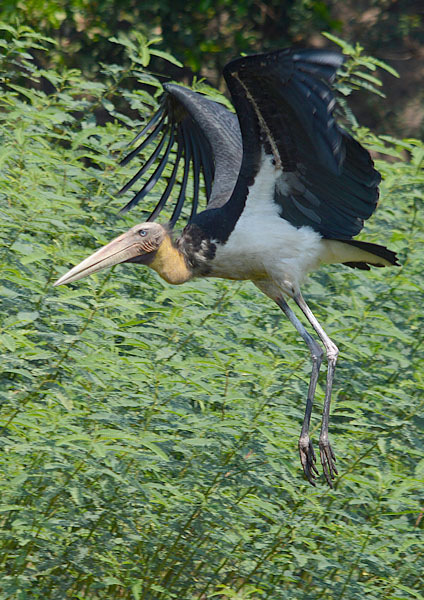
scrutiny they turned out to be Lesser Adjutants and Wolly-necked Storks. The
latter was a lifer and I was overjoyed. However in time, I realized that a sight
of soaring storks is not always a reason to celebrate as it could mean that the
storks have been recently spooked to flight from their feeding ground. When storks
and other large water birds are spooked they rarely return anytime soon and
sometimes, not at all.

On
this occasion, the culprit was a local villager and his dogs. Only God knows
why he had the sudden urge to walk his dogs through a wildlife sanctuary. His
unexplainable behaviour left us staring at an empty pond. Gradually, some birds
did return to the vicinity and the most notable one was the Green Bee-eater. I
may not have much time for this elegant beauty back at the Bengal Florican site
but I certainly did now.


Birding
in a foreign country meant every little brown job had to be scrutinized. And a
pipit, no matter how ordinary looking, perched on a tall dead tree deserved
some attention from its behaviour alone. It turned out to be an Olive-backed
Pipit – a species that I have not seen for many moons. I did not know then but
this dead tree overlooking the ‘ibis pond’ will play a significant part in my
life in the very near future.

The
Common Woodshrike, as the name implies, is a common sight here in Kulen Promtep.
This juvenile was by far the most confiding one we came across.

Young
birds can sometimes be too bold for their own good. Lucky for this guy, it has
absolutely nothing to fear from this group of humans.


The
dipterocarp forest briefly came to life once again in the late evening as the
residents prepared to roost for the night. I am no stranger to woodpeckers as
my homeland has a variety of stunning species. It may be a case of the grass is
always greener on the other side but I find the spectacular Black-headed
Woodpecker to have no parallels in terms of aesthetic appeal. Light was vanishing
by the minute but not to take the time to appreciate this pair of woodpeckers
bonding on a dead tree one last time before retiring for the night would be unforgivable.

As
darkness fell, a sense of gloom started to crawl its way into my soul. My main
target of the trip has eluded us so far. Will we suffer the same fate for our
remaining days here in this wilderness? As my mind started to ponder, my ears
picked up an odd call at a distance. The words “Giant Ibis” seeped through the
lips of our guide. Moments later three dark shapes flew overhead and alighted
on a distant tree. The moment I have been waiting for has arrived and as the one
percent of the world’s population of Giant Ibis prepared to roost, they were
unaware that a group of birders were watching their every move intently. There
was just about enough light left for a record shot but the quality of the image
was no longer relevant. But the moment and everything leading to it were - from
tolerating the aching joints after a long day of birding to the second I
finally laid eyes on this astonishing creature. I have come across countless interesting
bird species in all my 30 years as a birder and the Giant Ibis is certainly one
of the most incredible lifers for me. What a way to wrapped things up for our
third day of birding in Cambodia. As we made our way back in the dark, I now
have a good feeling about this birding site. To find out if my intuition was
right, you have to wait for my next post in which we continued our quest for the
critically endangered Giant Ibis.